Ekaterina JuskowskiYou are not native to the city, yet you have significantly impacted Miami. It seems your vision and ambition are continually evolving around large-scale cultural master planning. Can you share what elements of your approach have changed over time and what core principles have remained constant?
Ximena CaminosI’ve always worked on bringing art to people; this is my special expertise. When I lived in Buenos Aires before coming to Miami, I worked in the public sector, and I was also the curator for special projects at Museo de Arte Latinoamericano de Buenos Aires (MALBA) when I met Alan Faena in 2004. At the time he was doing the Faena District in Buenos Aires, and he told me, “I would love you to work for me, I would love you to help me make my district about art.” Art has always been my way, my tool. I knew how to create exhibitions within institutions, and I thought what he was proposing to me sounded fun, even if I didn’t yet understand what exactly he wanted me to do. But I love challenges.
I understood the cultural map of the city, and I recognized the needs of artists in Argentina. Back then, there wasn’t any place for cutting-edge contemporary art in Buenos Aires that wasn’t a basement. There were maybe two good galleries in the country, more than thirty incredible contemporary artists, and no art market. To address this, the artistic vision for Faena Art Center was born, and it has since become a well-known reference for contemporary art in Latin America. I also founded the Faena Prize for the Arts.
Eventually, we came to Miami and created Faena Arts here, which quickly became an extraordinary arts organization. I had the privilege of working with incredible individuals like my friend Carlos Basualdo, the curator of the Philadelphia Museum of Modern Art, Caroline Bourgeois, and Alex Poots, who was then the director of the Armory. I led the program for ten years, and we had a lot of fun.
However, at some point, I felt like my career in the arts had hit a plateau. I started wondering how far might I push the arts agenda? Using art to raise awareness is the part I always loved. But raising awareness was no longer enough for me. I needed to take some time for myself, reconnect with my essence, and contemplate what was next.
EJHow did the idea of the ReefLine come to mind, and what influenced you to turn to the ocean?
XCI have a very good friend, Francesca Thyssen-Bornemisza, whose foundation [TBA21 Thyssen-Bornemisza Art Contemporary] is one of the largest contemporary art collections in the world. One day I was in Jamaica with her, and she told me she noticed pollution of the rivers and ocean. She said, “My heart is broken. The fish have died, and the reefs where I used to swim as a child have disappeared. I know that art is important, but at the same time, I feel that I must do something different. So I thought of an idea.” I asked what it might be, and she said, “You know, at the Venice Biennale most countries have pavilions, but the ocean has no governance, so there’s no pavilion for the ocean. I thought I would love to create an ocean pavilion.” I felt like, Wow, aliens have landed. “Francesca, this is the best idea I’ve heard in years!” And she says, “My team is telling me it’s no good.” I say, “Oh, forget the team, you must do it.” And she did it. The Ocean Space in Venice opened in 2019 in the Church of San Lorenzo.
Francesca’s words resonated with me. I believe in purpose, so I asked myself: What purpose am I here to serve? What is the most powerful tool I possess, and how can I use it to make a positive impact? The answer to all my questions was the ReefLine. This project will be permanent testament to how art can be a vehicle of change, how it can do so much more than just raise awareness. Art can do the work.
EJOne doesn’t need to be a marine biologist to know that coral reefs are dying at a heartbreaking rate due to climate change and pollution. Yet the ocean remains a mystery, and the sense of ecological urgency feels abstract for most people, even those in oceanfront communities like Miami, because they simply lack regular contact with the underwater world. Do the locals understand and support what you are trying to accomplish with the ReefLine?
XcAny public project starts with winning the love of the local community. Before going global, the locals must understand your values and the makers of the city have to trust you. Otherwise, you’ll be throwing butter to the ceiling—tirar manteca al techo, as they say in Argentina. [laughs] Wasting your efforts and money chaotically. To build these relationships, we took a cross-disciplinary leadership approach and divided the ReefLine into roughly three areas: ocean (underwater park), beach (environmental awareness), and land (education).
Miami is rapidly becoming an ocean innovation hub, an urban think tank for environmental revolution. It’s a city with problems determined to become a city with solutions. The ReefLine couldn’t have happened in any other place. We are blessed to have the City of Miami Beach partnering with us on this ambitious project. It is a small but dynamic community with a daring vision and a lot of influence. The $5 million grant we have received shows the mindset of the local government and the residents. The citizens of Miami Beach voted 67% “yes” to tax themselves to make our project happen. It’s incredible to think that that many people volunteered to pay extra in taxes to support the ReefLine.
EJ“Until Man came along and fixed it up, Florida was no place to live,” writes Charles E. Harner in his book about Florida’s founding fathers, the visionary developers who transformed swamps into cities and lifted habitable islands up from the ocean. Given that many of today’s ecological problems stem from humanity’s destructive attitude toward nature, how can we cultivate a new ecological conscience amid ever-advancing technological progress?
XcArt is an ally of all revolutions. But I take the Duchampian approach to art; to me, art is everything. Science is art, and nature is art, too. We need to stop separating nature from culture. It’s true, Miami Beach is a human-made island. The dry land was created by pulling rocks from the ocean floor and filling the mangrove shoreline with them. The ecosystem was destroyed in the process. There was a very old and thriving fringe reef off the shore that managed to survive until 2002. Now most of the corals have died because of the sand replenishment projects aiming to make the beach even wider. I’m not a scientist, but I know that the reef is the perfect thermometer of the ocean’s health. If the reef dies, we die.
EJWhat do you have planned for Miami Art Week, and when will the sculptures be submerged?
XcThe deployment will happen in phases, because you cannot submerge a reef anytime you want. It’s like gardening: there is the right time for everything. We will start in summer 2025 with a cluster of twenty-two car sculptures by Leandro Erlich called Concrete Coral. It is like the sequel to his Order of Importance, but unlike the sand cars we showed on the beach in 2019, the underwater concrete sculptures will not degrade. At the same time, we’ll deploy Petroc Sesti’s Heart of Okeanos sculpture, which we commissioned and first showed in 2022.
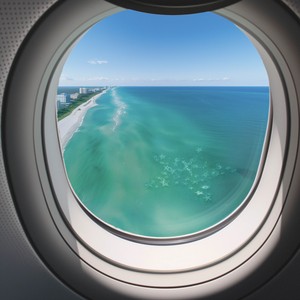
During Miami Art Week this year, on the beach on Collins and 36th Street, the ReefLine will present 3D-printed prototype studies for an installation called Miami Reef Star by artist Carlos Betancourt and architectural designer Alberto Latorre. This underwater reef-sculpture installation will ultimately be the size of two tennis courts, and its design is inspired by the star compass used among Micronesian seafaring communities, who relied on stars to navigate the ocean for thousands of years. The stars are designed to become a marine habitat, something like public housing for fish. Did you know that you can see the ocean reefs from the sky when you fly over? In the future, as you fly into Miami, you’ll be able to see this incredible landmark—or, rather, “watermark”—in the ocean.