Ashley Overbeek takes us through the history, the contemporary culture, and some of the people of a coastal Uruguayan town that hosts world-class museums and art installations.
Ashley Overbeek is the founder and CEO of the kombu caviar company Pearle. She is the former director of strategic initiatives at Gagosian, where she had the pleasure of working with artists on innovative digital projects.
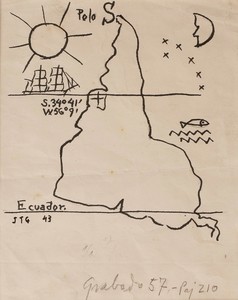
Created in 1943, América Invertida is a pen-and-ink drawing by the Uruguayan artist Joaquín Torres-García that depicts an upside-down South America. An instantly recognizable work for many in Uruguay, América Invertida relates to Torres-García’s concept of “constructive universalism”: a focus on the integration of the collective artistic legacies of the Americas, particularly the pre-Columbian art of South America, with modern artistic movements.
Torres-García created an earlier iteration of an inverted South America in 1935, on the cover of his manuscript La Escuela del Sur (The school of the South). In this manuscript he calls for South America to expand its artistic identity to encompass its own cultures and traditions, rather than defining itself only in relation to artistic movements from the North (namely the United States and Europe). Many of Torres-García’s issues remain relevant today, for those living beyond South America as well as within it. With an art-fair circuit that has historically looked primarily to cities in the global north, one can run the risk of missing the vibrancy of art and art destinations outside of a relatively narrow geographic area.
One such location is José Ignacio, a laid-back beachside town on the coast of Uruguay. Always a prime location for catching fresh seafood, José Ignacio was settled during the pre-Columbian era by the Indigenous Charrúa and Guarani, remained populated during the Spanish colonial period as a fishing village, and has since become a special town to visit for both domestic and international travelers. With fewer than 300 full-time residents, according to the last available census, José Ignacio has an outsize art and culture scene. Guests can begin their day at Rizoma, a hybrid art bookstore/café/studio, then pass by Casa Neptuna, an artist residency housed in a geometric bright-green building designed by the Argentine artist Edgardo Giménez, before taking a short drive to the Museo de Arte Contemporáneo Atchugarry in nearby Manantiales to view masterworks by local and foreign contemporary artists such as Carmelo Arden Quin, Gonzalo Fonseca, Vik Muniz, Louise Nevelson, and Frank Stella.
Given its long history through different eras of civilization, the identity of José Ignacio has been shaped by a variety of cultures, but according to current inhabitants has always reinforced the concept of community. “It’s a place where people say hello,” says Rodrigo González Di Carlo, the coordinator of the Fundación Cervieri Monsuárez, an art foundation and exhibition space in the town. “The human connection is so important here. When I’m walking down the street, we’re seeing each other face-to-face. When we ask, How are you?, we’re interested in knowing the answer. Maybe that’s partially dependent on the individual, but it’s also part of the context of José Ignacio: the culture, the nature nearby, the sound of the waves, the wind. You can see that in the way we interact with our neighbors and the town’s visitors.”
When walking along the main road of José Ignacio, one can easily spot the Fundación’s monumental building made of stone, glass, and umber weathered steel. Designed by the renowned Uruguayan architect Rafael Viñoly, the building itself reflects the geological and anthropological history of the town: “As Rafael stated, the pre-Hispanic design of the stone wall was inspired by José Ignacio’s coastal landform,” said González. The stones were meticulously crafted by Peruvian artisans who also worked on the restoration of Machu Picchu. This construction is a reflection of the cultural legacies of José Ignacio, as González elaborates: “You have this top-of-the-line artistic space for contemporary exhibits inside, but this building references a traditional method of precolonial Indigenous people who lived here in Latin America. So it has that duality too.”
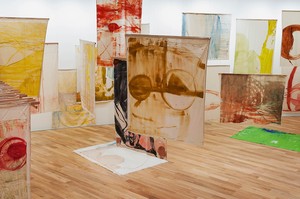
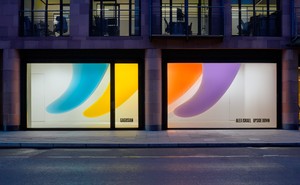
Inside the Fundación’s walls when I visited was an exhibition of work by Vivian Suter, who is Argentine-Swiss and lives in Guatemala. “It was an incredible exhibition,” says González, “over ninety paintings . . . including the body of work exhibited in the Reina Sofía [in Madrid]. . . . There were some others that came all the way directly from Guatemala, from her workshop. It was unbelievably special, the experience of working with [Suter] and having that kind of exhibit in my country.” Suter’s expansive canvases draped from the high ceilings of the Fundación, with swirls of bold organic colors in conversation with one another. This prolific kind of display is a recurring installation method for the Buenos Aires–born artist, who first employed it in 2014 at Kunsthalle Basel. After spending her childhood in Buenos Aires, Suter went on to live in Switzerland before returning to the Americas. In her current studio in Panajachel, Guatemala, she embraces her natural environment, often leaving canvases outside to interact with their surroundings: branches, soil, and rain mix with paint to create a hybrid abstraction.
Installation view, Vivian Suter, Fundación Cervieri Monsuárez, José Ignacio, Uruguay, January 6–March 31, 2024. Photo: Francisca Vivo, courtesy Vivian Suter, Gladstone Gallery, House of Gaga, Karma International, and Proyectos Ultravioleta
González tells me that the Fundación’s artistic program focuses at its core on Latin American artistic excellence, but also emphasizes local outreach as an important part of its organizational mission. “We have public rural schools in the area that we were lucky to invite to see the Vivian Suter exhibit and they were amazed,” González explains. “It’s very important to generate a sense of belonging for the families that live here year-round. It’s a vision we have for the foundation—not just to be open during the summertime, no, it’s going to be open year-round and we will have activities and extension programs in the communities. We hope to plant this seed in these next generations that art is not only a way to express yourself, but also a career path. That’s maybe not so talked about here in Uruguay. That art is a way to live and to have a future.”
Across the street from the Fundación Cervieri Monsuárez is Posada Ayana, a small boutique hotel, built by Robert and Edda Kofler. On entering the posada, visitors are met with a variety of artworks, ranging from the organic ceramic creations of Marcela Jacob to a mirrored etching by Marco Maggi to a richly dark polished-wood sculpture by Krikor Abrahamian. “Almost 90 percent of the art is from Uruguay,” says Robert Kofler. “We try to meet young artists at different events and buy art from them.”
Originally from Austria, the Koflers have furnished the posada as a tribute to the two places they call home, Europe and Uruguay. “We brought in vintage furniture from Europe to reuse and give new life to old furniture. And for everything else, we made it all according to our design with local carpenters. For me, it was very important to only buy local craftsmanship,” says Edda Kofler. Behind each item in the posada is a thoughtful sourcing story. When I asked about the creamy woolen blankets in the bedrooms, my directions were to “walk to the Faro de José Ignacio [a landmark local lighthouse, built in 1877] and look for Hugo; his workshop is next to it.” Hugo is a master weaver who is happy to take the time to show both neighbors (the term for those who reside in José Ignacio during a part or all of the year) and visitors his tools and techniques. “Scouting all these items has been a way for me to connect to Uruguay, to be more at home in a country that I’ve never lived in before,” Edda says, “because it helps me connect to other people and to see what it means to live here, what it’s like to feel the local culture and the local life.”
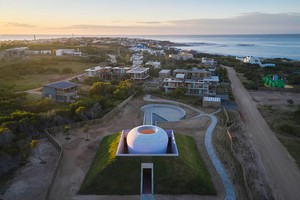
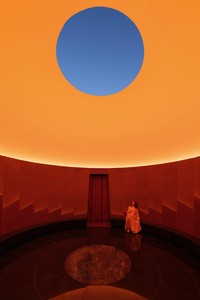
In addition to works by Uruguayan artists, Posada Ayana is also home to Ta Khut (The light, 2021), James Turrell’s first free-standing Skyspace in South America. “What impressed us so much about José Ignacio were the skies uncontaminated by [artificial] lights,” says Robert. “In the evening you really see the stars, the moon, everything is seen because you don’t have a lot of streetlights. So that’s why I thought that having an artwork related to light would be great.” Edda adds, “When you come to José Ignacio the very first time, you’re fascinated by the colors of the sky, the change of sunsets; you have the whole sky filled with pink and orange.”
Visitors to Ta Khut can sit on the peripheral seats, or lie on the floor on soft blankets to look up at the round opening set in the center of the structure’s white dome. Like other Skyspaces, Ta Khut has a light program for the twilight before sunrise and after sunset each day. During this cusp of change, day to night and night to day, the lights within the dome interact with the changing light and colors of the sky, creating sometimes supernatural hues in our perception of color. “We want to use Ta Khut as a catalyst for inspiring other art,” Robert says. “This year, in the spring, Edda initiated a program with students of the music school of Montevideo, Uruguay. They stayed with us for a week. They composed a sound piece connecting the Skyspace to the area. So all of this in the back of our minds, we wanted to bring something special to this area and hopefully be a catalyst to extend the cultural experience in the area.”
On a wall in his home, González has hung a poster of Torres-García’s América Invertida. “I think it’s very important for artists and agents of cultural spaces here in Latin America to live by this thing that Torres-García preached, ‘Our North is the South,’” he tells me:
We have to look at ourselves, at our cultural heritage, why we are the way we are. It was an incredible milestone for this Venice Biennale that for the first time ever, a Latin American curator was in charge of the exhibition. That’s great, but we also need our art spaces, our art fairs, our art biennials, and we need to be proud of them.
Ashley Overbeek is the founder and CEO of the kombu caviar company Pearle. She is the former director of strategic initiatives at Gagosian, where she had the pleasure of working with artists on innovative digital projects.