Rudolf Stingel: Vineyard Paintings
Thomas Demand looks at Rudolf Stingel’s Vineyard Paintings.
Winter 2024 Issue
Jessica Beck surveys the career of Rudolf Stingel, noting his sustained engagements with painting, environment, and memory.

Rudolf Stingel, Untitled, 2010 (detail), oil on canvas, 131 × 102 inches (332.7 × 259.1 cm). Photo: Rob McKeever
Rudolf Stingel, Untitled, 2010 (detail), oil on canvas, 131 × 102 inches (332.7 × 259.1 cm). Photo: Rob McKeever
I prefer to create an environment that you can step in to, one that creates a different awareness. An experience that you can carry with you.
—Rudolf Stingel, 2023
Well . . . when something happens it can leave a trace of itself behind. . . . Maybe things that happen leave other kinds of traces behind. Not things that anyone can notice, but things people who shine, can see.
—Dick Hallorann (Scatman Crothers), in Stanley Kubrick’s film The Shining, 1980
Rudolf Stingel has spent his career probing the limits of painting. His large-scale installations interrogate the boundaries of a canvas, his industrial materials, such as Styrofoam and Celotex, challenge the orthodoxy of a painter’s palette, and his wallpaper and carpets underscore the fineness of the line between art and decoration. For all the boundary-crossing in his work, at the core of his practice lies a deep reverence for painting. His installations immerse the viewer inside a painting: a floral carpet at Grand Central station in Manhattan becomes a play on landscape, an ode to Ernst Ludwig Kirchner calls us to remember the moving details of the German Expressionist’s portrait of a young girl, and his silver-foiled and carpeted walls coax us into our own mark-making, into leaving our own trace on his work. His use of color, texture, and pattern in his installations entices, perhaps confuses and seduces us, but above all it leaves a trace and an impression—an imprint that we can carry with us.
Stingel’s entry into the New York art world began with his 1991 exhibition at the Daniel Newburg Gallery, where he covered the entire floor in a carpet of a saturated orange, filling the space while also hollowing it out and simultaneously flipping the attention from the walls to the floor—a sly critique of and engagement with how we think and understand a traditional painting. A decade earlier, in 1981, Douglas Crimp’s essay “The End of Painting” had shaped a new discourse that forged the emergence of photography as a contemporary art form in the wake of painting’s decay and death.1 What came out of this period, though, was a decade heralding the rebirth of the medium and a new set of rules and criteria for what a painting could be. With his orange carpet, Stingel entered the scene with a wave of expansive thinking about the permutations and possibilities of painting at that early-’90s moment.
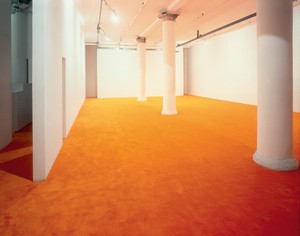
Installation view, Rudolf Stingel, Daniel Newburg Gallery, New York, 1991
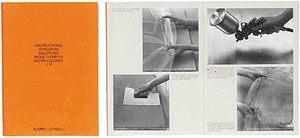
Rudolf Stingel, Instructions, 1989, limited-edition art book, 8 ¼ × 5 ⅞ inches
Born in Merano, in the South Tyrol province of northern Italy, and having spent his early twenties in Vienna, Stingel was influenced by German Expressionism and the grandeur of the Renaissance and the Baroque. But in his own practice he trod a conceptual path, and from the beginning he was concerned with the fundamentals of painting. In 1989 he created a manual, a conceptual work he called Instructions, which engaged directly with the debates on painting in the 1980s. In the manual, which he wrote in six languages, he provided a step-by-step guide to how he made his paintings. Anyone reading the manual could, in theory, make a Stingel. These instructions were neither Andy Warhol’s Do It Yourself paintings (1961) nor a Duchampian readymade, but uniquely his own statement about the mass production of painting, the heated debates about its longevity, and a democratization of the high art form to its basest and simplest form—a how-to. The instructions laid out in the manual became a manifesto for Stingel’s practice.2 In fact, the orange of the carpet in his bold installation at the Daniel Newburg Gallery three years later matched the color of the manual’s dust jacket. And the painting that the instructions offer a way to produce is silver, the color of the Celotex insulation boards that Stingel would use in large-scale installations in 2000. His first installation with silver-lined walls was at the Museo d’Arte Moderna e Contemporanea di Trento e Rovereto, Italy, and he revisited the idea at institutions across the United States and Europe: the Whitney Museum of American Art, New York, the MCA Chicago, the Palazzo Grassi, Venice, and more. At first, Stingel was conflicted when visitors started to leave their own marks on the silver panels, carving their names and messages and chipping away at the silver coating, but eventually he embraced the participation of visitors, whose destructive acts of rebellion took the place of brushstrokes on a traditional painting. These early installations set the stage for Stingel’s practice as an invitation to break the rules.
Following his 1991 debut, Stingel made a career of transforming mundane materials into glamorous, haunting installations ripe with poetic gestures and references to his past. At the Paula Cooper Gallery, New York, in 2000, a year before he was working with silver Celotex, Stingel debuted a series of large paintings made of industrial Styrofoam and marked with meandering footprints that echo abstract brushstrokes. He created these patterns by dipping his shoes in acid, then walking over the Styrofoam panels. The paintings read like cross-sections of an explorer’s tracks on densely packed snow, a reference surely tied to Stingel’s childhood in the snow-capped Italian Alps. Just as a traditional landscape might elicit the soft breeze of a pastoral scene, Stingel’s Styrofoam works evoke the familiar crunch of boots on freshly packed snow on a crisp winter day. At the same time, they also suggest the familiar crackle of fracturing Styrofoam, a commercial material widely distributed yet reviled for its pollutant qualities. In this way Stingel slyly conflates references to nature and to his own upbringing with the insinuation of industrial toxicity, even while his footprints moving across the canvas recall the long, fluid brushstrokes of an abstract painter. Like his silver-lined installations, which were sometimes adorned with crystal chandeliers, the works create the impression of the uncharted yet also the familiar.
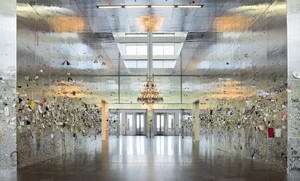
Installation view, Rudolf Stingel, Museum of Contemporary Art, Chicago, January 17–May 27, 2007. Photo: Stefan Altenburger
Since the success of these painting projects in the early 2000s, Stingel has driven deeper into his own memories and sensory experiences and has brought them to bear on various new iterations of painting. In 2016, in a year-long exhibition, in eight successive parts, at Gagosian’s Park & 75 gallery in New York, he presented a mix of paintings evoking his earlier installations—a group of stainless steel panels reminiscent of his Celotex installations, for example, and abstractions made from decorative textile patterns echoing the carpeted installation he had created at the Palazzo Grassi in 2013. For parts VII and VIII of the show, he presented something different, a group of oil paintings, for part VII in black and white, for part VIII in color, that he copied from the murals in the Bemelmans Bar at the Carlyle Hotel, a cultural mainstay of New York’s Upper East Side. Stingel rendered his paintings from photographs of the murals, which were painted in 1947 by Ludwig Bemelmans—who, like Stingel, was born in Merano. Bemelmans had based the murals on his earlier illustrations for his children’s story Madeline (1939). New Yorkers cherish the Bemelmans Bar, and Stingel’s paintings function like portals offering the viewer access to the cozy, warm, pleasurable experience of socializing over cocktails at the Carlyle. Stingel has said that he wanted visitors to be reminded of the bar—he was attracted to Bemelmans’s depictions of animals and the seasons, but his main interest was summoning the atmosphere of the bar itself: “My thing was more about capturing the bar, the vibe of the bar. Like when you have a drink, and you gaze at the wall.”3 The familiar came up again seven years later for another body of work, but this time the references were personal. Stingel’s quest to explore the limits of painting continues.
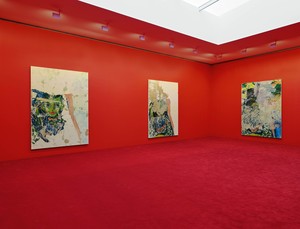
Installation view, Rudolf Stingel, Gagosian, Paris, March 17–May 27, 2023. Photo: Thomas Lannes
In 2023, for a solo exhibition at Gagosian, Paris, Stingel created a series of large-scale paintings by selecting details from one of Kirchner’s best-known works, Fränzi vor geschnitztem Stuhl (Fränzi in front of Carved Chair, 1910). Stingel installed his paintings within one of his bespoke installations, coating the walls, floor to ceiling, in a deep red and covering the floors in a matching carpet. Kirchner had made an unusual choice for Fränzi’s face, painting it a striking green, and Stingel’s choice of red for the surrounding environment offered a complementing contrast that activated and intensified his favorite detail. In Kirchner’s painting, not only the girl’s face but her hair and shirt are highlighted in shades of green, and her bright-red lips pop from the canvas. Stingel used the same detail repeatedly, focusing on the girl’s face and shirt, and sometimes twinning the face. He also abstracted the original by painting over his chosen detail and eliminating parts of the composition to give his works a distressed look—one might think of a cinema poster on a city wall, worn by the elements, or of a book cover worn from pleasure. Stingel has said that his inspiration for the work came from a childhood memory of his mother and an early appreciation for Kirchner: “My mother fed me with art books when I was young and there was one on Kirchner. I’m not sure if Fränzi was on the cover but it’s probably her green flesh that attracted me. After all, it’s one of his most reproduced images.”4 The vivid interior in which Stingel set these works, this time in a dramatic red, had a visual intensity that read as familiar yet dreamlike, as if viewers were entering a private chamber where they were surrounded by evocative paintings—a space where Stingel’s memory was cast onto the canvas.

Installation view with Rudolf Stingel, Untitled (2022), Gagosian, Paris, March 17–May 27, 2023. Photo: Thomas Lannes
The vividness and drama of Stingel’s installations recall the sweeping, expansive frames of film. One of the most successful movies to rely on this kind of visual intensity to tell a story is Stanley Kubrick’s masterpiece The Shining. In 1980, as art theory was expanding and Minimalism was losing its dominance, Kubrick was premiering his first and only horror movie, an adaptation of Stephen King’s novel of the same title (1977) starring Jack Nicholson and Shelley Duvall. At the time, the film met with mixed reviews, but Kubrick’s impeccably eerie and unsettling fictional world has lodged itself deep in the contemporary unconscious. The lasting success of The Shining is owed to the visual experience that Kubrick created, with his meticulous interiors, his extensive references to art and photography, and his innovative use of a Steadicam to create long, continuous shots.5 The Torrance family come to live at the Overlook Hotel, remote in the mountains of Colorado, where they navigate a series of horrifying visions of past murders and repressed traumas. Shots of young twin sisters and their bloodied bodies, the decaying flesh of an old woman, and a cascade of blood pouring from elevator doors are edited into the film as a series of quick, terrifying flashes, appearing like the photographs in a slide show that jumps between the past and the present. The performances of Nicholson and Duvall are essential to the film’s success, but the lasting power of The Shining relies on the visual intensity that Kubrick created with mostly nonverbal, imagined, and felt moments woven together throughout.
While Stingel’s work is not about horror, there is an intensity to his palette—the electrifying orange of the carpet in his New York debut, the decadence of his silver-chandeliered installation at the MCA Chicago, and the intensifying red of his Gagosian show in Paris 2023—that resonates on a similar frequency to the pictorial richness of Kubrick’s Shining. Just as a viewer engages with touching and immersing in Stingel’s installations—an experience that leaves a trace—the entire premise of The Shining has to do with what one can feel but not see or comprehend. Similarly, the viewer entering Stingel’s paintings is left with a deep, corporeal memory of the plush carpet, the synthetic Styrofoam, and the reflective surfaces of his silver walls.
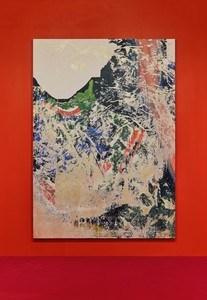
Installation view with Rudolf Stingel, Untitled (2022), Gagosian, Paris, March 17–May 27, 2023. Photo: Thomas Lannes
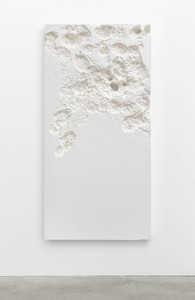
Rudolf Stingel, Untitled, 2000, Styrofoam and silicone, 96 × 48 inches (243.8 × 121.9 cm)
While many have defined Stingel as a descendant of Warhol, the comparison is often made through surface connections, such as the use of silver, repetition, and installation, for example. In fact their differences seem more important than their similarities. Warhol loved images for the messages they conveyed—fame, death, wealth, social capital—and was deeply invested in the power of a sign. He worked over images by heightening their eroticism and overplaying the power they maintain over us. Stingel, on the other hand, uses his works like a portal—echoing the memory of a painting, or conjuring a personal association with a painting. His works are more haunting than erotic and operate as links between past and present. When we sit with a Stingel long enough, a cascade of experiences and memories washes over us. His images work over the mind, activating our memories; Warhol was interested in how an image could work over our desires. Warhol shows us the crush of lived experience under the grip of capitalism by flattening and hollowing out his subjects; Stingel gives us something with the possibility of enduring outside of capitalism, or perhaps despite it—memory, sensory experience, and a deep, intense experience of looking.
Stingel’s career both challenges and pays tribute to the history of painting while pushing the medium to its limits. His work reminds us to look with more than our eyes—to use our senses, activate our memories, and bring our bodies into the work. In a way, he encourages us to use our own inner knowledge of what makes a great painting while at the same time shifting the perspective lines to get us to think outside its boundaries. Like Kubrick, he builds suspense with prolonged emptiness and the delay of filling it. Stingel’s work, although indebted to the debates of the 1980s, is not about the death of painting but about a deep love and reverence for it. His entire body of work calls us to feel and see and think about the possibilities of painting, and about the many lives and permutations of its past and future and its enduring mark on history.
1 Douglas Crimp, “The End of Painting,” October 16 (Spring 1981): pp. 69–86. On the lasting impact of Crimp’s text on contemporary criticism see Arthur C. Danto, David Joselit, Yve-Alain Bois, Thierry de Duve, Isabelle Graw, David Reed, and Elisabeth Sussman, “The Mourning After: A Roundtable,” Artforum 41, no. 7 (March 2003).
2 Speaking with the New York Times about Instructions, Stingel remarked that it was “like a manifesto” and “changed everything.” See Farah Nayeri, “Rudolf Stingel and a Career That Redefined Painting,” New York Times international edition, June 11, 2019.
3 Stingel, quoted in Robin Pogrebin, “Inside Art: Inspirational Murals,” New York Times, November 17, 2016.
4 Stingel, in Angel Lambo, “Rudolf Stingel Reanimates an Icon of German Expressionism,” Frieze, April 25, 2023.
5 Photography had a major influence over Stanley Kubrick’s work; indeed, his first professional job out of high school was as a photojournalist for Look magazine. There he worked with the photographer Diane Arbus, and the iconic twin sisters in The Shining were directly inspired by an Arbus photograph from 1966, Identical Twins, Roselle, N.J. See Nathan Abrams, “How Art Inspired Director Stanley Kubrick’s Famous Horror Film The Shining,” The Art Newspaper, December 14, 2022.
Artwork © Rudolf Stingel
Jessica Beck is a director at Gagosian, Beverly Hills. Formerly the Milton Fine Curator of Art at the Andy Warhol Museum, Pittsburgh, she has curated many projects, notably Andy Warhol: My Perfect Body, the first exhibition to explore the complexities of the body, through beauty, pain, and perfection, in Warhol’s practice. Photo: Abby Warhola
Thomas Demand looks at Rudolf Stingel’s Vineyard Paintings.
Jenny Saville reveals the process behind her new self-portrait, painted in response to Rembrandt’s masterpiece Self-Portrait with Two Circles.
In July 2017, a special installation of paintings was shown at Casa Malaparte, Capri, the famous house built by the author, publisher, diplomat, and filmmaker Curzio Malaparte.
Ahead of Alex Israel’s exhibition of four new Fin sculptures at Gagosian, London, the artist spoke with Susan Casey, author of The Wave: In Pursuit of the Rogues, Freaks, and Giants of the Ocean (2010), about the ocean, surfing, and Los Angeles.
On July 9, Simon Hantaï: the last studio opens at Gagosian, Gstaad. Curated by Anne Baldassari, the show comprises sixteen of the artist’s dernier atelier (last studio) paintings of 1982–85. The exhibition is accompanied by an illustrated catalogue, copublished by Gagosian and Skira, which features an essay by Baldassari and an extensive portfolio of previously unpublished photographs by Édouard Boubat. Here, we share the introductory chapter from the publication.

Adam D. Weinberg has been working with Giuseppe Penone on an exhibition of the artist’s new sculptures, The Reflection of Bronze, that opens at Gagosian, New York, on April 22. The works explore the character and possibilities of bronze. Here, Weinberg considers Penone’s enduring engagement with the alloy and addresses the conceptual underpinnings of the exhibition’s three-room structure.
Laura Bruni writes about a major exhibition celebrating the work of the British sculptor Henry Moore at the Royal Botanic Gardens, Kew, London.
On the occasion of Baselitz: AVANTI! at the Museo Novecento in Florence, Italy, Holly EJ Black considers the roots and reverberations of Georg Baselitz’s printmaking.
Mark Franko considers how Emily Coates resurrects the spirit of George Balanchine’s American beginnings through archival research, spoken dialogue, and movement in her performance Tell Me Where It Comes From.

Carlos Valladares wades through the discourse around the musician and actress Charli XCX’s mockumentary, guiding us through its myriad references, from the Spice Girls to Andy Warhol.
From the perspectives of their respective fields, three international cultural figures—artist and designer Ronan Bouroullec, fashion visionary Michèle Lamy, and chef and restaurateur Enrique Olvera—reflect on Donald Judd’s work in furniture, the subject of recent exhibitions in South Korea and Japan.

Janne Sirén considers Anselm Kiefer’s new paintings, the subject of an exhibition at Gagosian, New York, entitled Seal My Ears Shut and I Shall Hear You Still.