
Rudolf Stingel: A Trace
Jessica Beck surveys the career of Rudolf Stingel, noting his sustained engagements with painting, environment, and memory.
Fall 2025 Issue
Thomas Demand looks at Rudolf Stingel’s Vineyard Paintings.
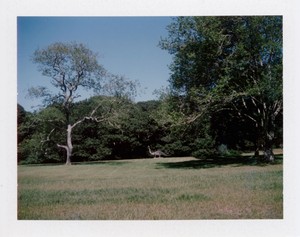
Exterior view from Rudolf Stingel’s studio, Martha’s Vineyard, Massachusetts, 2025. Photo: Rudolf Stingel
Exterior view from Rudolf Stingel’s studio, Martha’s Vineyard, Massachusetts, 2025. Photo: Rudolf Stingel
Not much light, foliage, a meadow in front of a forest. Spots, outlines, green on blue. The blurring of the introductory photograph in this feature already points to the fragile ambivalence of the images in this series of pictures. The paintings are obviously the result of a process of quaint gestures, without losing the sublimity of painting. Equally, it’s tempting to interpret this as a result of a mimetic action—a reproduction of vegetal forms like bark or crust.
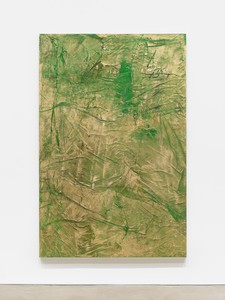
Rudolf Stingel, Untitled (Vineyard V), 2024, oil and enamel on canvas, 90 × 59 inches (228.6 × 150 cm)
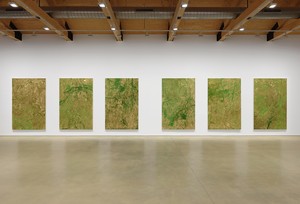
Interior view of Rudolf Stingel’s studio, Martha’s Vineyard, Massachusetts, 2025
But there can be no doubt that these are abstract images, not even abstractions. The three ingredients of this process are tulle, a fabric that is actually used for costumes, like the tulle skirt of Degas’s little dancer. But here it becomes the trace of a curtain, a gauze that has been pushed aside, revealing the layer underneath: a rich green. I am familiar with this green as a background in medieval portraits by Holbein, Cranach, and Memling. And then the gold, which forms the third and final layer, is reminiscent of courtly damask, of the woven, heavy robes that were common at the time of Henry VIII. The almost fluorescent green and the gold from the can, which may be somewhat striking in a different context, mingle to create a majestic, old-masterly picture pane that is broken up by the gauze. Yet “broken up” is too muscular a word, because the care and embrace of chance result in a delicate pictorial space, without creating seductive effects. Neither the green nor the tulle suggest glamour. Even the gold seems trivial when compared to the gold of altars.
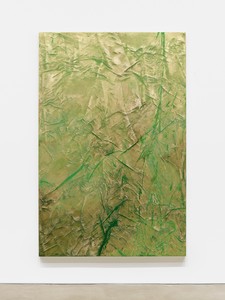
Rudolf Stingel, Untitled (Vineyard XI), 2024, oil and enamel on canvas, 90 × 59 inches (228.6 × 150 cm)
The true marrow of these pictures, however, is not this ambivalent chord of color—even if those elements sing of somewhat feudal memory—but the complex traces, tears, furrows, and lines that are joined by the impression of the gauze to form a suite of powerful drawings. The central gesture in these paintings is that of pulling away, on which the entire structuring of the surface is based. Absence is in fact the impression that arises when looking at them. Reading the surface does not lead to a symbolic interpretation, and even if the color palette evokes a historical grandeur, the masterful splendor remains an unfulfilled promise.
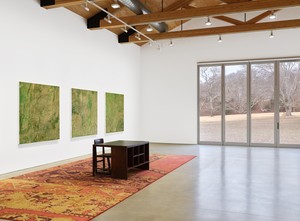
Interior view of Rudolf Stingel’s studio, Martha’s Vineyard, Massachusetts, 2025
Rudolf Stingel: Vineyard Paintings, Gagosian, Grosvenor Hill, London, June 12–September 20, 2025
Artwork © Rudolf Stingel; photos: Object Studies, New York
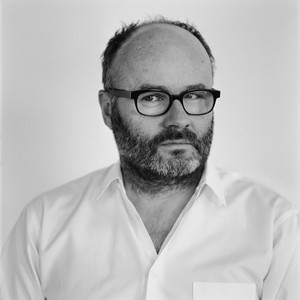
Thomas Demand is one of the foremost contemporary German artists. His singular oeuvre merges sculpture and photography and usually relies on found images. The artist, who lives in Berlin, painstakingly reconstructs the found photographs as three-dimensional, usually life-size models made of paper and cardboard before expertly lighting and photographing them with a large-format camera. The models are destroyed once the work process is complete. The result is an uncanny, hybrid image, both a document of the artist’s process and a reconstruction of a preexisting reality.
Jessica Beck surveys the career of Rudolf Stingel, noting his sustained engagements with painting, environment, and memory.
Jenny Saville reveals the process behind her new self-portrait, painted in response to Rembrandt’s masterpiece Self-Portrait with Two Circles.
In July 2017, a special installation of paintings was shown at Casa Malaparte, Capri, the famous house built by the author, publisher, diplomat, and filmmaker Curzio Malaparte.
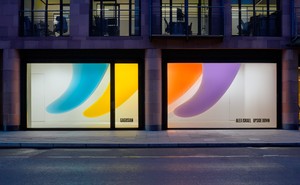
Ahead of Alex Israel’s exhibition of four new Fin sculptures at Gagosian, London, the artist spoke with Susan Casey, author of The Wave: In Pursuit of the Rogues, Freaks, and Giants of the Ocean (2010), about the ocean, surfing, and Los Angeles.
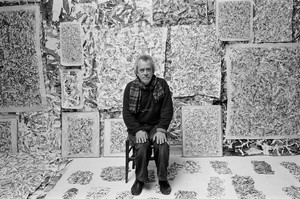
On July 9, Simon Hantaï: the last studio opens at Gagosian, Gstaad. Curated by Anne Baldassari, the show comprises sixteen of the artist’s dernier atelier (last studio) paintings of 1982–85. The exhibition is accompanied by an illustrated catalogue, copublished by Gagosian and Skira, which features an essay by Baldassari and an extensive portfolio of previously unpublished photographs by Édouard Boubat. Here, we share the introductory chapter from the publication.

Adam D. Weinberg has been working with Giuseppe Penone on an exhibition of the artist’s new sculptures, The Reflection of Bronze, that opens at Gagosian, New York, on April 22. The works explore the character and possibilities of bronze. Here, Weinberg considers Penone’s enduring engagement with the alloy and addresses the conceptual underpinnings of the exhibition’s three-room structure.
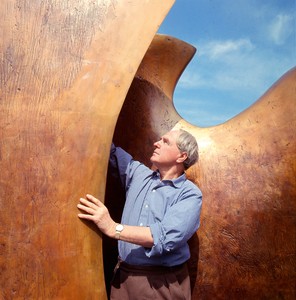
Laura Bruni writes about a major exhibition celebrating the work of the British sculptor Henry Moore at the Royal Botanic Gardens, Kew, London.
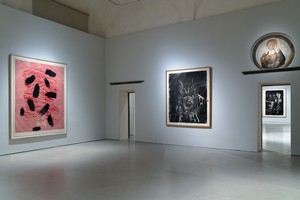
On the occasion of Baselitz: AVANTI! at the Museo Novecento in Florence, Italy, Holly EJ Black considers the roots and reverberations of Georg Baselitz’s printmaking.
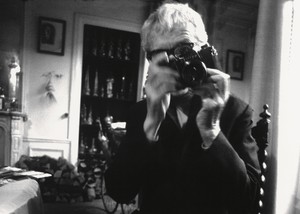
Christian House celebrates the generation-spanning and formally inventive photographs of Jacques-Henri Lartigue.
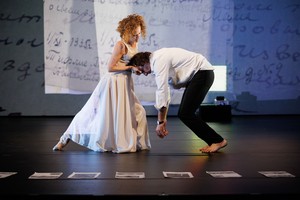
Mark Franko considers how Emily Coates resurrects the spirit of George Balanchine’s American beginnings through archival research, spoken dialogue, and movement in her performance Tell Me Where It Comes From.
Carlos Valladares wades through the discourse around the musician and actress Charli XCX’s mockumentary, guiding us through its myriad references, from the Spice Girls to Andy Warhol.
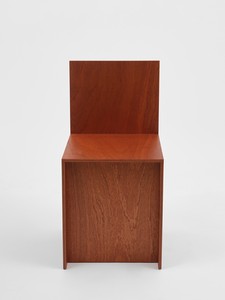
From the perspectives of their respective fields, three international cultural figures—artist and designer Ronan Bouroullec, fashion visionary Michèle Lamy, and chef and restaurateur Enrique Olvera—reflect on Donald Judd’s work in furniture, the subject of recent exhibitions in South Korea and Japan.