
Game Changer
Beatrice Wood
Salomé Gómez-Upegui honors Beatrice Wood, the “Mama of Dada,” an underappreciated trailblazer within the movement who went on to become a brilliant ceramist.
Winter 2024 Issue
Scott Rothkopf, Alice Pratt Brown Director of the Whitney Museum of American Art, New York, remembers his friend, Dorothy Lichtenstein.
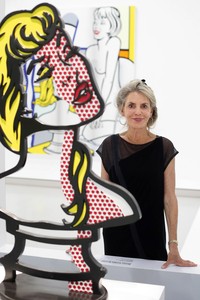
Dorothy Lichtenstein, Centre Pompidou, Paris, 2013. Photo: Thomas Samson/AFP via Getty Images
Dorothy Lichtenstein, Centre Pompidou, Paris, 2013. Photo: Thomas Samson/AFP via Getty Images
When Dorothy Lichtenstein died last July, the news came as a shock to many of us who loved her, because even at the age of eighty-four, few people seemed so full of life. All her signature qualities were intact, from her warm and present gaze to her intellectual avidity to her effortless sex appeal. And she still had probably the best laugh I’ve ever known: huge, gravelly, and endearing, with an occasional hint of wickedness appreciable only to her intimates, or so we liked to think. But for me, at least, the shock of her death also owed to the grim recognition that we are losing the last of that 1960s Greatest Generation, including Brice Marden, Richard Serra, and Frank Stella, who all died over the past year and were all living links to an artistic golden age. Dorothy was real-deal art-world royalty. If her modesty might have bristled at this description, she had the good sense to embrace the responsibility that comes with having a remarkable past and making something of it for the future.
One of the ways Dorothy did this was to welcome young people into her life, and I was fortunate to be among them. I first met her as a college student nearly thirty years ago, and from that moment on she was far kinder to me than she had any good reason to be. That was Dorothy: generous beyond measure and forever open and curious about the next generation of just about everything. She had a casualness and confidence that came with being smart and beautiful and having been at the center of it all. She had amazing stories of hanging with Andy Warhol and Robert Rauschenberg, or working at the Bianchini Gallery in the ’60s when Elaine Sturtevant did her wild pseudo-Pop show there. (Dorothy once even promised me one of those paintings for the Whitney—if only she could find it!) But there was nothing nostalgic about her. She didn’t just share her unpretentious yet starry aura with kids like me; she showed genuine enthusiasm for what we brought to the table. In my case that meant commissions for two of my first published essays, both on her husband Roy, and real interest in the first exhibitions I curated of artists she’d never heard of that I cared a lot about. This kind of generosity is hard to quantify and easy to underestimate but was one of Dorothy’s enduring gifts.
Her other gifts were more readily classified as world-class philanthropy, even if they were rare in their adventurousness and largesse. She served the Rauschenberg Foundation on behalf of her old friend Bob. She supported museums and educational initiatives all over, especially on the East End of Long Island, where she and Roy long lived. She nurtured a gorgeous friendship with Agnes Gund that benefited Studio in a School and the Art for Justice initiative, formed to help those currently and formerly incarcerated. When Aggie wanted to sell one of her most prized possessions—and one of Roy’s best paintings—to benefit Art for Justice, Dorothy not only blessed the deal but championed the idea of using art’s power and value to lift those most in need.
I always looked forward to visiting Dorothy during the summer at her classic Hamptons house on Gin Lane. It was so much more modest and old school than one might have expected for a person of her stature and means. The ceiling was low and the sofa was long, ample enough to accommodate her hulking Bouvier, Brutus, and sheaves of the New York Times. Usually we sat at the kitchen table over Tate’s cookies and a glass of water (from the tap!), Dorothy’s trim carriage and perfect posture offset by her signature, ever-so-slightly disheveled hair. Hours flew by as we gossiped and talked politics (a die-hard progressive), and I traded news from the art world for a trove of memories. Our last visit there was a few months before I would become director of the Whitney, an institution that had been committed to Roy’s work since his first appearance in the museum’s Annual exhibition back in the 1960s. When we had lunch again last spring, she embraced with excitement our new free-admissions programs, which would expose so many young and diverse people to contemporary art. The fact that there will be no more of these cherished visits leaves a gaping hole in my heart.
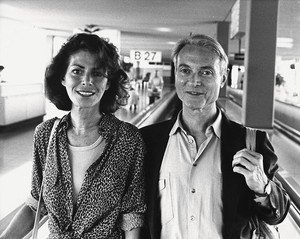
Dorothy and Roy Lichtenstein, Amsterdam, 1987. Photo: Marcel Antonisse/ANP/AFP via Getty Images
Dorothy’s greatest bequest to future generations was her impeccable stewardship of Roy’s artistic legacy, which she oversaw with an improbable mixture of scholarly exactitude and surprise-me laissez-faire. Through the Roy Lichtenstein Foundation she supported serious academic endeavors such as monographs by PhD students, focused exhibitions, and a monumental digital catalogue raisonné dedicated to Roy’s work. In this she was aided by the Foundation’s inaugural executive director, Jack Cowart; its longtime chair, Ruth Fine; an incomparable staff; and passionate trustees, including her stepsons, David and Mitchell Lichtenstein. Yet she always remained open to new—and, dare I say, fun—ventures that furthered Roy’s spirit, from Pop paraphernalia sold at the dearly departed Barney’s to a 2023 postage stamp commemorating the centennial of Roy’s birth. I’ll never forget presiding over the latter’s launch in the Whitney’s theater, where we grinningly signed first-day covers alongside US Postal Service brass for adoring philatelists from far and wide. Dorothy’s twin modes of custodianship—rigorous and open—were not mutually exclusive but mutually enriching, as when she blessed the Whitney’s suggestion that Roy’s first New York retrospective in nearly forty years be cocurated by a young artist, Alex Da Corte. To her this unprecedented, even daring, proposal seemed like the most natural and wonderful thing in the world.
Equally natural and wonderful in her eyes was a late-in-life decision to donate Roy’s former studio and their home on Washington Street, just four blocks from the Whitney, to house the museum’s Independent Study Program. Dorothy had long wondered what to do with the building, but the one thing she knew for certain was that it shouldn’t become a shrine to her and Roy. For years, she and the Foundation were in dialogue with her new neighbors at the Whitney about what would become a gift of more than 400 works to create a Roy Lichtenstein Study Collection around the corner from his studio. And eventually her contribution came to include the building itself, after my visionary predecessor as Whitney director, Adam Weinberg, had the brainstorm that it house the ISP, an interdisciplinary training program for artists, curators, and critics. Dorothy loved the notion that the renovated home and studio would forever be inhabited by young people and renegade new ideas. At a dedication luncheon last year she remarked that she had never regretted her decision and that with each passing day it felt more right. She died just six months after the first cohort moved in, but her inimitable spirit will live on there and everywhere through successive waves of contest and creation.

Scott Rothkopf is the Alice Pratt Brown Director of the Whitney Museum of American Art, New York, where he previously served as the Nancy and Steve Crown Family Chief Curator. He joined the Whitney’s staff in 2009 and has curated and cocurated many exhibitions there, including Jasper Johns: Mind Mirror (2021), Glenn Ligon: AMERICA (2011), Wade Guyton OS (2012), Jeff Koons: A Retrospective (2014), America Is Hard to See (2015), Open Plan: Andrea Fraser (2016), Virginia Overton: Sculpture Gardens (2016), and Laura Owens (2017).
Salomé Gómez-Upegui honors Beatrice Wood, the “Mama of Dada,” an underappreciated trailblazer within the movement who went on to become a brilliant ceramist.

Amie Corry celebrates Poly Styrene, the genre-bending, heterodox lead singer of the pioneering punk band X-Ray Spex.

Gillian Pistell celebrates the life and work of Kay Bearman, a pivotal force in the cultural life of midcentury New York.

Curator Richard Calvocoressi remembers the extraordinary talent of Frank Auerbach.

Mark Francis remembers his late friend, the indefatigable and radical curator Kasper König.

Curator and author Peter Galassi, coeditor of the recent collection Ulf Linde: Essays from a Lifetime in the Arts (König, 2023), reflects on the life and work of the Swedish art critic and museum director.
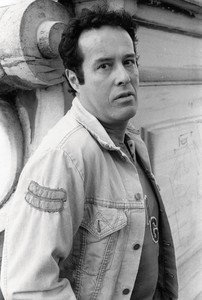
William Breeze pays homage to his friend the filmmaker and author Kenneth Anger, reflecting on his revolutionary work in color, Magick, and spirituality.
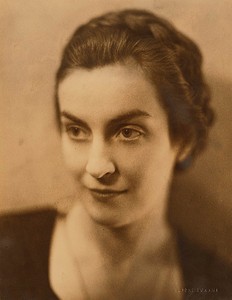
Scholar Wendy Jeffers is working on a comprehensive biography of Dorothy Miller, the groundbreaking curator who joined the Museum of Modern Art in its early years, building, over the course of decades, an innovative and remarkable program promoting contemporary American artists. Here, Jeffers recounts some key moments from this extraordinary life.

Michael Slenske pays tribute to the life and work of artist Ashley Bickerton.
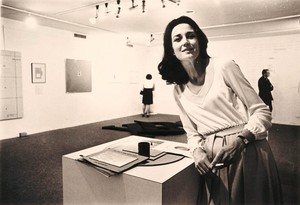
Charles Stuckey reflects on the unparalleled life and career of the gallerist, patron, and curator Virginia Dwan, enumerating key moments from a lifetime dedicated to artists and their visions.
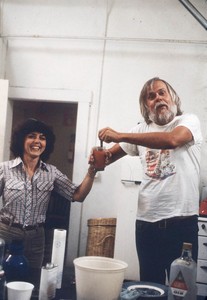
Michael Auping pays tribute to the late bicoastal curator, admiring her contributions to the proliferation of Conceptual art.
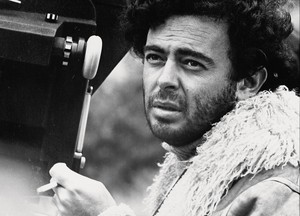
Carlos Valladares celebrates the visionary Brazilian director.