Game Changer
Jacques-Henri Lartigue
Christian House celebrates the generation-spanning and formally inventive photographs of Jacques-Henri Lartigue.
Winter 2025 Issue
Amie Corry celebrates Poly Styrene, the genre-bending, heterodox lead singer of the pioneering punk band X-Ray Spex.

Poly Styrene, 1977. Photo: Trinity Mirror/Mirrorpix/Alamy
Poly Styrene, 1977. Photo: Trinity Mirror/Mirrorpix/Alamy
In 1980, the foremost women of punk gathered in a West London hotel for a now-famous photo shoot.1 It was commissioned for New Music News, a magazine hastily established to circumvent strike action by staff writers at NME. The photo that ended up on the magazine’s cover shows Chrissie Hynde (the Pretenders), Debbie Harry (Blondie), Siouxsie Sioux (the Banshees), and Viv Albertine (The Slits), laughing and jostling, their bodies tight to one another. Seated in another row, eyeing the camera with relative reserve, are Mari Elliott, better known as Poly Styrene of X-Ray Spex, and Pauline Black of the legendary ska band the Selecter. Black recalls a sense of awkwardness she shared with Poly, the only other woman of color in the room. She found herself thinking, “Am I here to make sure that there’s a couple of black faces around?”2
Four years earlier, Poly Styrene, then a teenager running a fashion stall in the counterculture London enclave the World’s End, placed an advert in Melody Maker magazine seeking “young punxs who want to stick it together.” It was 1976, the cusp of punk’s shattering birth, and Poly had just seen the Sex Pistols live. She went on to have a complex relationship with the movement and its sometime savagery, but she remains the apotheosis of its energy: singularly nonconforming, with an unflinching eye on societal whims and ills.
Singer, lyricist, and art director for X-Ray Spex, the band forged from the Melody Maker ad, Poly Styrene chose her moniker from a flick through the yellow pages. She was looking, she said, for “something about today, something plastic, synthetic”; the name proved the perfect “send-up of being a pop star.”3 Her startlingly mature, not to say prophetic absorption in the trappings of artifice—in terms both of the music industry and of socioeconomic production—was a constant throughout her too-short life. When Britain’s Capital Radio asked her to introduce the band’s music with the words “I’m Poly. This is my new single. It should be yours,” she instead spouted, “This is a prefabricated icon speaking, don’t buy it, it’s dangerous, or on the other hand . . . it’s just a harmless piece of plastic from X-Ray Spex.”4 The gesture was typical of an artist who was as much radical innovator as she was outlier, engaged with futurism—you might say Afrofuturism—while her peers primarily reveled in and rebelled against the contemporary.
Poly was born in 1957 to an Irish-Scottish mother—a legal secretary—and a Somali father, a dockworker who longed to return to the country of his birth. Growing up biracial in postwar Brixton, Poly faced significant prejudice, and she remained acutely attuned to the challenges of sitting outside binary identifiers. “Identity is the crisis, can’t you see?” she rails at an urgent, accelerated pitch on “Identity,” from the band’s only album, Germfree Adolescents (1978): “When you look in the mirror, do you see yourself?/Do you see yourself on the TV screen?/Do you see yourself in the magazine?”5
On Germfree Adolescents Poly mined the surreal and satirical to influential effect. Her lyrics, laceratingly sharp and set to the frenzied saxophone of her female bandmate Lora Logic, are irresistible. They’re most famously immortalized in the feminist anthem “Oh Bondage! Up Yours!,” which was initially banned from radio.6 She returned again and again to the subject of consumerism, of both image and object: “It’s 1977 and we’ve seen too many ads,” she screeches on “Plastic Bag,” “my mind is like a plastic bag . . . that sucks up all the rubbish.” As Vivienne Westwood remembered in 2019, her thinking was consistently “near to where we are right now.”7
Poly was an electrifying performer, holding tiny underground stages with assured possession, her body throbbing, aggressively eyeballing her audience, utterly herself. A polymath, she crafted DIY costumes unlike anything worn by her punk peers. Sporting teeth braces, unrelaxed hair, fluorescent eyebrows, and outfits that ranged from ’50s-inspired twinsets to rubber-tube dresses with military helmets, her looks arguably served as protective barriers against archetypal expectation. This she coupled with a fiercely shrewd and ambitious business mind: She fell out with the rest of X-Ray Spex over her retention of 90 percent of the copyright for the music.8
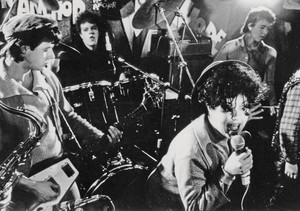
X-Ray Spex, 1978. Photo: Pictorial Press Ltd/Alamy
Poly’s intelligence and sensitivity proved unhappy bedfellows with the brutal mill of fame and public exposure, and her story recalls that of any number of hounded women in the modern media. By 1978, X-Ray Spex’s star was on the rise, with international tours and chart success. Bob Marley saw the band and invited Poly to record with him.9 But in New York, Poly found the drugs too hard and the band’s schedule overwhelming. In Paris she fled the stage, shocked by a violent, spitting crowd. Back in the United Kingdom, she was convinced of UFO sightings. Fraternizing with punk’s male icons—Johnny Rotten and Sid Vicious—only exacerbated her feelings of isolation; Vicious once trapped her in a cupboard for hours as a cruel joke.
Her deteriorating health coincided with the release of Germfree Adolescents, on the cover of which her and Logic’s bodies were manipulated without their knowledge to look thinner. She watched her own performance on the British TV show Top of the Pops from the Maudsley, a London psychiatric hospital, later musing, “It isn’t normal to be up on stage and people jumping all over you and ripping your clothes off. . . . And then you get people coming to your house, and then you get people trying to break in.”10 Her acute bipolar disorder was initially misdiagnosed as schizophrenia, a known error with people of color.11 She struggled for the rest of her life with manic episodes and imperfect medication.
Arguably in an attempt to regain control of narratives around her body, Poly shaved her head at Rotten’s house ahead of the seminal Rock Against Racism concert in East London in 1978. Her manager begged her not to expose the look, but during “Identity” she teasingly unwound a headscarf for an 80,000-strong crowd.12 The moment’s context serves as an important reminder: Alongside its nihilism, later whitewashing by the media, and a move toward white supremacy, punk played a vital role in radical activism in the mid-’70s.
Deeply unwell, Poly disbanded X-Ray Spex after Germfree Adolescents. In 1981 she released Translucence. It’s a beautiful record, retaining the tight, observational poetry of her earlier work, but her voice has mellowed to a sweet high. The press, renowned for its aversion to experiment, eviscerated the album. She quit, had her daughter, the musician and filmmaker Celeste Bell, and traveled to India, later joining the Hare Krishnas. In 2008, X-Ray Spex reunited for a one-off special at the Roundhouse in London. Poly was working on new music but she died in 2011, aged fifty-three, from breast cancer.
A punk frontwoman of color battling the unremitting ferocity of the public eye: It was anything but easy, but Poly Styrene proved what could be. With her uncompromising talent and through music that retains its anarchic energy today, she showed, in musician Neneh Cherry’s words, “that it was possible.”13
1 The photographer was Michael Putland.
2 Pauline Black, quoted in Celeste Bell and Zoë Howe, Dayglo: The Poly Styrene Story (London: Omnibus, 2019), pp. 136–37.
3 Poly Styrene, in “Who Is Poly Styrene?,” Arena, BBC2, January 22, 1979. Available online at www.youtube.com/watch?v=UO0HwmUReOg (accessed September 8, 2025).
4 Poly Styrene, quoted in Bell and Howe, Dayglo, p. 99.
5 X-Ray Spex, “Identity,” Germfree Adolescents (London: EMI, 1978).
6 “Oh Bondage!” was written, Poly said, in response to all types of societal bondage: racial, gendered, and economic.
7 Vivienne Westwood, quoted in Bell and Howe, Dayglo, p. 200.
8 When mentally unwell in the late ’70s, Poly signed away her publishing rights and with them her financial stability. She finally regained control of them in the 1990s.
9 See Bell and Howe, Dayglo, p. 139.
10 Poly Styrene, in “Who Is Poly Styrene?.”
11 See Patti Verbanas, “African Americans More Likely to Be Misdiagnosed with Schizophrenia, Rutgers Study Finds,” Rutgers Today, March 21, 2019. Available online at www.rutgers.edu/news/african-americans-more-likely-be-misdiagnosed-schizophrenia-rutgers-study-finds (accessed September 6, 2025).
12 See Celeste Bell and Paul Sng, Poly Styrene: I Am a Cliché (Modern Films and Pacific Northwest Pictures, 2021).
13 Neneh Cherry, quoted in ibid., p. 87.

Amie Corry is a London-based writer and editor. She was senior editor of Other Criteria Books from 2014 to 2020 and is director of publications for the artist Do Ho Suh. Corry contributes to the Times Literary Supplement, Burlington Contemporary, and other publications, and in 2013 she coproduced a pioneering audit on gender equality in the London art sector.
Christian House celebrates the generation-spanning and formally inventive photographs of Jacques-Henri Lartigue.

Salomé Gómez-Upegui honors Beatrice Wood, the “Mama of Dada,” an underappreciated trailblazer within the movement who went on to become a brilliant ceramist.

Gillian Pistell celebrates the life and work of Kay Bearman, a pivotal force in the cultural life of midcentury New York.

Curator Richard Calvocoressi remembers the extraordinary talent of Frank Auerbach.

Scott Rothkopf, Alice Pratt Brown Director of the Whitney Museum of American Art, New York, remembers his friend, Dorothy Lichtenstein.

Mark Francis remembers his late friend, the indefatigable and radical curator Kasper König.

Curator and author Peter Galassi, coeditor of the recent collection Ulf Linde: Essays from a Lifetime in the Arts (König, 2023), reflects on the life and work of the Swedish art critic and museum director.
William Breeze pays homage to his friend the filmmaker and author Kenneth Anger, reflecting on his revolutionary work in color, Magick, and spirituality.

Scholar Wendy Jeffers is working on a comprehensive biography of Dorothy Miller, the groundbreaking curator who joined the Museum of Modern Art in its early years, building, over the course of decades, an innovative and remarkable program promoting contemporary American artists. Here, Jeffers recounts some key moments from this extraordinary life.

Michael Slenske pays tribute to the life and work of artist Ashley Bickerton.

Charles Stuckey reflects on the unparalleled life and career of the gallerist, patron, and curator Virginia Dwan, enumerating key moments from a lifetime dedicated to artists and their visions.
Michael Auping pays tribute to the late bicoastal curator, admiring her contributions to the proliferation of Conceptual art.