
Game Changer
Beatrice Wood
Salomé Gómez-Upegui honors Beatrice Wood, the “Mama of Dada,” an underappreciated trailblazer within the movement who went on to become a brilliant ceramist.
Winter 2024 Issue
Mark Francis remembers his late friend, the indefatigable and radical curator Kasper König.
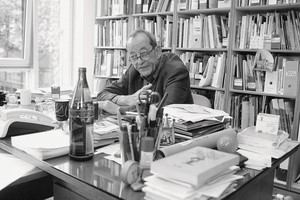
Kasper König, 2006. Photo: ullstein bild/Getty Images
Kasper König, 2006. Photo: ullstein bild/Getty Images
It is a vivid indication of the meteoric trajectory of Kasper König’s career that his first experience of curating a museum exhibition was for the artist Claes Oldenburg, at Moderna Museet in Stockholm, in 1966, when König was only twenty-three years old. And he topped this a couple of years later when he organized an Andy Warhol exhibition, also at Moderna Museet, in 1968. He had proposed to Pontus Hultén, then the director of the museum, a popular exhibition that would cost almost nothing, and this was happily approved. Then he went to Warhol to suggest that they make the exhibition in Stockholm itself, rather than send works from the artist’s studio in New York: hundreds of Brillo Boxes (1964) and Silver Clouds (1966) would be fabricated on site, Cow wallpaper (1966) would be pasted to the museum’s exterior walls, and Warhol’s early films, such as Sleep (1964), would be projected in the galleries. It was a revolutionary way to present an artist’s work, entirely in the spirit of Warhol, and it proved highly successful: the museum claimed to have sold over 250,000 copies of the catalogue, a kind of artist’s book featuring the photographs of Billy Name.
König was born in 1943 in Mettingen, near Münster, Germany. In his late teens, still at school in Essen, he saw a Cy Twombly exhibition at Rudolf Zwirner’s gallery and briefly became an intern there. He soon moved to London, working for the gallerist Robert Fraser, and then on to New York, where he immersed himself in the downtown art, dance, and music worlds, meeting artists such as Oldenburg, Richard Artschwager, On Kawara, and Dan Graham, dancers Yvonne Rainer and Simone Forti, and many others.
In 1969, following the two precocious and well-received museum exhibitions in Stockholm, König somewhat mysteriously moved back to Europe and spent a year in Antwerp, becoming close to Marcel Broodthaers and Fluxus artists such as Robert Filliou and Addi Koepke. And then another move, to become the publisher of the Nova Scotia College of Art and Design’s series of books with artists—Bernhard Leitner’s The Architecture of Ludwig Wittgenstein (1973), Yvonne Rainer’s Work 1961–73 (1974), Donald Judd’s first Complete Writings (1975). He connected different strands of the avant-garde and became an essential conduit between the New York and European art worlds, especially those of Düsseldorf and Cologne.
For Harald Szeemann’s documenta exhibition in Kassel in 1972, König presented Oldenburg’s Mouse Museum as a single-artist museum within the larger exhibition. It should have been obvious by this point that König was one of the most brilliant and dynamic young curators in Germany, but he was notoriously never invited to curate documenta in the following years. Instead, he organized the first iteration of the Skulptur Projekte exhibitions in the town of Münster in 1977, coinciding with, and rather overshadowing, the documenta of the same year. It became his defining project, which he repeated in 1987 and expanded each decade until his final version, in 2017. Despite having no academic background and no institutional position, he independently curated the revisionist exhibition Westkunst. Zeitgenössische Kunst seit 1939 (West-art: Contemporary art since 1939), with the art historian Laszlo Glozer, in the trade fair halls in Cologne in 1981. The show was seen as provocative at the time, including overlooked work such as late paintings by Vasily Kandinsky and René Magritte’s Vache (Cow) paintings (1947–48), and it explicitly acknowledged the competitive hegemony of Western Europe and North America in the postwar period.
In 1984, König followed this enormous project with another, Von hier aus—Zwei Monate neue deutsche Kunst in Düsseldorf (Up from here—Two months of new German art in Düsseldorf), a survey of contemporary German art. Only in the 1990s did he take a professional position, becoming the director of the Städelschule in Frankfurt, which rapidly became a dynamic art school, and founding Portikus, an associated Kunsthalle where he could present exhibitions of established and younger artists alike. One of the first, and most significant, was the exhibition of Gerhard Richter’s 18. Oktober 1977 series, made in 1988, which addressed the highly charged subject of the deaths in custody of members of the revolutionary group the Red Army Faction.
Then, in 2000, König became the director of the Museum Ludwig in Cologne, a final vindication of his distinguished status both nationally and internationally. He remained open to new ideas and to younger artists and became a mentor and supporter of the next generation of curators, such as Okwui Enwezor and Hans Ulrich Obrist. His energy was prodigious and he participated often in advisory committees, panels, and seminars.
Among my experiences over our long friendship, when I cocurated the Carnegie International exhibition in Pittsburgh in 1991 with Lynne Cooke, we invited Kasper to be on the jury for the Carnegie Prize. He insisted that On Kawara be awarded the prize, a decision not widely popular at the time, but certainly prescient and daring.
Kasper died in August. I last saw him in December in Berlin, where he
lived after retiring from the Museum Ludwig and where he still had an office in the artist Douglas Gordon’s studio complex. We met at the Nationalgalerie, newly restored by David Chipperfield, and he had characteristically acute comments on the concurrent exhibitions of work by his old friends Richter and Isa Genzken. Kasper loved art and artists, and he retained his humor and anarchic spirit until the end.
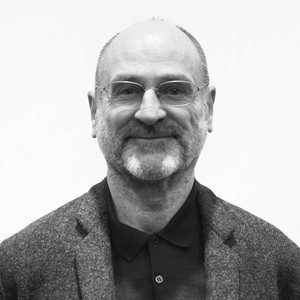
A director at Gagosian since 2002, Mark Francis was formerly founding director and chief curator of the Andy Warhol Museum, Pittsburgh. He has been a curator at the Centre Pompidou, Paris; the Fruitmarket Gallery, Edinburgh; the Whitechapel Art Gallery, London; and the Museum of Modern Art, Oxford, England.
Salomé Gómez-Upegui honors Beatrice Wood, the “Mama of Dada,” an underappreciated trailblazer within the movement who went on to become a brilliant ceramist.

Amie Corry celebrates Poly Styrene, the genre-bending, heterodox lead singer of the pioneering punk band X-Ray Spex.

Gillian Pistell celebrates the life and work of Kay Bearman, a pivotal force in the cultural life of midcentury New York.

Curator Richard Calvocoressi remembers the extraordinary talent of Frank Auerbach.

Scott Rothkopf, Alice Pratt Brown Director of the Whitney Museum of American Art, New York, remembers his friend, Dorothy Lichtenstein.

Curator and author Peter Galassi, coeditor of the recent collection Ulf Linde: Essays from a Lifetime in the Arts (König, 2023), reflects on the life and work of the Swedish art critic and museum director.
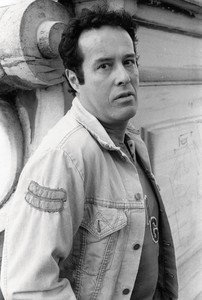
William Breeze pays homage to his friend the filmmaker and author Kenneth Anger, reflecting on his revolutionary work in color, Magick, and spirituality.
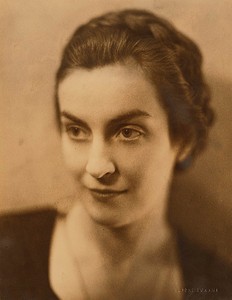
Scholar Wendy Jeffers is working on a comprehensive biography of Dorothy Miller, the groundbreaking curator who joined the Museum of Modern Art in its early years, building, over the course of decades, an innovative and remarkable program promoting contemporary American artists. Here, Jeffers recounts some key moments from this extraordinary life.
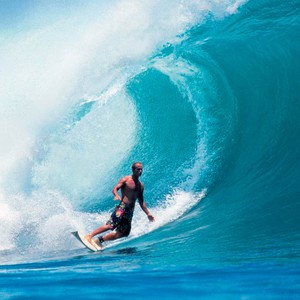
Michael Slenske pays tribute to the life and work of artist Ashley Bickerton.
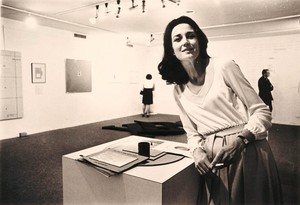
Charles Stuckey reflects on the unparalleled life and career of the gallerist, patron, and curator Virginia Dwan, enumerating key moments from a lifetime dedicated to artists and their visions.
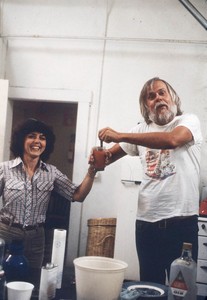
Michael Auping pays tribute to the late bicoastal curator, admiring her contributions to the proliferation of Conceptual art.
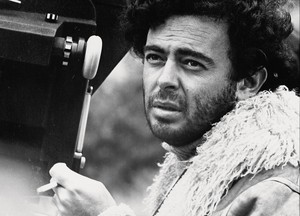
Carlos Valladares celebrates the visionary Brazilian director.