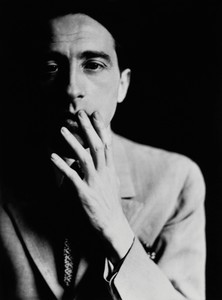
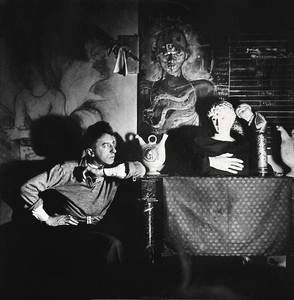
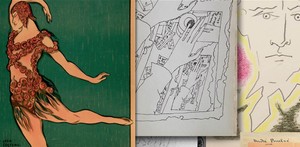
Filmmaker and author Lisa Immordino Vreeland has created a new documentary on the life and art of Jean Cocteau. Narrated by Josh O’Connor, the film makes the case for the enduring relevance and prophetic poetry of Cocteau’s singular life and art. Here, Josh Zajdman reflects on the urgent necessity of engaging with the poet, filmmaker, artist, playwright, and novelist’s uncategorizable existence.
It would be fair to say that the author and documentarian Lisa Immordino Vreeland has a thing for visionaries. For over a decade she has turned her lens and pen to people who have helped us see the world anew. First came Diana Vreeland (grandmother of Lisa’s husband), then Peggy Guggenheim, followed by the inimitable Cecil Beaton. Each of them challenged notions of taste, beauty, and style. An Immordino Vreeland documentary always promises a feast for the senses and her latest doesn’t waver from that promise: in Jean Cocteau, she has landed on the worthiest of subjects, and the result is a rich and informative look at an artist who defies categorization. Though each film preceding it has been eye-opening and lusciously crafted, something about this one feels different. It seems like we need a new way of seeing, and who better than Cocteau to guide us? When we aren’t actually watching Cocteau, our Virgil is voiced by the chameleonically talented actor Josh O’Connor. This dual perspective entices the viewer with a look not just at a life but at how to live.
Immordino Vreeland’s film is a vastly overdue opportunity to introduce Cocteau to a generation grappling with many of the same things he did (not in order of priority): in art, rigid classification of mediums, and in the world beyond, fascism, homophobia, mortal dread, existential crises. While “Cocteau” is a name many know or have heard of, few, paradoxically, can say why he is important. He’s often shoehorned with various Dadaists or Surrealists as if he were interchangeable with any character from Woody Allen’s Midnight in Paris (2011), but that is not the case.
He published as widely as many of his contemporaries, and biographies of him have been written as well, but he’s harder to pin down. A condition of which he was well aware: “I have been accused of jumping from branch to branch. Well, I have—but always in the same tree.”
In an attempt to be a literary arborist and to ensnare what he could of Cocteau’s essence, the scholar, biographer, and translator Frances Steegmuller wrote, “Of all the titles to which he had a claim, he consented to use only one—poet—and that he insisted upon. He was the most self-proclaimed of poets, to the extent that he rigorously classified all his great variety of work, his poems, novels, plays, essays, drawings, and films, under the headings of ‘poésie, poésie de roman, poésie de théâtre, poésie critique, poésie graphique and poésie cinématographique.’” Although Steegmuller’s biography is foundational, today it comes across as stuffy and occasionally judgmental, and it puts the wild and wide-ranging Cocteau on a short leash. Ours is an age of hyperclassification and excessive scrutiny, dependent on naming something so we know exactly where it goes and how to use it. But what if we took a page out of Cocteau’s book of life and advocated living in a more exploratory and less taxonomical way?
Toward the end of Immordino Vreeland’s documentary, Cocteau admits that this is no simple gesture. “To shape oneself is not easy. I forced the lock and twisted my key in every direction. In the end, everything is resolved except for the difficulty of being, which is never resolved.” A call to arms. What if we were willing to reshape ourselves?
What if you could create a foundation or through line for your way of seeing the world, and accordingly could see it through a wider lens, or without blinders on? This revolutionary perspective is just one of the things you can learn from Cocteau.
Cocteau was the king of maxims, one of which—“Time does not exist, it’s a phenomenon of perspective”—can help explain why his approach to life and art continues to resonate through the decades since his death. Shifting perspective and avoiding distraction allow the work to be the focal point, and for Cocteau, the work was paramount. Its success of course was various, but the making and breaking were what guided him over the years, sustaining him and keeping the darkness (mostly) at bay. “Work, believe and pretend the future does not present a frightening enigma.” Can you think of a maxim more applicable to today’s world? I can’t.
Cocteau’s life and work unfolded against the vital and violent twentieth century. Born in 1889, the same year as Charlie Chaplin, Martin Heidegger, and Adolf Hitler, he lived through world wars, depressions, and revolts, and died, finally, one month before JFK was assassinated. Yet, to paraphrase The Sound of Music (1965)—which he almost certainly would have hated—the question asked during his lifetime and certainly after was, How do you solve a problem like Cocteau?
Well, first, don’t look at him the way so many have. He was not a dabbler or a dilettante, nor was he merely a member of a movement who never broke away from his peers. The biggest crime against Cocteau remains the belief that he couldn’t commit, couldn’t find enough success in a single art form, so he flitted from one to another and over to the next. Immordino Vreeland helps us to understand with another glance into Cocteau’s thinking. “I had that strange privilege of being that most invisible of artists and the most visible of men. As a consequence, the man draws fire but the artist is never hit.”
His perspective, his way of thinking, and his way of living matter now more than ever. He seemed to exist everywhere, with everything, and all at once.
What so many viewed as a negative was actually one of Cocteau’s greatest strengths. His freedom of movement had a porous quality, which reflected across the variety of work he produced and the modes in which he did it. It was his willingness to stay open to inspiration but not beholden to it that spurred his creativity to incredible heights. In his 1934 play La Machine infernale (The Infernal Machine) he riffs on Oedipus and Hamlet, resulting in a howlingly funny and beautifully rendered take on Sophocles. Twelve years later came the landmark film Beauty and the Beast, adapted from the fairy tale but seeing it through Cocteau’s eyes. He was clearly comfortable with adapting, presenting something fresh even if the source was familiar.
Was he all talent and charm? No. Along with his affinity for Hitler, he had various not-so-savory attributes. The list of people who danced between affection and aggrievement was gilded. He was a Zelig of the Left Bank. Had he lived in the age of Venmo, you’d see names like Apollinaire, Bakst, Bernhardt, Breton, Daudet, Diaghilev, Gide, Hahn, Nijinsky, Piaf, Picasso, Proust, Satie, and Stravinsky in his transaction history. A potpourri composed entirely of the coterie. This simultaneity, this outright sense of juxtaposition, marked Cocteau in both his interests and his relationships. Whether it was art, sex, or society, he’d have what he wanted and the way he wanted it. This certainty propelled him through life’s uncertainties. Only such a man could say: “Everything one achieves in life, even love, occurs on an express train racing toward[s] death.”
He’s not wrong.
It’s often assumed that the narrator in Marcel Proust’s In Search of Lost Time has the most famous literary epiphany. That may be, but if you too were unaware of that which Cocteau underwent one cold spring evening, hold on. This is a moment covered in both Steegmuller’s biography and Immordino Vreeland’s documentary:
One night in 1912, I see us in the Place de la Concorde. Diaghilev is walking home after a performance, his thick underlip sagging, his eyes bleary as Portuguese oysters, his tiny hat perched on his enormous head. Ahead, Nijinsky is sulking, his evening clothes bulging over his muscles. I was at the absurd age when one thinks oneself a poet, and I sensed in Diaghilev a polite resistance. I questioned him about this, and he answered, “Astound me! I’ll wait for you to astound me.”…From that moment I decided to die and be born again. The labor was long and agonizing.
It goes without saying that Diaghilev was used to astounding but was rarely astounded. As a result, such a directive was not taken lightly or accomplished quickly. In fact, it wouldn’t be until 1917 that Cocteau was able to achieve the feat. In May of that year, a one-act ballet entitled Parade premiered in Paris. The scenario was written by Cocteau, the music composed by Erik Satie, and the sets and costumes by a Spanish artist with whom Cocteau had become quite close, one Pablo Picasso. The same charitable collaborator who later said, “I am the comet, Cocteau is merely a spark in my tail.”
Some of the reactions to Parade skewed toward feral. Whether apocryphal or not, Cocteau said that women who were coming toward him with hat pins at the ready for blinding (it was always Oedipus with Mr. C), were stalled only when they saw Guillaume Apollinaire’s head wrapped in a bandage, having returned recently from the Front. It was Apollinaire who, in a review, wrote that Parade “had a surrealism about it,” which introduced the word into modern parlance. Proust wrote to Cocteau that he was “delighted by the considerable stir made by your ballet.” Though he was astounded, Diaghilev was also displeased by the public response and pulled the ballet from the Ballets Russes repertoire. Three years later, it was remounted thanks to a young, new costume designer who also helped fund it. Money talks. Her name was Gabrielle, Coco to her friends, Chanel.
Thomas Wolfe, a contemporary of Cocteau’s, may have been right. You can’t go home again. At some point, Cocteau’s home on rue de Montpensier became too much. Eventually, Cocteau and his then partner, Jean Marais, who had played that famed Beast, looked outside of the city for a p(a)lace to call their own. They found it roughly fifty miles outside of Paris in a small town called Milly-la-Forêt. It became more than just a way to escape, however. Today, it’s a house retaining the furniture, designs, and touchstones of Cocteau, with his body buried in a nearby chapel. Both the house and the chapel are centuries old.
Somehow, though, the man is not in the least bit old. To understand Cocteau is to understand art, love, history, familial strife, loss, hope, addiction, and possibility. In the winter of 1949, after spending nearly three weeks in New York City, Cocteau began an essay on the plane ride home. Entitled Letter to the Americans, reading it today reminds you that possibility can cut both ways. Although he doesn’t call it a warning, per se, his penchant for prophecy remains as piercing seventy-five years later:
Americans,
I’m going to try to sleep and to dream. I love to live my dreams and forget them upon waking. For there I inhabit a world where control doesn’t yet exist. It will exist if you keep going down the same direction. Dreams will be controlled—and not by psychiatrists, but by the police. Dreams will be controlled and they will be punished. They will punish the act of dreaming.
Good night.
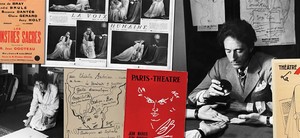
The great gift of Immordino Vreeland’s film is its ability to maintain the tension of all that Cocteau embodied. He didn’t merely write The Human Voice, he was a human voice. Whether in plays, poetry, drawing, film, or literature, he destabilized what we knew and took for granted, resulting in something unexpected and sublime. A seer and sage born barely a decade after the telephone was invented, he died the year The Birds, Cleopatra, Charade, and The Leopard were released in theaters.
It was a heart attack at his chateau in Milly-la-Forêt. He died alone on the same day that he found out that his longtime friend, Edith Piaf, had died. Apocrypha says that he died of a broken heart.
Cocteau’s legacy is manifold, but especially evident in the willingness to go for it that you see across all forms of art in today’s world. He would love A24 as much as he would Rachel Cusk and Taylor Mac. His perspective, his way of thinking, and his way of living matter now more than ever. He seemed to exist everywhere, with everything, and all at once. There was the opium, and Orpheus, those lovable Holy Terrors, and much more. How to grapple with him and his contributions to not just art, but life?
Well, as he would have it, let’s give him the last word:
I congratulate myself that you are more familiar with my name than with my works, because knowledge of my works would lead you down the path of sleepwalkers, giving you vertigo, for which you’d never forgive me.
All we can do is hope. How dangerous.
When not writing about books or art, Josh Zajdman is doom-scrolling Instagram or working on his novel.