John Szwed is the author and editor of many books, including biographies of Billie Holiday, Miles Davis, Sun Ra, and Alan Lomax. He has received fellowships from the Guggenheim Foundation and the Rockefeller Foundation, and in 2005 was awarded a Grammy for Doctor Jazz, a book included with the album Jelly Roll Morton: The Complete Library of Congress Recordings by Alan Lomax.
Nothing is more comparable than the intensity of jazz. It is jazz which has really contradicted the impressionists in painting. It is jazz and the Rite of Spring. It has played the same role as the fauve painters.
There is a century-long history of attempts to turn sound and music into something visible. In 1925, theosophists Annie Besant and C. W. Leadbeater thought that words, colors, and sounds could all emerge from thoughts and spiritual states in a form of synesthesia. Vasily Kandinsky, in 1926, said that geometric forms could be used to paint visual representations of music as complicated as Beethoven’s Fifth Symphony (1804–08). Not much came from these and other speculations, and they are now mostly forgotten. But there is another concept that reckons there is an affinity between jazz and painting. It’s less known to the public, but has long been embraced by painters and musicians.
I came upon this subject a few years back when some art museums were announcing they would be presenting jazz events. There were those who saw this as just another effort to attract new demographics and money into the building, like today’s stagings of weddings, fashion shows, overnighters, and yoga. Some jazz fans grumbled that this trend of jazz in museums was a sign of the music’s death. But in fact, several major art museums had been interested in jazz for over eighty years. As early as 1940, the Museum of Modern Art, New York, began to present jazz concerts carefully structured to introduce jazz to the museum’s public, and the San Francisco Museum of Art was scheduling concerts and lectures on jazz in 1943. These art institutions were clearly registering the shock of this particular form of the new, and assaying its implications. The seriousness with which it was presented showed that they already saw jazz to be a form of high art.
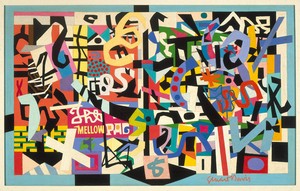
Others saw a connection between the two arts even earlier. While the 1913 Armory Show was shaking up the art world, ragtime was becoming a national craze that unsettled nineteenth-century conceptions of music and dance. The artist Stuart Davis, whose work was in the Armory Show, later said, “My objective was to make paintings that could be looked at whilst listening to [a jazz] record at the same time, without incongruity of mood.” Having seen paintings by Paul Gauguin, Vincent van Gogh, and Henri Matisse, Davis said there was “an objective order in these works which I felt was lacking in my own work. . . . It gave me the same kind of excitement I got from the numerical precisions of the Negro piano players in the Negro saloons of Newark. I resolved that I would quite definitely have to become a ‘modern’ artist.” In that same year Davis had been making sketches in some of those saloons.
It was a time when all the arts were in flux, since jazz, motion pictures, modern dance, and modern art had all grown up together, and elements of these arts affected each other. It was not yet clear what jazz was, but whatever it was, it signaled modernity. Ragtime, the earliest form of jazz, was the subject of controversy, a dispute that helped bring about the increasing visibility and autonomy of Black Americans in the cultural life of the nation and the world, introduced new forms of dance (and the clothing that those dances required), and helped to create a heightened sense of sexuality in the arts. F. Scott Fitzgerald declared that he was living in the Jazz Age.
Even the word “jazz” had the power and glamour of other trending words of the time—“cocktails,” “gramophone,” “skyscraper,” “sex appeal,” and “escalator.” In one of its earliest appearances in print, a 1913 San Francisco Bulletin piece titled “In Praise of ‘Jazz,’ a Futurist Word Which Has Just Joined the Language,” the anonymous author had some fun explaining that there were different ways of spelling the word and an endless number of meanings, “something like life, energy, effervescence of spirit, joy, pep, magnetism, verve, ebulliency, courage, happiness.” The word still has something of that ambiguity and force: it appears as a name for stores, food products, computer software, bands in Haiti and Africa (none of which actually play jazz), as well as the names of rappers (Jay-Z was originally known as Jazzy, after the name of his mentor Jaz-O).
But beyond the fashionable, what was it about jazz that led to its particular impact on the visual arts? American painters had to notice that jazz was not an art coming from Europe, the beaux arts, or the so-called “pure” traditions of art, but was a home-grown product of the Black vernacular. Once they learned that the essence of jazz was improvisation—composing in the moment, amid the simultaneous collective improvisations of others—some artists resonated with the idea, and with what it might offer them in their own practice. The Surrealists, for example, with their interest in automatic writing and painting, where the subconscious was allowed control over the work, saw jazz as particularly attractive. Some even spoke of jazz musicians as performing under spirit possession.
Rhythm was the most notable feature of this new music, and was seen not just as something hidden behind the melody and the other musicians. The drum set itself, first created by Black drummers, was an art object: cymbals, gongs, and triangles from Turkey, tom-toms from China and Africa, snare drums from European military bands, cowbells and woodblocks from Africa, all clustered together in shimmering silver and gold, drums trimmed in pearl, the face of the bass drum painted with exotic scenes of palm trees, rivers, swirls of color, and bearing the initials of the drummer. Jean Cocteau, Francis Picabia, and the composer Darius Milhaud all took up jazz drumming, as did Man Ray, who had himself photographed as a one-man band.
The French were among the first to recognize the importance of jazz, and the possibilities of learning from it can be seen in “Il n’y a plus de perspective” (No more perspective), a 1933 article in Le Cahier Bleu by the designer René Guilleré:
In jazz all elements are brought to the foreground. This is an important law that can be found in painting, in stage design, in films, and in poetry of this period. Conventional perspective, with its fixed focus and its gradual vanishing point, has abdicated. . . . [In jazz there] is not an accompaniment and song similar to a figure against a background. Everything works. There is not a solo instrument against the background orchestra, each instrument solos while participating in the whole . . . each man plays for himself in general ensemble. The same law applies to art: the background is itself a volume.
A decade later, Sergei Eisenstein, in his book Film Sense, summarized Guilleré’s article by noting that jazz had multiple perspectives instead of a single fixed one, and had erased the strict lines between foreground and background. He added, “We have only to glance at a group of Cubist paintings to convince ourselves that what takes place in these paintings has already been heard in jazz music.”
Painters of Jazz
The connection between jazz and painting was in part a result of social forces. There were communities that didn’t necessarily belong to the same craft or profession, but learned or developed by encountering groups that shared some of their interests. This was certainly the case in the early years of jazz in New Orleans, where many artists’ and craftspersons’ business cards also listed them as musicians. Manhattan in the 1950s was a different scene, but painters and musicians gathered at the Five Spot, the Cedar Tavern, and Stanley’s in Greenwich Village, where they heard modern jazz on jukeboxes and sometimes live.
The first images of jazz and the blues were done by illustrators for covers of sheet music and as advertisements for records, and were often images of whatever they thought a song might be about. Photography soon followed, most often with posed pictures of stars. The increasing sale of records in the 1920s overlapped with the Harlem Renaissance, and painter Aaron Douglas created a few silhouetted archetypal musical figures, often in heroic, powerful poses (Play de Blues, 1926). A few years later, another Black painter, Archibald Motley, Jr., seemed to be responding to Davis when he did a series of realistic paintings that emphasized the closeness and musically heated atmosphere of nightclubs (Blues, 1929).
The French painter Francis Picabia made several works inspired by an African-American singer he heard in a Harlem cabaret during a New York show of his paintings in 1913. Asked to explain the principles of abstraction to a reporter, Picabia replied, “Does the [musical composer] attempt a literal reproduction of the landscape scene, of its details of form and color? No, he expresses it in sound waves. . . . And as there are themselves absolute sound waves, so there are absolute waves of color and form.” Picabia’s explanation seems akin to the nineteenth-century critic Walter Pater’s famous statement that “all art constantly aspires to the status of music”—that in music, form and content are the same, and that music points to nothing beyond itself. Music is just about music.
While Picabia was in New York, he met the young painter Arthur Dove. They discovered they were both using similar forms, similar colors, and repeated figures in their paintings to suggest rhythm. Dove was painting from recordings, daringly attempting to produce works that were the visual equivalent of the feelings and sensory qualities involved in the acts of playing and listening to a record. He saw the premiere performance of George Gershwin’s Rhapsody in Blue in 1924 and then bought the two-sided 78 rpm abbreviated recording of it by the Paul Whiteman Orchestra, with Gershwin at the piano. He made two paintings of what he heard, one for each side of the record, and spent days listening, then painting, turning the record over and over as he worked. The first of these paintings, Rhapsody in Blue, Part I (1927), was painted on aluminum and had an uncoiled metal spring hanging over it. Conjecture has it that the phonograph Dove was using had a hand-wound spring drive and he wanted the viewer to know his sources; others have said it represents the long upward movement of the opening clarinet solo in Rhapsody. Dove said of this project, rather defensively, “It will make people see that the so-called ‘abstractions’ are not abstract at all. . . . It is illustration.”
Davis was indelibly an American painter and he declared it in his jazz paintings. Many of his pictures contained signposts pointing to the music, either by their titles or by words written across the canvas (Swing Landscape (1938) or The Mellow Pad (1945–51)). He knew some of the key jazz musicians of his time, and Duke Ellington, James P. Johnson, and Earl Hines were among his fans. In 1942, when Davis’s work was exhibited in Edith Halpert’s Downtown Gallery, on opening night John Hammond arranged something of an all-star jam session featuring Ellington, Red Norvo, W. C. Handy, Mildred Bailey, and others. Piet Mondrian was in the audience.
When jazz drummer George Wettling turned to painting, Davis took him on as a student, and even copainted with him when Wettling used one of his paintings on the record jacket of George Wettling’s Jazz Band (Columbia CL6189, 1951).
Mondrian moved from London to New York in 1940. He had already heard and seen jazz played by Black American servicemen in Paris after World War I and had learned some of the new dances that accompanied them. His 1927 essay “Jazz and Neo-Plastic” spelled out his plans to paint in the purest form possible, with straight and horizontal lines, squares and rectangles, primary colors and no color. It’s fascinating that he conceived of this purest of arts when he was incited to paint in the spirit of what many Americans at the time still thought of as debased music, but “jazz,” Mondrian said, “now realizes an almost pure rhythm, thanks to its greater intensity of sound. Its rhythm gives the illusion of being open, unhampered by form. . . . Jazz above all creates the nightclub’s open rhythm. It annihilates form. It frees rhythm from form. Thus a haven is created in the nightclub for those who would be free of form.”
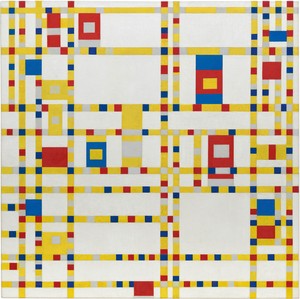
In New York Mondrian surrendered completely to jazz, spending nights dancing at Café Society with Lee Krasner and Peggy Guggenheim, the only two people who could adjust to his eccentric dancing, all angles, sharp edges, and complex footwork. Mondrian was most impressed by boogie-woogie, especially when played by the piano trio of Albert Ammons, Meade Lux Lewis, and Pete Johnson. It was music that seemed to have no beginning, middle, or end and that rumbled rhythmically like a freight train in the night. Broadway Boogie Woogie (1942–43) has been seen by some as a map of the syncopations and overlapping rhythms of these three pianists. By the time Mondrian painted Victory Boogie Woogie (1942–44), one of his last works, it’s said that he had discovered Minton’s Playhouse in Harlem, an after-hours club where young musicians were nightly inventing bebop. Thelonious Monk was the house pianist there, and he and Mondrian became close enough that Monk began to talk about his music in the same terms that Mondrian used to describe his paintings.
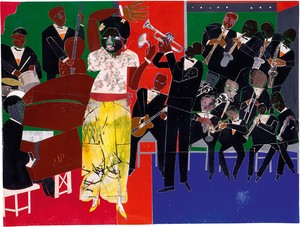
Romare Bearden was a master of many art forms, but it was not until late in his career that he became a collagist, and some of his best collages were of jazz. He had been a Cubist for most of his life, but said he wanted to have a less predictable and static feeling in these late works. “When I did the jazz series I had to modify [Cubism] a bit. . . . I think my jazz work has the feeling of classic African sculpture, the Benin or Dan” (Billie Holiday, 1973; Jazz with Armstrong, 1981). He thought of his mission as using the language and methods of jazz musicians and the consciousness of Black experience to redefine the human experience.
Bearden was certainly the most famous jazz collagist, but he was not the first. That honor goes to Louis Armstrong, who began collaging some years earlier for his own amusement and memories. With Scotch tape and cutouts, he collaged over 600 tape-recording boxes, and though some of them indicate who’s recorded on that tape, most are more freely done, and some illustrate small stories with his own typing. Others are in every sense abstractions. It was a serious enterprise, highlighted when Armstrong decided to collage the walls of his den.
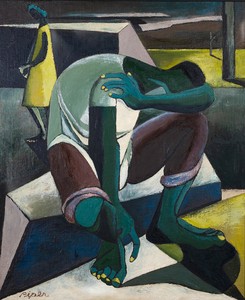
Rose Piper traveled the South in 1947 and did a series of semiabstract paintings of blues and folk singers that clearly called attention to the songs as measures of the inequities of race in America. When she showed them that year at the RoKo Gallery in New York, she received high praise from critics and from Bearden. That a Black woman could be presented by a New York gallery at that time (or for that matter at any time) was an act of bravery and great artistry (The Death of Bessie Smith, 1947; Grievin’ Hearted, c. 1948). The passion and intensity of Piper’s pictures seem echoed later in the work of David Stone Martin, who did paintings for hundreds of record covers for Verve Records in the 1950s.
In New York in the early 1940s the new style of jazz was bebop, a music so aggressively different from swing, the pop music of the day, that it was widely detested. Created by a group of young Black music intellectuals largely from farm communities in North and South Carolina, it was played by small groups of musicians, rather than the popular big bands, was performed fast and relentlessly, and required close listening. Bop musicians sometimes dressed as stereotypical artistes or bohemians and spoke their own language of hip, naming their tunes with nondescriptive and off-putting titles such as “Anthropology,” “Epistrophy,” and “Ornithology.” There was no irony here: they were serious.
The melodies and rhythms of bop were asymmetrical and jagged, not floating smoothly like swing; its harmony was more complex than in any previous form of jazz. The players were clearly not bothered by breaking rules and were always in search of something new. Previously, jazz musicians had improvised solos on the melodies and harmonies of well-known songs, but were always careful to play those original melodies at the beginning and end of each piece so that the audience would know the theme that they were varying. But beboppers composed entirely new melodies on the chord structure of older pop tunes without fully revealing their sources. “Sweet Georgia Brown” could be turned into Coleman Hawkins’s “Hollywood Stampede” or Thelonious Monk’s “Bright Mississippi,” with the old melody peeking subliminally through the new one. These compositions with their ghostly subsurfaces created a tension that opened up new possibilities for invention. Fans and music critics still tethered to swing and perplexed by bebop called it “Chinese” music, an ethnic dismissal that was also used against abstract painters in the same era.
Bebop inspired new art ways among the Beats on both coasts: the jazz poetry of Robert Creeley, Allen Ginsberg, Amiri Baraka, Kenneth Patchen, and Bob Kaufman; singer/poet King Pleasure’s words were put to the instrumental solos of famous musicians. Jack Kerouac called his experiments in music-influenced writing “spontaneous prose.” Ginsberg explained Kerouac’s writing by pointing out that on Dizzy Gillespie’s recording of “Salt Peanuts” the horns imitated the pitch and rhythm of those words; “Black musicians were imitating speech cadences and Kerouac was imitating the Black musicians’ breath cadences on their horns and brought it back to speech.”
The connection between jazz and Abstract Expressionist painting was daringly announced when the Samuel M. Kootz Gallery in New York launched the exhibition Homage to Jazz: A Colorful Tribute in Paint to a Great American Art in December of 1946. There were works by Bearden, William Baziotes (That Evening Sun Goes Down, a line from a blues song), Byron Browne, Adolph Gottlieb (Black and Tan Fantasy and Mood Indigo, both named after Ellington compositions), Carl Holty, and Robert Motherwell. The show’s catalogue contained an essay by Barry Ulanov, the editor of Metronome magazine and one of the earliest advocates of bebop. In it he drew attention to the coincidence of jazz fans’ complaints about bop’s rethinking of the music and the rejection of abstraction by many in the art world: “It was like noise, they said, it was superficial and without perspective. Without perspective, two dimensional. Even as the painters had robbed parallel lines of their converging point, even as they flattened houses and faces and guitars, jazzmen had reduced the values of notes, flattening them.” Ulanov concluded by noting that many painters had embraced the new jazz while the musicians had taken to the new art: “They have discovered each other, the painters and the jazzmen, and their mutual discoveries about the function of art, as they had to. For these are the pre-eminent arts of this era in this country, the provocative, the original arts.”
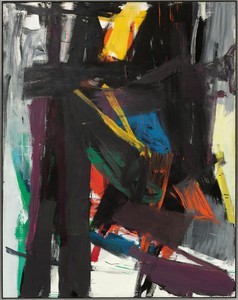
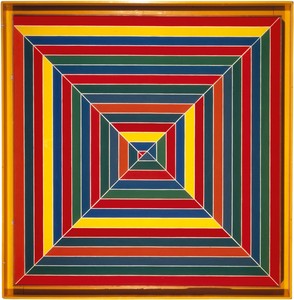
Jazz of that period was referred to in one way or another by painters such as Willem de Kooning, Franz Kline, Norman Lewis, and Frank Stella. The music, the musicians, and the bars they frequented were titled in their paintings and mentioned in interviews and conversation. Kline’s King Oliver (1958) celebrated Joe “King” Oliver, Armstrong’s musical mentor. Stella’s paintings’ titles called attention to jazz records such as Jelly Roll Morton’s “Hyena Stomp” (1927) and Glenn Miller’s “Tuxedo Junction” (1940). De Kooning’s Female Head(The Jazz Singer) (c. 1965) was drawn from one of the nightspots he frequented.
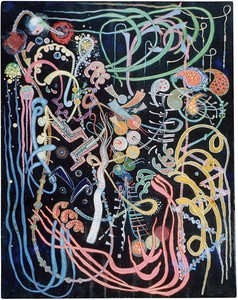
Harry Smith, Manteca, c. 1948–49, 35mm color slide of lost original painting. Photo: courtesy Harry Smith Archives/Estate of Jordan Belson
Anthropologist, filmmaker, and artist Harry Smith painted from bebop recordings, but unlike Dove, he wanted to produce a visual translation of the sound of a recording, what he called a transcription. Every note and chord would be represented by dots, brushstrokes, and other actions on the canvas, with each transcription set in a different form—sometimes a mandala, sometimes a maze—a tedious project that often took him years to do. He was particularly interested in jazz recordings that mixed Latin and jazz rhythms, such as Gillespie’s 1947 “Manteca.” Once a painting was finished, he would “perform” it by playing the record before an audience of a few friends, using a pointer to help them follow the work’s visual correspondence with the sounds. Smith was not so much interested in accurate visual transcription as in animating paintings to see how improvisation would look, a practice similar to that of those jazz musicians who transcribe improvised solos from recordings to see how they work (Manteca, 1948; Dizzy Gillespie’s recording “Algo Bueno,” c. 1952). Smith carried this idea further when he did abstract jazz murals for Jimbo’s Bop City in a Black neighborhood of San Francisco, in 1950, or when he created soundtracks for the animated abstract films he made by painting directly on film stock. Smith influenced a number of West Coast art filmmakers who also used jazz: Jordan Belson, Hy Hirsh, Charles Eames, Patricia Marx, and others.
Jeff Schlanger, a painter who called himself “The Music Witness,” attempted to take into account the difference between a recording and a live jazz performance. He painted performances in real time, starting when the musicians began and stopping when they finished. Painting on large pieces of cardboard, he used colored pens, metallic confetti, and other effects to capture something of the look of the musicians in action, but also to produce an abstraction of what the music sounded like. The painting was done in one take. It was difficult to paint on his lap or on a small table, and he was sometimes thrown out of clubs as a distraction.
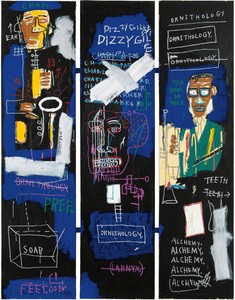
Most painters who reference jazz focus on musicians of their generation, usually running ahead of the public’s awareness of the music. But there are exceptions. When Kline was twenty-three, in 1933, he painted the rather cartoonish monochromatic Jazz Murals series for a roller-skating rink in Lehighton, Pennsylvania, and in 1940 he did Hot Jazz, some figurative murals in color for a Bleecker Street bar. Later, after he had totally converted to abstraction and had become involved with more modern musicians, he was still celebrating older figures such as “King” Oliver, in a 1958 painting. Jean-Michel Basquiat was another: though clearly a painter of his time in his use of social commentary, he drew on the bebop generation thirty years earlier. His works include celebrations of eminent bop musicians, particularly Charlie Parker (Charles the First and CPRKR, both 1982), and Parker and Gillespie (Horn Players, 1983). The paintings are coded with elliptical biographical and musical references—dates, titles, quotes. Some paintings show discographic lists and visual puns, the sort of work done by the most serious fans (Charlie Parker Freeboppers, 1986).
There is no way of knowing how many artists painted while listening to jazz, though some have made a point of making it known: Dove, Mondrian, Wadsworth Jarrell, Norman Lewis, Sam Middleton, Joe Overstreet, Robert Ryman, Bob Thompson, and Stanley Whitney, among others. Jackson Pollock is often thought of as playing jazz records while painting, but actually he only listened to them (“at full volume and by the hour,” Lee Krasner said) when he wasn’t painting.
Musicians as Painters
Painters are not often asked about musical influences, and when they are, the interviewers seldom follow up. But when they do, the answers are usually very revealing. Pollock thought jazz was the only other creative thing that was happening in this country. Belson, when asked about his interest in bebop, said, “It was simply the most radical thing at the time. Dissonance, a curious take on pop music.” “Dissonance” is a word that often came up in discussions of bop—a clashing of notes or chords, something unpleasant to the ear, the dictionaries say, but Belson was celebrating it. Lewis spoke of “beauty in dissonance” in music and art. Monk named one of his compositions “Ugly Beauty.” Sun Ra urged his musicians to “do something right: make a mistake.” It was this willingness to experiment and take risks in the competitive spirit of bop that likely caught the attention of artists.
“I think painting can project the same kind of sense as music, it’s just a different medium. I sometimes listen to music while I’m painting. Modern jazz mostly.”
Robert Ryman
A surprising number of musicians have painted and had their work shown and sold, or at least got them on their own record covers. By my count, at least seventy-five. Some are surprising by the seeming gap between their music and their art—Pee Wee Russell, for one, a clarinetist whose career spanned almost the whole history of jazz in his lifetime, from Bix Beiderbecke to Monk, but whose paintings seem rooted in Davis’s early years. Or Bill Dixon, one of the first free-jazz players of the 1960s, who insisted that there was no necessary relation between his music and his painting. But then musician painters don’t often get asked about their painting by jazz interviewers, either.
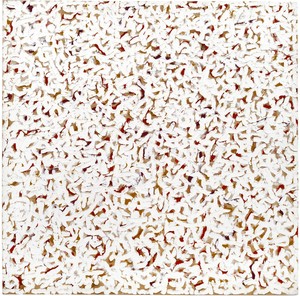
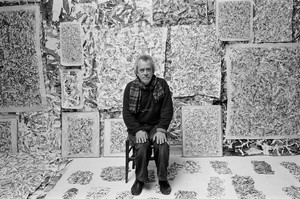
Ryman was an artist who was occasionally asked about his musical background. He was an accomplished saxophonist before he took up painting, and had studied with Lennie Tristano, a pianist who developed his own system of bebop-inspired improvisation. Tristano’s compositions were equivalents of the older forms of jazz that originated through interaction with other musicians in performance, rather than through the solo improvisation favored by bebop players. Ryman is noted for his all-white paintings, and his jazz influence is not easy to see on first glance. But he was always eager to explain what he thought about the relationship between his two vocations:
I wanted to compose; to compose with my instrument, to improvise, to find out all the things you can do with the instrument. In that respect it’s related to painting. What’s important is the composition, the discoveries you make while working. Painting really resembles music in that way. You develop something and then you take the part that interests you. That’s how it happened.
Music is a medium that people are more attuned to, so to speak, than painting. Vocal music, which is more popular, I see as more like representational painting, because it conveys meanings outside the music itself. Instrumental music, which is rather less popular perhaps, is more abstract, but still projects feeling and emotion. I think painting can project the same kind of sense as music, it’s just a different medium. I sometimes listen to music while I’m painting. Modern jazz mostly.
Asked about his one orange painting, Ryman said, “I don’t remember the process. There are probably all kinds of things going on there. It didn’t start off orange, I’m sure.” Pointing to the specks of green showing through and around the sides of the canvas, he said, “That’s important.” It was important because he had painted over an undercoat, intentionally leaving that small corner revealed. He made that point when he talked about what was being called the whiteness of his works: “They’re not white or monochromatic paintings because of the surfaces functioning as a second color in contrast to the white of the paint. It was a matter of making the surface very animated, giving it a lot of movement and activity. This was done not just with the brushwork and the use of quite heavy paint but with color which was subtly creeping up through the white.”
A few of Ryman’s paintings have the titles of Tristano recordings or of those of Tristano’s students. Untitled (Background Music) (c. 1962) is one such. It’s named after a record by the saxophonist Warne Marsh, itself a bebop creation of a new melody layered on an old one, in this case Billie Holiday’s “All of Me” (1941). The background of Ryman’s white painting was not white. There is no deception here, either in Marsh’s recording or in the painting. It’s possible to hear or see what has been done. Nor does appreciation of either the music or the painting depend on knowing what the process was. Such layering was a basic practice of bebop musicians.
Record Covers and Musicians Inspired by Paintings
The development of twelve-inch LPs made possible a new way of selling and seeing music. These records were large enough to allow the sleeve to include information about the music and to display photos or paintings, all in a single package that could be hung on the wall of the record store as in an art gallery. Although the LP was initially intended for “long-playing” classical works—works the length of symphonies—by the 1950s it was standard for pop and jazz LPs. The early classical LPs often had cover art influenced by then-trendy Abstract Expressionism, though usually rather blandly executed. The larger record companies tried a variety of visuals with nonclassical recordings, often a model lounging on a couch listening to a record. Jazz records were a bit more daring, with what were then called progressive jazz musicians such as Dave Brubeck asking to have well-known painters’ works on their covers. The smaller jazz record companies used local, largely unknown artists to create their covers cheaply. Some, like the self-taught painter Richard Slater Jennings (better known as Prophet Jennings), became famous among jazz musicians, if not among the public. The jackets of Eric Dolphy’s Outward Bound (1960) and Out There (1961) are typical of the surreal quality Jennings sought to describe what he heard in the music. Salvador Dalí was one of his favorites, and Dalí himself provided paintings for record covers by Stan Kenton and Jackie Gleason.
Coleman Hawkins, the man who brought the tenor saxophone into jazz, recorded two pieces that are noted as unaccompanied improvisations, something rare for a wind instrument at the time. They were titled Dali and Picasso, and were probably named by his producer, Norman Granz, also a famous collector of modern art.
Perhaps the best-known painting on a jazz record cover is Pollock’s White Light (1954), used as part of the cover design of Ornette Coleman’s Free Jazz: A Collective Improvisation (1961). Pollock had no interest in modern jazz and did not live long enough to hear Coleman’s music, nor was this cover Coleman’s idea. Still, Coleman said that Pollock “was in the same state as I was in—doing what I was doing.” And in his notes to his 1959 recording Change of the Century, he wrote that there was “continuity of expression” between Pollock’s paintings and his music.
Many musicians have made music inspired by paintings or other artworks. Jane Ira Bloom’s Chasing Paint (2002) is music motivated by Pollock. On other recordings she drew on Marc Chagall and Joan Miró. Myra Melford talks about the influence of growing up in a Frank Lloyd Wright house, and also of the sculptures of Miró and the paintings of Cy Twombly; Bobby Previte recorded The 23 Constellations of Joan Miró (2001); Marty Ehrlich’s music and Oliver Jackson’s paintings were developed into a gallery exhibition and a recording in 2003 titled The Long View. Other examples are Branford Marsalis’s Romare Bearden Revealed (2003); Lisle Ellis’s Sucker Punch Requiem: An Homage to Jean-Michel Basquiat (2008); the Matt Kendrick Unit’s Art/Jazz (1994), influenced by various artists; the Swiss Jazz Orchestra and Jim McNeely’s Paul Klee (2006); and Alain Kirili and Thomas Buckner’s Kirili et les Nymphéas: Hommage à Monet (2008). Ted Nash’s Portrait in Seven Shades (2010) was inspired by Chagall, Dalí, Matisse, Pollock, Van Gogh, Claude Monet, and Pablo Picasso. His most recent project is Rauschenberg in Jazz: Nine Details, released in 2023.
There is more to be said about the origins and the nexus at which these different art forms meet, and if we included other forms such as the quilts made by Black women of Gee’s Bend in Alabama, we’d find improvisation, off-beat accents, shifting or staggered rhythm patterns, figure-ground manipulation, all of them coming from the same roots as jazz.
1 Jean Cocteau in Jack Hopper, “Jean Cocteau on Jazz,” DownBeat, January 14, 1964
John Szwed is the author and editor of many books, including biographies of Billie Holiday, Miles Davis, Sun Ra, and Alan Lomax. He has received fellowships from the Guggenheim Foundation and the Rockefeller Foundation, and in 2005 was awarded a Grammy for Doctor Jazz, a book included with the album Jelly Roll Morton: The Complete Library of Congress Recordings by Alan Lomax.