Joshua Chuang unpacks the history behind a selection of Paul McCartney’s photographs that went on view at Gagosian, Beverly Hills, on April 25.
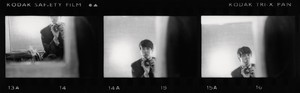
Paul McCartney, Self-portrait in a mirror at the Hotel George V, Paris, January 1964, 2025
Paul McCartney, Self-portrait in a mirror at the Hotel George V, Paris, January 1964, 2025
Joshua Chuang is a director of photography at Gagosian. He was formerly Miriam & Ira D. Wallach Associate Director for Art, Prints, and Photographs and Robert B. Menschel Senior Curator of Photography at the New York Public Library.
Brian Epstein wasn’t sure what to expect as he descended the dark, greasy steps of Liverpool’s Cavern Club in November 1961 to see a young band he’d read about in the pages of Mersey Beat, the city’s own chronicle of its burgeoning music scene. As the proprietor of a music shop near the city center, he’d noted unusual enthusiasm for a Tony Sheridan record issued in Germany and backed by a local group called The Beatles. After learning that they played regular gigs less than 200 yards away, Epstein arranged to attend one of their lunchtime performances. “They were not very tidy and not very clean. . . . They smoked as they played and they ate and talked and pretended to hit each other. They turned their backs on the audience and shouted at them and laughed at private jokes,” he recalled. “But they gave a captivating and honest show and they had very considerable magnetism. . . . I was fascinated by this, to me, new music with its pounding bass beat and its vast engulfing sound.”1
A few weeks later, spurred by a fortuitous mix of restlessness, naivete, and absolute conviction of The Beatles’ potential, Epstein proposed to the band that he manage them, to which they agreed. Although Epstein had no experience whatsoever in talent development, his training in the theater and his entrepreneurial ambition served the scruffy foursome well. To improve the band’s stage presence, he emphasized punctuality and tightly orchestrated, preplanned sets, insisting that their casual behavior and slapstick antics on stage limited their appeal. He commissioned a local wedding photographer to take the group’s first studio portrait, just in time for it to appear underneath a Mersey Beat headline that proclaimed The Beatles the top act of 1961. Epstein also encouraged the band to trade their black leather jackets and slim-fitting jeans, which had become a kind of uniform for them during their months-long residencies in Hamburg’s Reeperbahn district, for a more refined appearance of sweaters and eventually, with some resistance, matching tailored suits. A distinctive aspect of The Beatles’ preprofessional image that was preserved, however, was the mid-length, swept-across-the-forehead hairstyle adopted from German art students who had befriended them in Hamburg.
Epstein’s shrewd management of the band yielded undeniable momentum that built over the course of 1962. In February The Beatles were granted an audition with the BBC, which led to their national radio debut a few weeks later. That same month, Epstein traveled to London to meet EMI label-head George Martin, who, despite being underwhelmed by The Beatles’ demo, was eventually convinced to offer the band their first solo recording contract with his Parlophone imprint. After striking out with virtually every other major label, this was the band’s first big break. In early September, The Beatles (now joined by Ringo Starr, who had been recruited to replace Pete Best, the band’s original drummer) recorded “Love Me Do,” an original Paul McCartney/John Lennon composition that would become the band’s first single, peaking at number 17 on the UK charts. By the end of the year, The Beatles had more than tripled their previous year’s income.
With the final iteration of the Fab Four (a nickname coined in an early press release) now set, The Beatles’ continued ascent paved the way for not only greater creative exploration but also a rebranding of their visual identity—in large part through photography. As their second single, “Please Please Me,” climbed the UK charts, the band recorded its first LP, composed of newly written McCartney/Lennon originals, the bulk of them recorded in a single marathon session at London’s Abbey Road Studios in February 1963. Portraying the band for the album’s cover was a separate creative endeavor: after a few failed attempts (including a photoshoot at the London Zoo), Martin and the group settled on a picture that photographer Angus McBean improvised by lying flat on his back at EMI’s London headquarters and pointing his camera toward an upper-floor landing from which the foursome peered down, smiling. Despite being “done in an almighty rush, like the music,” the picture became instantly iconic, registering each member’s personality while collectively conveying the playful, clean-cut professionalism that Epstein felt was so important to their success.2
Free of guile, the pictures are a revelation—the ultimate insider’s account of one of the most buoyant and significant cultural movements of the past century, acutely observed by one of the story’s central figures.
As the band’s popularity soared, so did demand for memorable pictures of them. Some derived from one-off magazine assignments, such as Fiona Adams’s portrait of The Beatles on a World War II bomb site near Euston Square, commissioned by the teenage-girl magazine Boyfriend and later used for the cover of Twist and Shout, the band’s first EP. “They came outside, and there was this great pit in the ground,” recalled Adams. “I had the idea of getting them to jump. They were wearing Cuban-heeled boots and there was lots of rubble around up there, so it probably wasn’t very safe, but they did it beautifully. Each of them jumped in a different style, as if they’d been practicing.”3 Others came from seasoned professionals such as Dezo Hoffmann and Robert Freeman, both of whom were captivated by the young lads from Liverpool, earned their and Epstein’s trust, and continued to portray them throughout their rise.
On the way to becoming the most photographed figures of their era—so ubiquitous was the presence of photographers in The Beatles’ lives that a giant faux “Beatax” camera was created for one of their sets—John, Paul, Ringo, and George began to cultivate their own interest in photography, each acquiring a 35mm camera at some point between 1963 and early 1964. “Now there was the opportunity to do all this stuff we’d been dreaming of, we could actually take pictures ourselves,” McCartney has said. “Everywhere I went I just took pictures.”4
As much as is already known about The Beatles’ breathtaking rise from regional act to universal superstardom, a unique perspective has emerged in the form of the photographs McCartney recorded with his Asahi Pentax more than six decades ago. Their recent rediscovery adds an indispensable layer to the visual narrative of that time. Free of guile, the pictures are a revelation—the ultimate insider’s account of one of the most buoyant and significant cultural movements of the past century, acutely observed by one of the story’s central figures.
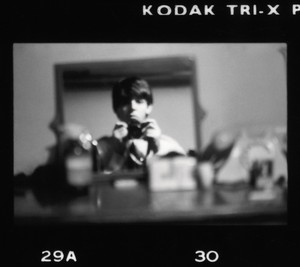
Paul McCartney, Self-portrait in my room at the Asher family home, Wimpole Street, London, December 1963, 2025
In the summer of 1963, The Beatles moved their base of operations from Liverpool to London, initially sharing a three-bedroom flat in Mayfair. Paul McCartney found himself spending more time, however, at 57 Wimpole Street in Marylebone, where his girlfriend Jane Asher, an actress, lived with her parents and two siblings. Filled with interesting guests and domestic warmth, the distinguished six-story Georgian house became McCartney’s home away from home. Eventually Jane’s mother, Margaret, invited Paul to live with them, which he did until the end of 1966. McCartney took this “selfie” with his new Pentax soon after moving into the garret room at the back of the house.
In addition to teaching at the Guildhall School of Music and Drama, Margaret Asher, an accomplished oboist, gave private lessons in a music room in their cellar; one of her former pupils was George Martin, who in 1962 had signed The Beatles to EMI’s Parlophone label. John Lennon would come by the Asher home often to work with McCartney; there they composed many of The Beatles’ hits, among them “I Want to Hold Your Hand.”
One day McCartney awoke in his attic room with a melody lodged in his head. “I fell out of bed and the piano was right there, just to the side. I thought I’d try to work out how it went. I thought it had to be some old standard I’d heard years earlier and had forgotten. . . . And to solidify it in my memory I blocked it out with some dummy words: ‘scrambled eggs, oh my baby how I love your legs. . . . ’” After more than a year of tinkering, McCartney recalls that the lyrics finally came to him on May 27, 1965, during a holiday drive with Asher to southern Portugal: “Yesterday / All my troubles seemed so far away . . . ”
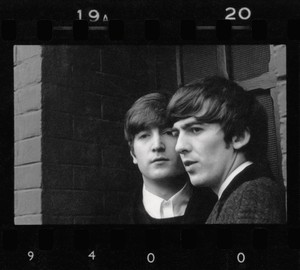
Paul McCartney, John and George during a photo shoot with Dezo Hoffmann, Paris, January 1964, 2025
The Beatles’ time in Paris in early 1964 was a crucial prelude to their international rise. During their three-week residency at the Olympia, the group played to a different kind of audience from the ones they had grown accustomed to, one that skewed older, male, and reserved, rather than the throngs of teenage girls whose screams drowned out their performances. Their initial reviews in the French press were also lukewarm.
Yet the band was seduced by the charm of the city, exploring it between performances and absorbing its culture. Without being mobbed, they could walk in public and go on impromptu photoshoots, including this one staged by their trusted photographer Dezo Hoffmann, whose color picture from the session was eventually made into a poster. In contrast, McCartney’s outtake has a hushed intimacy recalling the cinematic language of French New Wave auteurs such as Jean-Luc Godard and François Truffaut, who shot films on the street with handheld cameras for a more immediate and naturalistic feel.
The Beatles’ fortune in Paris began to turn shortly after news broke on January 17 that “I Want to Hold Your Hand” had reached number 1 on the US Cash Box chart. By the time they arrived in America a few short weeks later, they were poised for the explosive success that for better or worse would help define them.
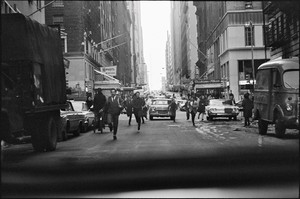
Paul McCartney, Being chased by fans on West 58th Street, New York City, 12 February 1964, 2025
The morning after their first concert in the United States, a raucous affair at the Coliseum in Washington, DC, The Beatles boarded a train back to New York, where they were slated to perform that evening at Carnegie Hall as the first rock act ever to play at the esteemed venue. Their arrival at Penn Station was met with chaos as several thousand fans—many of whom had the day off due to a public holiday—engulfed the concourses searching for their idols. Anticipating this, railroad officials detached the band’s private car and diverted it to an isolated platform, but fans were waiting there also. The Fab Four were ultimately spirited into a taxi on Seventh Avenue, and along the way were transferred to a limousine that took them across the canyons of midtown Manhattan to the Plaza Hotel.
Depicting a handful of people excitedly sprinting after his vehicle in impromptu pursuit—one man appears to sport a waiter’s jacket—the photograph McCartney took through the back window of his car also records a particular moment in time when pop culture and fandom collided in unprecedented ways.
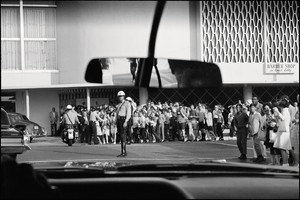
Paul McCartney, Arriving at the Deauville (me in the rearview mirror), Miami Beach, 13 February 1964, 2025
Especially after their appearance on The Ed Sullivan Show on February 9, 1964, The Beatles’ every move was closely tracked by fans, who rushed to various points along the band’s anticipated route. At the Miami International Airport, an estimated crowd of several thousand, alerted by local radio hosts, greeted the band and their entourage as they deplaned. As The Beatles’ convoy left the airport, fans followed in their own cars, some racing alongside to catch a glimpse of the Fab Four as they made their way along the Julia Tuttle Causeway to the beachfront Deauville Hotel.
The Deauville, built in 1957, was designed by Melvin Grossman in a subtropical adaptation of the International Style known as Miami Modern. The resort had previously hosted high-profile figures such as Frank Sinatra, Judy Garland, Sammy Davis Jr., and John F. Kennedy, but The Beatles’ stay and performance in the hotel’s Napoleon Ballroom catapulted it to even greater renown.
Shot through a windshield, McCartney’s photograph of the spectacle that awaited him and his bandmates as they arrived at the Deauville is perhaps his most formally and spatially complex. A horde of mostly teenage fans—their expressions a kaleidoscope of giddiness, adoration, disbelief, and ecstasy, rendered in sharp detail and bathed in late afternoon light—are improbably held in check by a handful of uniformed police officers. Hovering above the scene in the rearview mirror is the shadowy reflection of McCartney himself, coolly observing the unfolding drama with his camera eye.
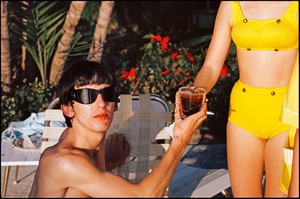
Paul McCartney, George relaxing poolside at the Pollaks’, Miami, 15 February 1964, 2025
On Valentine’s Day, The Beatles’ first full day in Miami, Life magazine had scheduled a photo shoot at the Deauville, where the group was slated to perform live on The Ed Sullivan Show for the second time. But the fans who swarmed the hotel forced a change in plans. Instead, a now iconic black-and-white shot of the four mop-tops bobbing in a frigid pool was staged several miles away at the gated North Bay home of Jerri Kruger Pollak, a former big-band singer; her husband, Paul, a hotel developer; and their four kids. Jerri liked the young lads so much that she gave them an open invitation to drop by again while they were in town.
The next morning they took Mrs. Pollak up on her generous offer and showed up, unannounced, with their entourage. Besides the Pollaks’ maid, who answered the door, the only person home at the time was fifteen-year-old Linda Pollak, who frantically called her mother to ask if she could invite The Beatles in, receiving both permission and advice: “Offer the boys a drink [and] call a few of your friends, but don’t let it get out of hand.” Lunch was ordered, Linda’s brothers returned from the beach, and friends came over for a few unforgettable hours of dancing, basketball, and relaxing by the pool. McCartney’s photographs of the impromptu house party exude the unscripted joy and down-to-earth normalcy the foursome was able to experience during a rare moment away from the public eye during peak Beatlemania.
1 Brian Epstein, A Cellarful of Noise (London: Souvenir Press, 1964), p. 47.
2 See George Martin with William Pearson, With a Little Help from My Friends: The Making of Sgt. Pepper (New York: Little Brown, 1994), p. 121.
Joshua Chuang is a director of photography at Gagosian. He was formerly Miriam & Ira D. Wallach Associate Director for Art, Prints, and Photographs and Robert B. Menschel Senior Curator of Photography at the New York Public Library.