Last December, the world lost the fearless and trailblazing artist and writer Lorraine O’Grady. Working across forms, she challenged conventions, celebrated beauty, and altered the cultural landscape. Here, DK Nnuro considers her work through the lens of translation and transcreation.
DK Nnuro is a writer born in Ghana. He is currently curator of special projects at the Stanley Museum of Art at the University of Iowa and adjunct assistant professor in the English department there. His debut novel, What Napoleon Could Not Do (Riverhead, 2023), was one of Barack Obama’s 2023 Summer Reading List picks.
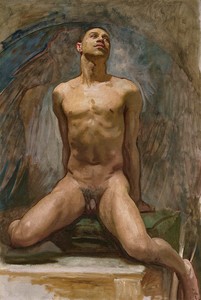
John Singer Sargent, we know, is widely considered the foremost portraitist of late-nineteenth-century America, the period dubbed the Gilded Age. And according to Boston’s Apollo: Thomas McKeller and John Singer Sargent, a 2020 exhibition at the Isabella Stewart Gardner Museum, Boston, this celebrated artist was also responsible for erasing the relevance of a certain Black man to the work of his later years. Here for the first time was an exhibition devoted to that Black man, Thomas Eugene McKeller, as Sargent captured him in nine charcoal drawings and a lithograph, all made between 1916 and 1921. In each, a mid-twenties McKeller, roughly thirty-five years younger than Sargent and his secret paramour, luxuriates homoerotically in muscular nude (hence the Apollo of the exhibition’s title). For his popular murals in the rotunda at the Boston Museum of Fine Arts and subsequent major works, Sargent would also appropriate McKeller’s body, transforming it into the figures of classical gods and goddesses, both male and female but always white, keeping McKeller himself in the shadows. As told by Boston’s Apollo, this erasure was informed by Sargent’s casual racism and internalized homophobia.
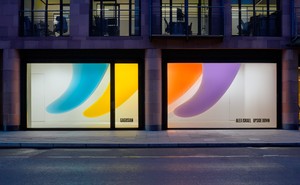
A month before the show, the Gardner launched an installation on its building’s facade: The Strange Taxi, Stretched, an enlargement of an autobiographical photomontage from 1991 by the groundbreaking conceptual artist Lorraine O’Grady. The work features four elegantly dressed Black women—O’Grady’s mother and three maternal and paternal aunts—seemingly rising into the sky from a New England mansion equipped with wheels. In the early twentieth century these women emigrated from Jamaica to Boston, where they worked as maids in homes like this one. In the large-scale 2020 version of The Strange Taxi, the sky is stretched to suggest the limitless possibilities of the women’s postdomestic existence. But all is not redeemed: as they ascend, the wheeled mansion trundles along another Black woman’s back. In this commentary on Black female subjectivity from one of its leading philosophers, both white prosperity and Black prosperity happen on the backs of Black women.
Hybridity puts process on view. Process becomes the essential thing. O’Grady is notorious for reworking her creations and these repeats, with their self-evident alterations, invite us into her process.
These simultaneous Black-themed exhibitions at the Gardner occasioned an essay by O’Grady in the catalogue for the McKeller/Sargent show. At first blush, the title of her text, “Notes on Living a Translated Life,” suggests a piece grounded in her résumé as a translator: a late-’60s tenure at a Chicago-based translation firm, then her own late-’80s founding of another that counted Citibank as a client. Perhaps most impressive is their precedent, the publication of the Chilean writer José Donoso’s novel Este domingo (1966) in O’Grady’s English translation as This Sunday (Knopf, 1967). O’Grady and Donoso, student and instructor respectively, had cultivated a friendship and working relationship after meeting at the Iowa Writers’ Workshop in 1965. O’Grady would complete her translation of the novel within a year. In a letter to Donoso dated December 29, 1966, Knopf editor Angus Cameron outlined his impressions of the manuscript: “let me say that your translator did a very good job. . . . The novel has illuminated that mysterious business of the living of the simultaneous lives of the generation in one family.”1
It turns out that O’Grady’s association with “that mysterious business of the living of simultaneous lives” would hold fifty-four years later: her 2020 catalogue essay concerns the simultaneous lives of Thomas McKeller and Edwin O’Grady, O’Grady’s father, both newly arrived in early-twentieth-century Boston. The “Translated” of the title refers, as O’Grady put it, to “a young Black gay man translating himself from North Carolina to Boston, and a guy who translated himself from Kingston to Boston.”2 This focus on relocation suggests a definition of “translated” in strict mathematical terms: geometry informs us that a figure becomes “translated” when all of its points are moved in the same distance and direction without change to its size, shape, or orientation. We quickly learn, though, that O’Grady is more interested in a translation that involves change, especially the changes to McKeller’s physique after he moves to Boston. “Translated,” then, evolves into “transformation,” an expansion of the word seemingly better aligned with O’Grady’s background as a translator. As the literary critic George Steiner writes in his canonical After Babel: Aspects of Language and Translation (1975), “no language . . . imports without risk of being transformed.”3
Indeed, more significant than Sargent’s recreations of McKeller in Boston, O’Grady insists, was McKeller’s self-orchestrated transformation of his own body. McKeller was in his mid-teens when he moved to Boston, during the Great Migration of the early 1900s. By the time he met Sargent, in the spring of 1916, he was possessed of “a physique which [the artist] perceived would be of artistic value,” in the words of Thomas Fox, the architect who collaborated with Sargent on the museum murals.4 It is this physique that O’Grady studies closely in Sargent’s drawings of McKeller, describing it as “not accidental.”5 “It must have taken relentless work,” she adds, “to make a delicate frame that strong.” (McKeller’s World War I draft card describes him as “short.”)6 In this way McKeller’s transformed physicality recalls some modern gay men’s obsession with achieving perfect bodies, engaging in, as Mark Harris writes, “a calculatedly self-aware physical performance of straight masculinity, with a flourish or two of ironic detailing . . . [that] subverted straight culture by reinventing it as something gay.”7 This is translation that transforms creatively. Unencumbered, it pushes its source material into new conceptual territories.
The academic field of translation studies features a mode it calls “transcreation.” Emerging in the 1950s, the concept is posited to have been developed by the Brazilian concrete poets Haroldo and Augusto de Campos, brothers who pioneered the Brazilian school of literary translation. Others find transcreation’s origins in the scholar and translator Purushottama Lal’s argument that “the translator must edit, reconcile, and transmute.”8 Inherent to transcreation is its accommodation of a more imaginative process than literal translation. How a source material is edited, reconciled, and transmuted is often informed by the translator’s selfhood. This is why, according to Samantha Schnee, translator from Spanish to English and founding editor of the online magazine Words without Borders: The Home for International Literature, “no two translators would ever create the same translation from the same text.”9 The Brazilian-born Bruna Dantas Lobato, who translates Brazilian literature, conveys her singularity in her rejection of translation as “some white person from [Western] culture who goes into another culture and imports these artifacts.”10 As a translator of her own culture, she is able to bring to her English translations an insider’s “flourish,” to use Harris’s word.
The title “Notes on Living a Translated Life” is every bit the equivoque. It states a fact—the essay is about how two Black men remade themselves in early-twentieth-century Boston—but also signals other interpretations. One announces a chief principle of transcreation: translation inherently involves the self. Another returns to our earlier supposition that the text explores O’Grady’s background as a translator. This proves true in spirit and by extension: although O’Grady abandoned the business of translation in the early ’90s because she “didn’t want to live [her] life as a translator,” a sampling of her work as a conceptual artist—a portmanteau of Black female subjectivity expressed through photomontage, performance, collage, video—reveals the inflections of transcreation.11
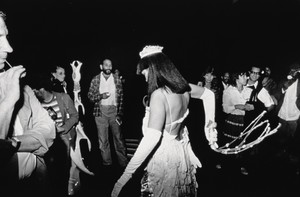
In American culture today, the sociologist Musa al-Gharbi charges, “elites from [non-white] groups are often passed over in silence or are explicitly exempted from critique (and even celebrated!).”12 O’Grady’s debut as a performance artist—in 1980, at the age of forty-five—marked a historic disruption of such celebrations, intent as she was on supplying the criticism al-Gharbi finds absent, delivering it through a theatrical self-presentation that rebuked the Black elite. As the now-iconic persona Mlle Bourgeoise Noire, O’Grady invaded the opening of Outlaw Aesthetics, a June show at Just Above Midtown (or JAM), a New York haven of Black avant-garde expression. “Mlle Bourgeoise Noire”—“Miss Black bourgeoise”—is a nom de plume invoking O’Grady’s own Black-middle-class upbringing and the origins of the persona, which she placed in Cayenne, French Guiana. The character is clearly a beauty queen, wearing an evening gown and cape fashioned from 180 pairs of white dinner gloves and a congratulatory tiara and sash. In place of a scepter, she carries a white whip adorned with chrysanthemums. Transcreation theory pervades this initial offering in O’Grady’s performance-art practice: there is the resonance of the centering of the transcreator’s lived experience—after all, Mlle Bourgeoise Noire embodies O’Grady’s membership among Boston’s Black elites. As well there is O’Grady’s precisely ironic flourish: the flapping white gloves satirize the troubling respectability politics of upwardly mobile Blacks, the whip the twin histories of colonialism and enslavement that have cemented an adherence to a socially acceptable order. This is high camp! The praxis of Black prosperity is reinvented as drag.
O’Grady’s critique at JAM also set its sights on those present: while Mlle Bourgeoise Noire flagellated herself with the whip, she railed against the conformity of the Black artists and Black art around her in the gallery. She enacted her rage through a poem, which opened on a charged note—“That’s enough!”—and ended with a clarion call: “Black art must take more risks!” In another ambience of irony, the same woman who whipped herself and declaimed revolutionary poetry sweetly distributed flowers to the opening’s guests. And applying transcreation in the literal sense of translation, the poem was an adaptation of the Francophone writer Léon-Gontran Damas’s poem “Trêve” (1972), which translates as “Enough.” Damas, fittingly, was originally from Cayenne, French Guiana.
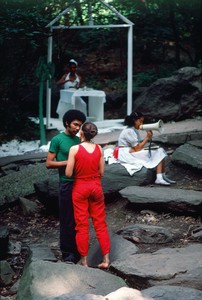
Mlle Bourgeoise Noire repeated her performance a year later at the opening of the exhibition Persona at the New Museum, New York, in September 1981. There, her rage poem had a new ring: “Now is the time for invasion,” this one ended, a clarion call for Black artists to take up space in New York’s lily-white galleries and museums. Mlle Bourgeoise Noire’s theater would continue until 1983, documented through photographs that today enliven museum collections. Alongside these treasures are photographs of another performance, the one-time staging of Rivers, First Draft, in the woods of northern Central Park on August 18, 1982. The “rivers” of the title cite, to a degree, the stream in the site where scenes from O’Grady’s life—she was then forty-seven—played out. Featuring O’Grady and a group of actors, the photographed scenes are exhibited with discrete captions, including “Rivers, First Draft: The stove becomes more and more red,” a surrealist interpretation of a crossroads moment for O’Grady, when she responded to a disagreeable art world with a healthy dose of artistic fury. In “Rivers, First Draft: A Little Girl with Pink Sash memorizes her Latin lesson,” we bear witness to the respectable little Black girl whom Mlle Bourgeoise Noire sought to exorcise: white dress with pink sash—you are not wrong to imagine a Black JonBenét—dutifully memorizing Latin by reciting it through a megaphone. We will never see the before of McKeller’s transcreation; all we will ever know is the after we find in Sargent’s renderings. In the connective tissue of O’Grady’s before/after, though, we can locate some of the satisfaction of robust knowing.
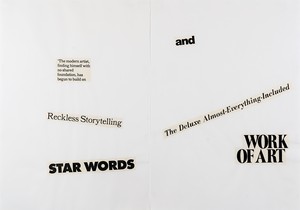
During the Central Park staging of Rivers, the Little Girl also recited a poem pulsing with memory (“back home deep in the woods of Vermont”) and mood (“Isn’t it time you took a vacation?”). One senses a precocious childhood, presaging the newspaper poems O’Grady started to make in 1977, and of course Mlle Bourgeoise Noire’s later recitations. The newspaper-poem practice fruited from a biopsy O’Grady sought mental escape from by reading André Breton, lord of Surrealist theory, who defined Surrealism as “psychic automatism in its pure state.”13 How, O’Grady wondered, might she artistically capture her own memories and moods, and with more conscious control and thought than automatism allows? In response she started to create collages of words cut out from the New York Times, achieving large canvases of leaping, animated texts. The conventional analytical framework for these works buckets them as Dada poems, and indeed O’Grady herself talked of hues of Dada in her work.14 Self-styled Dada “president” Tristan Tzara said of Dada poetry, “The poem will resemble you,” and the resemblances here are reflections of O’Grady’s own moods and memories.15 Also, the newspaper poems vividly exhibit the features of concrete poetry, which the Campos brothers developed in Brazil under the taxonomy of transcreation. In the poems’ inventive arrangement of language, one finds meaning. Call it word art, if you must.
Before/after is itself a kind of concrete poem in its illustrative diptychness, and O’Grady in fact favors the diptych as a creative format. The Clearing: or Cortés and La Malinche, Thomas Jefferson and Sally Hemings, N. and Me (1991/2019), for instance, is a pair of collocated black-and-white fêtes galantes elucidating, through title and image, the inescapable perniciousness of romances between white men and Black women. The left-hand photomontage (another favored format, as in Strange Taxi) shows two obviously biracial siblings frolicking, their Black mother and white father hovering in the air above them in the throes of lovemaking, a gun lying casually on the grass. Perhaps the gun’s meaning is to be found in the right panel, where the children have disappeared; the lovemakers now lie on the grass, and—possibly the now-vanished gun’s association—the white man has become a living corpse.
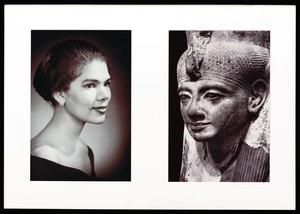
Perhaps the most famous diptychs appear in the series Miscegenated Family Album (1980/94)—note the word “miscegenated,” the interracial subject a thematic preoccupation of O’Grady’s that she roundly classified as “hybridity.” She herself was a hodgepodge of ancestries, legacies of Blackness and whiteness. Miscegenated Family Album, which she called a “novel in space,” includes sixteen diptychs; most show on one side various family members—O’Grady’s older sister, Devonia, and niece, Candace, for example—and on the other the ancient Egyptian queen Nefertiti and family, summoning a purported Egyptian lineage. One diptych offers a more direct before/after of O’Grady (better the horse’s mouth than this critic’s appetite for connections): in Sisters IV (L: Devonia’s sister, Lorraine, R: Nefertiti’s sister, Mutnedjmet), a youthful O’Grady on the left faces an Egyptian princess on the right. The resemblance between the two is uncanny, which is the point. This depiction sports irony: typically, the left-hand panel would boast a “before” (circa ancient Egypt), the right-hand one an “after” (circa the young O’Grady). This is the temporal flow of most of the series’ diptychs, but not this one. Underlying this overt centering of the transcreator is attendant flourish.
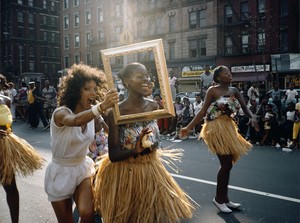
Writing in Babel, a scholarly journal for translators, Oliver Carreira describes transcreation as “a form of hybridization of different existing creative practices.”16 The transcreator’s output, then, is a fundamentally hybridized thing; so how natural that hybridity is a trademark of O’Grady’s. One feature of hybridity: it outs its parts, outs itself as a constructed being. Consider how a person of mixed ancestry betrays the unlike parts that have made them whole; and the counterpoint that is the phenomenon of passing, literature especially tells us, was often made possible by the onlooker’s choice to ignore the nagging signs. Therefore hybridity puts process on view. Process becomes the essential thing. O’Grady is notorious for reworking her creations—again, recall Strange Taxi—and these repeats, with their self-evident alterations, invite us into her process. The diptychs and photomontages do the same thing: What but a matter of process is the experience of their union of synecdoches? Doubtless that the most famous of these invitations, indeed more overt than the others, is 1983’s Art Is . . . During that year’s African American Day Parade in Harlem, O’Grady and friends appeared on an unauthorized float flourishing a large gold picture frame. Soon, her co-conspirators started working the crowd with smaller frames, into which paradegoers stuck their heads, instantly becoming art. The message? “Art Is . . . whatever you make it.” It is an assertion of multivalence echoing the transcreator’s creed: translation inherently involves the self.
1 Angus Cameron, letter to José Donoso, December 29, 1966. MsC 340, Box 5, José Donoso Papers, 1951–1967, The University of Iowa Libraries.
2 Lorraine O’Grady, in Malik Gaines and O’Grady, “Lorraine O’Grady Is Making Deep Cuts,” Frieze 218 (April 2021). Available online at www.frieze.com/article/lorraine-ogrady-interview-2021 (accessed December 26, 2024).
3 George Steiner, “The Hermeneutic Motion,” in Steiner, After Babel: Aspects of Language and Translation (London, Oxford, and New York: Oxford University Press, 1975), p. 299. Quoted here from Lawrence Venuti, ed., The Translation Studies Reader (London and New York: Routledge, 2000), p. 188.
4 Thomas A. Fox, quoted in Paul Silver, “Atlas, with the World on His Shoulders, This Was My Body: Thomas E. McKeller and His Work with John Singer Sargent,” in Nathaniel Silver, ed., Boston’s Apollo: Thomas McKeller and John Singer Sargent, exh. cat. (Boston: Isabella Stewart Gardner Museum, 2020), p. 43.
5 O’Grady, “Notes on Living a Translated Life,” in Nathaniel Silver, ed., Boston’s Apollo, 88. Repr. in and quoted here from Hyperallergic. October 11, 2020. Available online at https://hyperallergic.com/589872/notes-on-living-a-translated-life/ (accessed December 26, 2024).
6 O’Grady, “Notes on Living a Translated Life,” in ibid.
12 Musa al-Gharbi, We Have Never Been Woke: The Cultural Contradictions of a New Elite (Princeton: Princeton University Press, 2024), p. 16.
13 André Breton, “Manifesto of Surrealism,” 1924, in Breton, Manifestoes of Surrealism, trans. Richard Seaver and Helen R. Lane (Ann Arbor: University of Michigan Press, 1969), p. 26.
16 Oliver Carreira, “Is Transcreation a Service or a Strategy? A Social Study into the Perceptions of Language Professionals,” Babel 68, no. 4 (2022): p. 501.
DK Nnuro is a writer born in Ghana. He is currently curator of special projects at the Stanley Museum of Art at the University of Iowa and adjunct assistant professor in the English department there. His debut novel, What Napoleon Could Not Do (Riverhead, 2023), was one of Barack Obama’s 2023 Summer Reading List picks.