Gavin Morrison grapples with the architect Berthold Lubetkin’s biography, inspiration, and legacy.
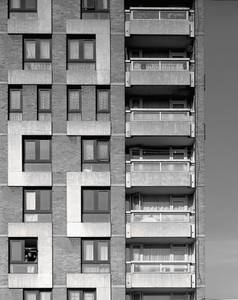
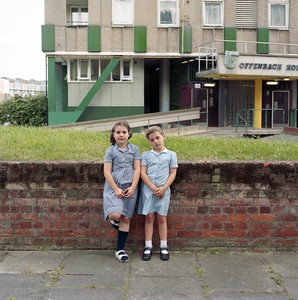
Sivill House, Columbia Road, Bethnal Green, London: detail of the main facade to Columbia Road, 2002, designed by Skinner Bailey & Lubetkin in 1962. Photo: Morley von Sternberg/RIBA Collections
Sivill House, Columbia Road, Bethnal Green, London: detail of the main facade to Columbia Road, 2002, designed by Skinner Bailey & Lubetkin in 1962. Photo: Morley von Sternberg/RIBA Collections
Gavin Morrison is a Scottish writer and curator currently living in Dallas. He is presently writing a book on Donald Judd’s relationship with Iceland for Lars Müller Publishers, Zürich.
In the latter years of his life, the architect Berthold Lubetkin (1901–1990) started to write notes toward a possible memoir. Often a compilation of disjointed but lyrical anecdotes, the manuscript unsurprisingly never reached a publishable form, but Lubetkin did find a fitting title for this book that never was: Samizdat by Anarchitect. Within these recollections are several passages that describe the influence that his childhood in Tbilisi—called Tiflis at the time—had on his architectural thought. The writing of Samizdat took place in England and nearly eighty years after he would last have seen the Georgian capital. The distance was not only geographic but also the effect of war, revolution, and regime change. Lubetkin was an exile, and the only one who could write his history.
As the narrator of his own story he was unreliable, and intentionally so. These biographical doubts would be of mere anecdotal interest were it not for Lubetkin’s use of elements within his work that appear to reference his history. His commitment to moral ambiguity creates a more unsettling uncertainty. He claimed to have been born in Tiflis in 1901, but his British passport lists his birth as two years later and places it in Warsaw, Poland. This was a fiction, he claimed, created to avoid any suggestion that he had fought in the Red Army. The uncertainty of the most elemental biographical facts of Lubetkin’s life would lead his youngest daughter, Louise Kehoe, to publish—a few years after his death—a memoir, In This Dark House. It is an account of a tumultuous childhood due to her father’s belligerence, a character trait that she felt could be attributed to his past. The book documents Kehoe’s attempts to discover the truth, and the reasons for his distortions about his history. Even here, though, in a document purporting to dispel doubt and uncover the facts behind a difficult family history, there is a caveat. A statement prefaces the text: “This book represents the truth as I see it, but because of the sheer complexity of the story it has been necessary to introduce occasional elements of fiction.” It is an awkward concession for a book that seeks to be a corrective to the deceptive biography her father told, but one that is perhaps unavoidable and is also consistent with family patterns: Lubetkin recounted his own father’s proclamation, “I am not a fanatical worshipper of truth or of conventional morals; morality is a matter of individual conscience.” Lubetkin’s mentioning of his father’s relativistic beliefs is perhaps a conspicuous signal of his support for them.
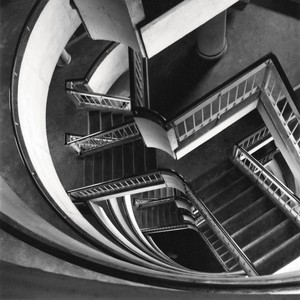
Lubetkin would design complex staircases as social and spatial condensers . . . they could resemble parts of a machine, and would create spaces for impromptu social interaction among the building’s inhabitants.
Berthold Lubetkin was, probably, born in Tiflis, Georgia, in 1901. The city straddles the Mtkvari River and is near the historical Silk Road, and this, combined with being closer to Baghdad than to Moscow, affords it a notable Persian influence. It was annexed by the Russian Empire in the 1800s. Following the Russian Revolution in 1917, a short-lived period of independence was ended in 1921, when the Red Army invaded. Lubetkin described his birthplace as “the back of beyond” and said that “the big question being debated at the time was whether we should welcome the rising tide of Western influence.” Lubetkin went west and in 1931 arrived in London, where he quickly established an architectural practice, Tecton, that responded to Britain’s housing boom and nascent welfare state. Lubetkin was the elder figurehead of a group otherwise composed of idealistic young architects who were committed to collaborative thinking and shared authorship.1 Though the practice only existed until 1938, Tecton was instrumental in the development of modernist architecture in Britain, with Lubetkin providing quotable ideological rhetoric such as “Nothing is too good for ordinary people.”
Lubetkin’s journey from Tiflis to London was a peripatetic one. His family left the city of his birth when he was a child and moved to the Russian city of Rostov-on-Don, close to the eastern border of Ukraine, for a year. He would then go on to study at Svomas, Petrograd, in 1919 and at Vkhutemas, Moscow, from 1920 to 1922. An opportunity to accompany an exhibition of Russian art to Berlin allowed him to attend the city’s Höhere Fachschule für Textil und Bekleidungsindustrie, and from there he went to Vienna to study collections of carpets, including the Royal Collection at the Hofburg Imperial Palace. In 1923 he entered the architectural school at the Politechnika Warszawska in Warsaw, Poland, and after graduating in 1925 he moved to Paris and the following year enrolled in the École spéciale d’architecture. He would remain in Paris until moving to London.
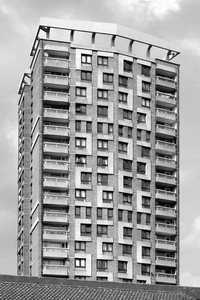
Sivill House, Columbia Road, Bethnal Green, London, 2009, designed by Skinner Bailey & Lubetkin in 1962. Photo: David Borland/RIBA Collections
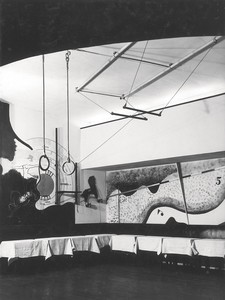
Club Trapèze Volant, at the corner of the rue de Volontaires and rue de Vaugirard, Paris, 1928, designed by Berthold Lubetkin and Bob Rodionov in 1928. Photo: RIBA Collections
It was in Paris that Lubetkin’s architectural thinking started to take material form. In 1927 he designed the interior of the Club Trapèze Volant, a circus-themed nightclub that utilized gymnastic apparatus and would become popular with Jean Cocteau’s Left Bank milieu. More substantially he designed an apartment building, with Jean Ginsberg, on the avenue de Versailles. The building was in the International Style, with obvious idiomatic borrowings from Le Corbusier.
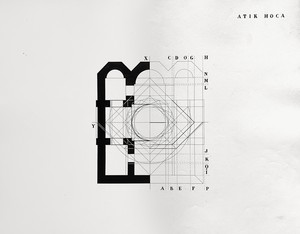
In Paris Lubetkin was a member of an extensive émigré population that developed there during the interwar years. Many of these were artists, writers, and other creative individuals seeking an environment of freedom and safety. The group included Ilia Zdanevich, a writer, artist, designer, and publisher born, like Lubetkin, in Tiflis but a few years older. Although there is no record that they met, their biographies closely mirror each other. Zdanevich (who went by Iliazd, a contraction of his names) had studied in Saint Petersburg. There, in 1912, he gave Russia’s first lecture on Futurism, and he later met Filippo Tommaso Marinetti during the writer’s visit to Moscow in 1914. On his return to Tiflis in 1918 he established 41°, an avant-garde publishing initiative for which he developed a distinctive Constructivist typographic style. For Zdanevich the page was a territory where letters and words became material and form. There is an obvious continuity between architecture and these experiments in typesetting. It is not surprising, then, that Zdanevich had a considerable interest in the ancient Georgian churches of Georgia, northern Turkey, and Armenia. He began an extensive study of these structures and created drawings depicting their ground plans and presenting the spatial relationships that govern their design; the drawings describe a hidden logic, a similar one that he used to determine the arrangements of his typography. In 1920 Zdanevich left Georgia for Constantinople, where he spent a year waiting for a French visa and making studies of Byzantine churches. In 1930 he would write a fictional autobiographical account of his time in Constantinople in the form of the novel, PhiloSophia; the text rewrites his history and invents a Bolshevik revolutionary centered on the city’s Grand Mosque Hagia Sophia. In 1921 Zdanevich moved to Paris, which gave him an expanded avant-garde community. It included the Dadaist Tristan Tzara, a Romanian exile; the two collaborated often, with Zdanevich designing a notable announcement for Tzara’s infamous 1923 event Soirée du coeur à barbe (Soirée of the bearded heart).
Both Zdanevich and Lubetkin considered their early lives in Tiflis formative for their mature work through something like a metaphysical destiny. Here Lubetkin describes sitting with a young friend by an ornamental pool in Tiflis:
The sparkling pool was lined to the brim with a tangled undergrowth of submerged ornamentation, each tile asserting the endless threads of Islamic texts and Koranic quotations that knit into a coherent whole. . . . I do believe that this occasion was the beginning of a realization that the forces contained in images are but a translation of current beliefs and commitments. . . . All was solved for me. It remained only to grow up.
This can be compared to Zdanevich’s recollection of an instance from his own childhood:
At night, my mother put my hair into curls with strips of paper that were taken, page by page, from the gradually diminishing library of my grandfather. Pushkin, Griboyedov, Gogol all disappeared bit by bit. I spent the night with these books hanging around my head, and sure enough, little by little, I became a poet.
The material objects that these men encountered in childhood contained and transmitted a cultural force. Of course such post hoc explanations come easily, but the idea of objects possessing embedded meaning would recur in Lubetkin’s work.
Once in London, Lubetkin would initially continue to work in the International Style manner he had developed in Paris. Not long after his arrival in Britain, however, in his work with Tecton, he would begin to design housing projects in London (although the completion of many of these was delayed until after World War II). Lubetkin sought to mitigate the deadening social effects of the monolithic slabs in which the requirements for such high-occupancy buildings often resulted. His approach was to develop what he termed the “spatial vector,” a strategy to break up the imposing monotony. Environmental landscaping was a principal element, but so too was the design of the facades of the buildings. For this latter aspect Lubetkin referred back to his childhood in Tiflis, and the local traditions of carpet and kilim design. He understood that their design was not arbitrary but articulated an intricate relationship with the culture that gave rise to them. Lubetkin deployed this principle by creating facades that directly reference carpet designs through the rhythmic patterns of fenestration, walkways, and balconies. The approach is used in the Priory Green Estate in Islington, London, which he designed in the 1930s (although the first phase of construction was not completed until 1947), but he continued to use the device throughout his career. It is evident in the facade for Sivill House in Bethnal Green, London, a tower block on which he collaborated with former Tecton members Francis Skinner and Douglas Bailey. Completed in 1962, the facade used a stylized version of the design from the Caucus dragon carpet. Its curious lyricism speaks not merely of the design it appropriates but of Lubetkin’s specific history, yet this reference would be all but unknown to most of those who encounter the building.
As can be seen from Lubetkin’s route from Tiflis to London, there is evidence in the cities he visited of his abiding inquisitiveness about textiles: he traveled to Vienna to study the carpets in the Royal Collection and attended the Höhere Fachschule für Textil und Bekleidungsindustrie in Berlin. Carpet production would also serve him as a metaphoric means to understand the practice of architecture: he would compare the weft and warp of weaving with the layering of building elements that in concert creates strength. In a drawing for Cranbrook Estate, a project of 1955–66, also in Bethnal Green, the placement of the housing blocks is explained through analogy to a carpet. The dynamism of the site plan evolves from an understanding of the structure of carpet design.
Flats in Holford Square, Finsbury, London: the central spiral staircase of Bevin Court, 1954, designed by Skinner Bailey & Lubetkin in 1954. Photo: John McCann/RIBA Collections
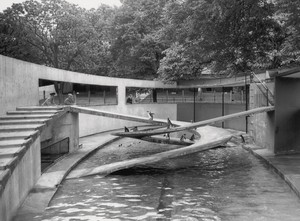
The Penguin Pool at London Zoo, Regent’s Park, 1954, designed by Berthold Lubetkin in 1934. Photo: Topical Press Agency/Hulton Archive/Getty Images
In Cranbrook we also see a recurrent echo that can be traced back to Lubetkin’s studies in Petrograd and Moscow, where he was exposed to the Constructivist thinking of Alexander Rodchenko and Vladimir Tatlin. Lubetkin would design complex staircases as social and spatial condensers; pragmatic elements of architecture written in the language of Constructivist sculpture, they could resemble parts of a machine, and would create spaces for impromptu social interaction among the building’s inhabitants. At Cranbrook the staircase is not as complex as earlier examples in the social-housing developments of Bevin Court (1954) and the Dorset Estate (1951–57), but Cranbrook’s staircases do demonstrate an intention to create a spatial flow through shared space. The Constructivist qualities of Lubetkin’s approach, though, may be most evident in his design for the London Zoo (1934). Here he worked closely with the Danish engineer Ove Arup, another recent arrival in London, to realize the complex forms he envisaged. The buildings were less “machines for living” and more tools for viewing. The Penguin Pool in particular was a Constructivist music box populated by a diminutive Busby Berkeley chorus line, perpetually ascending and descending its intertwined ramps. There was no attempt to simulate the natural environment of the penguins, no fiction of icebergs cast in concrete. If the building alluded to anything, it was an abstraction of the machine age, wrought in a Euclidean absolutism of line, mass, and void.
In 1933, Lubetkin began the design of a housing block, Highpoint I, in Highgate, London. The building was commissioned by Sigmund Gestetner, owner of a family business producing an early form of office copying machine; Gestetner initially intended the building for the housing of his company’s workers. When Le Corbusier visited the project after its completion, he commended it as architecture “of the first rank.” (The debt the design owes to him is obvious.) This white monolith on a hill appears as rational as it is elegant. The building provided its occupants with the conveniences and utilities promised by modern living: well-ventilated homes, roof terrace, laundry chutes, communal café, and so on. Following its success, a second, smaller development was planned on an adjacent site. Highpoint II, as it would be called, completed in 1938, was generally in keeping with its neighbor, but a theoretical shift can be detected between the two buildings. Lubetkin’s commitment to the tenets of Le Corbusier’s version of modernism were waning, to be replaced by a distinctive approach that evolved from the idiosyncrasies of personality and history.
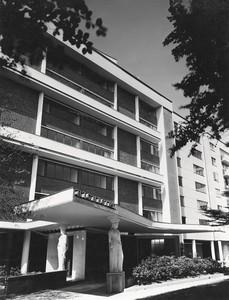
Highpoint II, North Hill, Highgate, London: the porte cochere and entrance facade, 1938, designed by Lubetkin & Tecton in 1938. Photo: John Maltby/RIBA Collections
This is explicit in the presence of two caryatids that uphold the canopy at the entrance to Highpoint II. Their presence was seen as a direct affront to the evangelical modernists and an almost baroque inclusion, performing a function, yet one that could have been undertaken with a far more prosaic form. A bemused but accommodating curator of antiquities at the British Museum supplied Lubetkin with molds taken from casts of the Erechtheion caryatids. Lubetkin’s provocation operated in two directions: not only were the modernists aghast but so too were the traditionalists, who saw the inclusion of the caryatids as so out of context as to be read as a joke at their expense. In its reference to a historical and architectural lineage, the gesture could be seen as a postmodernist precursor, but one disrupted and set apart. Meanwhile, however, a more personal narrative also underlies their inclusion: while Lubetkin was studying in Warsaw, his gaze would often fall upon a balcony that had a pair of smiling caryatids. He recalled these with great affection. We can read Lubetkin’s caryatids in London as an analogue to those he left behind, as not merely generic historical objects but objects from a personal history.
In 1947, after the war, Lubetkin and his wife, Margaret Church, visited Poland and made a point of visiting the street where he used to live. He recalls that it was mostly destroyed apart from one gable wall, but adjoined to that wall was a section of the balcony and there the caryatids still stood, still smiling. In his Samizdat by Anarchitect he describes the scene:
In this lunar landscape the only vertical fixture was part of the elevation of the very house in which I lived when I was studying at the Architectural Faculty. There was the familiar entrance above the workshop, and on the very top the same balcony where I used to study geometry, under a large cornice supported by two caryatids. How well I remember their timeless smiles, that serene confidence in permanence and continuity. They were still dreaming dreams of eternity when the demolition brigades started to batter at the remainder of the ruin.
Lubetkin’s use of biography, words, narrative, and truth becomes more revealing and more opaque.
Do the caryatids at Highpoint II represent for Lubetkin those notions of “permanence and continuity”? Were they totems standing as emblems of cultural persistence, and of humanity’s need to be attentive to the past while creating anew? Lubetkin’s use of biography, words, narrative, and truth becomes more revealing and more opaque. It leaves the narrative between his buildings and his biography somewhat uncertain. Reflecting long after the halcyon days of their collaborations, Arup recalled that Lubetkin “often told me himself, that he is not interested in truth as such; for him any statement, spoken or written, is just propaganda to further an aim which is considered to be of overriding importance for mankind. This is of course the normal communist attitude, which I know only too well having clashed with it on numerous occasions.” This criticism suggests that Lubetkin was ambivalent about truth, but that that ambivalence let him avail himself of a certain pragmatism.
The possibility resonates with Kehoe’s conclusions from In This Dark House. She grew up with a man she did not know. His history and past were shrouded in uncertainty, but perhaps his obfuscation through fiction was a pragmatic means for survival. He came from a Jewish family; in their later life his parents ran a jewelry store in Warsaw until the Nazis arrived. His leaning toward biographical ambiguity may be traceable to the erasure of his personal history during the war, and his escape from a past to which he couldn’t return. Lubetkin was an exile. It is a paradox that the architecture of modernism, with which he is closely aligned, often uses a rhetoric that appeals to notions of truth and honesty: truth to materials, to social program, and to functional intent. It was a form of experiment where words were built into buildings. Berthold Lubetkin went further: history and biography, fact and fiction, are also the material of architecture.
1 The original members of Tecton were Anthony Chitty, Lindsay Drake, Michael Dugdale, Val Harding, Berthold Lubetkin, Godfrey Samuel, and Francis Skinner. Denys Lasdun joined in 1937.
Gavin Morrison is a Scottish writer and curator currently living in Dallas. He is presently writing a book on Donald Judd’s relationship with Iceland for Lars Müller Publishers, Zürich.