A major retrospective of the work of the Colombian fiber artist Olga de Amaral has landed in Miami by way of Paris. Presented in collaboration with the Fondation Cartier pour l’art contemporain, this career-spanning exhibition will be on view at the Institute of Contemporary Art, Miami, through the fall of 2025. Here, Ekaterina Juskowski delves into the six decades of Amaral’s life, work, and inspirations.
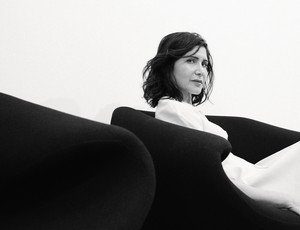
Olga de Amaral, Casa Amaral, Bogotá, 2024. Photo: courtesy the artist
Olga de Amaral, Casa Amaral, Bogotá, 2024. Photo: courtesy the artist
Ekaterina Juskowski is an interdisciplinary curator, researcher, and photographer. Her practice brings together a range of topics from art history, social justice, gender, cultural heritage, and AI technologies. She is the founder of the art residency at the Old Carpet Factory, on the island of Hydra, Greece, and the author of the book The Warp of Time (2024). Photo: Zain Shah
Few forces shape the imagination of many artists more profoundly than nature. For Olga de Amaral, now ninety-three, lauded as a pioneer of fiber art and an enduring voice in postwar Latin American abstraction, the landscapes of her homeland have been a lifelong inspiration. She was born in Bogotá and raised in a family with strong ties to the countryside. Immersed in nature, her vivid imagination was impressed by Colombia’s majestic towering mountains, serene sweltering valleys, and the vast tropical plains of the llanos. Some of her most precious memories are of market days with her mother, where, as a young girl, she first encountered Andean fabrics, blankets, and ruanas handwoven and dyed by local women using pre-Columbian techniques. Decades later, in a lecture at New York’s Metropolitan Museum of Art, Amaral reminisced with quiet reverence about the Colombia of her youth. She described it as a land of extraordinary natural beauty and inhabited by warm, solemn, dignified people, a place she poignantly referred to as the “lost country.”
Memory and place are at the heart of everything Amaral creates. With her signature gift for weaving meaning into fiber, she creates at the intersection of modernism and tradition. Deeply engaged with Colombia’s ancestral textile practices, her sophisticated abstract works simultaneously challenge the limits of modernist art. Her masterful touch transforms simple materials such as cotton, linen, horsehair, gesso, rice paper, and gold leaf into elaborate threads that become a metaphoric representation of her country’s landscapes.
This year, a landmark retrospective at the Institute of Contemporary Art, Miami (ICA Miami), presented in collaboration with the Fondation Cartier pour l’art contemporain, Paris, honors Amaral’s remarkable career. Tracing the evolution of her practice over six decades, the exhibition illuminates the ways in which she transcends canonical artistic categorizations. It offers a unique opportunity to experience Amaral’s work at the nexus of art, design, craft, architecture, history, and cultural identity. Following the exhibition’s acclaimed debut in Paris, curators Marie Perennès and Stephanie Seidel have thoughtfully anchored the exhibition within Miami’s cultural pulse, while the architect Lina Ghotmeh, who orchestrated the spatial experience, beautifully reimagined it for the new setting.
For Perennès, the exhibition represents a long and deeply personal journey. Having collaborated closely with Amaral and her family for three years, she offers both an intellectual and an intimate understanding of the artist’s work, situating it within a broader historical arc of the transformation of tapestry from the realms of decorative, domestic, and female craft into an artistic, architectural, and technological force that has reshaped previously male-dominated fields. “The transition to the space-oriented approach that Amaral and her peers were leading at the time was revolutionary,” explains Perennès, referring to the pivotal shift of the 1960s when artists such as Amaral, Magdalena Abakanowicz, Sheila Hicks, Elsi Giauque, and other contemporaries boldly liberated fiber from the confines of utility and ornament. These pioneering women claimed space with their work, threading volume, architecture, and movement into a practice that inevitably transcended the fiber medium. Their creations became immersive environments.
Initially drawn to the allure of architecture, Amaral learned that obtaining a degree required a seven-year commitment. In a conversation with the poet Piedad Bonnett, she admitted that she wasn’t willing to give this much of her “living” (“7 años de vivir”) to studying. Instead, Amaral pursued architectural drafting at the Colegio Mayor de Cundinamarca in Bogotá. Having studied drawing, color theory, mathematics, and the theory and history of architecture, working closely with architecture professionals, she graduated restless, uninspired, and uncertain about her next steps. She was thinking of broader artistic possibilities when a friend recommended the Cranbrook Academy of Art, outside Detroit—an institution offering courses in textiles, ceramics, jewelry, and architecture. In 1954 she was admitted to Cranbrook, leaving Colombia amid the escalating social unrest of La Violencia, the country’s ten-year civil war of the late 1940s and ’50s.
At the time, Cranbrook was an unlikely place for a young Colombian student. Originally conceived as an experimental artists’ colony, it rapidly evolved into a creative hub and became an incubator of American midcentury modernism. The founders, passionate about the ideals of the Arts and Crafts Movement, rejected mass production and factory-made goods in favor of culturally significant artifacts. Craftsmanship was central to the school’s academic practice and was championed as a force for change. The eighty graduate students were free to design their study paths, and Amaral joined the weaving program. Serendipitously, that was the only department accepting students without a graduate degree.
In the textile workshop at Cranbrook, Amaral didn’t simply learn how to weave. Naturally interested in the logic of numbers, she discovered in weaving the original binary system—the pattern language, thousands of years old, that ultimately laid the groundwork for the logic of computation. The mathematical structure of weaving allowed Amaral to speak the language of color, its gradients and densities, with tactile eloquence.
Olga de Amaral, Entorno Quieto 2, 1992, wool and horsehair, 86 ⅝ × 84 ⅝ (220 × 215 cm)
At the loom, the color that Amaral loved so much ceased to be mere pigment; it became a living force, something she could feel with her hands, something imbued with what she calls “the certainty of color.” The word “text” shares its origins with the word “textile,” both stemming from the Latin textere, meaning “to weave.” In this respect, it’s not surprising that weaving is often compared to storytelling. For the first time, Amaral began to weave meaning into hue, or, as she puts it, “to speak in color.”
At the same time, in Amaral’s hands, fiber turned into the vocabulary of nature. For her, each strand carries the imprint of its origin. Cotton, she muses, is “spongy and yielding”; linen, “thin, clean and hard as a line, textureless and pure”—until, together, they create something “claylike,” a substance malleable in its resistance, shaped into woven fragments that become sentences, textiles that compose landscapes of memory, of emotion, of meaning. The warp and weft of her work capture the essence of place and feeling: the shadowy cliffs of Riscos en Sombra (Shadow cliffs, 1985), the hush of Entorno Quieto 2 (Quiet environment 2, 1992), the luminescent purity of Luz Blanco (White light, 1969), the dappled depth of Bosques (Forests, 1998).
Amaral’s lifetime devotion to her craft has yielded a staggering legacy of 1,500 works, each articulating her singular language of fiber, texture, and color. From this vast body, the curators’ collaboration has distilled fifty pieces for the ICA Miami exhibition, including private loans from local collections. During the selection process, Seidel approached Amaral’s work as a conversation between art and environment to deepen the viewer’s understanding of her boundary-defying practice. “Olga de Amaral’s bold and cutting-edge practice transcends and transforms the possibilities of textiles through innovative scales and alternative materials that defy categorization,” she explains.
Ghotmeh designed the exhibition spaces for the retrospective in both Paris and Miami. Her approach—which she calls the “archaeology of the future”—draws inspiration from the memory of spaces rooted in surrounding natural environments. For the exhibition in ICA Miami, Ghotmeh responded to Miami’s vivid light and the cityscape’s vertical linearity. She applied the concept of permeability to connect the gallery on the third floor with the living, breathing world below. Through the visual illusion of reflective “lake” surfaces inside the galleries, Ghotmeh created a sense of porosity that allows the landscape outside the window to extend into the rooms.
Traced chronologically, Amaral’s work presents a dynamic narrative of the evolution of her ever deepening mastery of weaving techniques, her daring material experimentation, and her unrelenting expansion of scale. Ghotmeh proposes an alternative mode of engagement, placing Amaral’s work in a spatial progression that travels with the light from the window to the back of the open room. The works are suspended on vertical poles that mimic the structure of vertical looms. In this abstract forest of poles, one passes through a range of creations: small sketches in thread; a scaled-up sculptural knot (Nudo 24, 2015); monumental works such as Gran Muro (Great wall), created in 1976 for the lobby of the Peachtree Plaza Hotel, Atlanta; and the Alquimias (Alchemies, 1983–), equally fascinating on both the front and the reverse side.
The centerpiece of the exhibition, and perhaps the pinnacle of Amaral’s career, lies in two striking series, Brumas (Mists, 2013–) and Estelas (Stelae, 1996–), located at opposite ends of a room. The Brumas, ethereal and fleeting, are placed closest to the window, dissolving into light, while the Estelas anchor the space from the back, commanding presences with shimmering solidity. Mists and stones, they inhabit contrasting realms of perception. The intricate Brumas cascade from the ceiling, hanging vertically from a wooden frame, a colorful drizzle caught mid-flight. They are made of countless cotton threads, coated in gesso and painted in acrylic with geometric patterns, transforming them into diaphanous three-dimensional compositions that exist in a liminal state—neither fully defined nor entirely formless. The Brumas linger in the air, their layered textures swaying and shifting as the viewer moves around them.
Stelae have long served as anchors for accumulated knowledge and wisdom. They are records of humanity. Traditionally inscribed with laws, decrees, and triumphs, they demarcated sacred sites, territorial boundaries, and the farthest reaches of civilization. Amaral’s Estelas, shimmering constellations of megaliths, appear suspended in space-time, defying gravity itself. These luminous monuments embody both the primordial and the futuristic. Gold leaf, with its gleaming permanence, symbolizes immortality and carries layered meanings—from the sacred radiance of pre-Columbian ritual artifacts to the opulent grandeur of Bogotá’s Baroque cathedrals.
Entering the world of Amaral’s works means traveling to the places of her past. In this intrinsic connection to memory, weaving becomes an act of preservation, where each composition is a testament to time’s imprint. Amaral’s art is not an elegy for what has vanished, instead, it is a form of return. The Miami retrospective is a portrait of an artist who has spent a lifetime reclaiming all the things she loves. Her life’s work offers a luminous affirmation of continuity, a quiet, yet resounding proof that nothing is ever truly lost, only transformed. Somewhere beyond the fabric of Amaral’s imagination, just at the edge of forgetting, her “lost country” awaits.
Olga de Amaral, Institute of Contemporary Art, Miami, May 1–October 12, 2025
Ekaterina Juskowski is an interdisciplinary curator, researcher, and photographer. Her practice brings together a range of topics from art history, social justice, gender, cultural heritage, and AI technologies. She is the founder of the art residency at the Old Carpet Factory, on the island of Hydra, Greece, and the author of the book The Warp of Time (2024). Photo: Zain Shah