Vicky Richardson is a curator, journalist, educator, and architectural adviser. She is the former Head of Architecture at the Royal Academy of Arts, London, and director of the makerspace Grymsdyke Farm. She recently set up Pick Up Architecture Ltd.
Farshid Moussavi thrives on the unpredictability of contemporary life, in which, she says, “change is the only constant.” Circumstances that make most of us anxious or insecure drive her to want to learn more about the world. Alongside running an international architecture practice, Moussavi is a prolific writer—author of four books—and for the past twenty years has held the post of professor in practice of architecture at the Harvard Graduate School of Design. She also finds time to be “town architect” of Lewisham, a borough in South London, and an active member of the Royal Academy of Arts.
Iranian born, Moussavi has lived all over the world but makes her home in London, a city she describes as having a “unique sense of freedom.” The openness of London’s culture, and the city heritage that she says is “constantly being reworked,” plays to her ability to navigate the complexity of history, aesthetics, and politics. Founded in 2011, her East London studio, Farshid Moussavi Architecture (FMA), is developing a range of projects that reflect Moussavi’s interests, including a bespoke store for a luxury brand in Shanghai; a primary school and mixed-use apartment buildings in France; and the design of a tapestry for an exhibition in Scotland. Her largest project to date, the Ismaili Center, Houston, has been her main focus for the past six years and opened to the public last December.
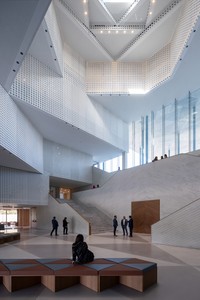
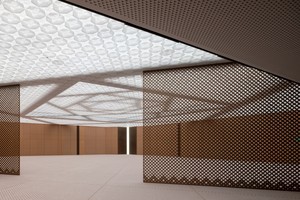
The Ismaili Center’s central atrium, Houston. Architect: Farshid Moussavi Architecture. Photo: Iwan Baan
Moussavi’s latest and possibly most exciting challenge is to design a new wing for the National Gallery in London’s Trafalgar Square. FMA has been shortlisted in a high-profile competition alongside a stellar group of global architects: Foster + Partners, Kengo Kuma & Associates (profiled in the Summer 2025 issue of the Quarterly), Renzo Piano Building Workshop, Selldorf Architects, and Studio Seilern. This is a huge moment for Moussavi, who has yet to design a major cultural building in her home city. She describes the opportunity as a “perfect project because it involves thinking about the next chapter of the museum, and as part of that, the contribution museums make to the cultural life of the city.”
Moussavi initially made her name in the 1990s with her previous practice, Foreign Office Architects, a practice title that she and Alejandro Zaera-Polo, her partner there and former husband, came up with to express the condition of being outsiders in London. Moussavi then spent several years as an itinerant architect: in Cambridge, Massachusetts, for two years while working on her master’s at Harvard Graduate School of Design; in Genoa working for Renzo Piano; in Rotterdam with Rem Koolhaas’s practice OMA; in Tokyo, working on Foreign Office Architects’ award-winning Yokohama Port Terminal, completed in 2001; and in Vienna as head of the Akademie der bildenden Künste’s Institut für Kunst und Architektur from 2002 to 2006. Reflecting on what drew her back to London, she says, “Each place I’ve lived in is different, but they all expected you to conform. I love the fact that British culture allows you to be who you want to be. You can walk into any store on Sloane Street and no one will judge the way you look. Whereas in Italy if you don’t change your tights from black to nude on the first day of spring, you get tutted at.”
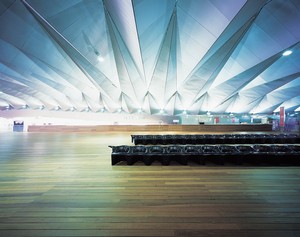
The interior of the Yokohama International Port Terminal. Architect: Foreign Office Architects. Photo: Ramon Pratt
The mental image of Moussavi on a bus in Italy wearing black in the sunshine easily comes to mind. When we meet she is dressed head to toe in black Comme des Garçons, with a signature puffy skirt and Peter Pan collar blouse. She insists that the distinctive outfit is—like her architecture—purely practical: “I’m wearing a nylon shirt that can go in the washing machine and my wedge shoes are very comfortable.”
The freedom that Moussavi experiences in London allows her to move easily between the worlds of architecture, art, and fashion. Fashion designers Hussein Chalayan and Daniel W. Fletcher are good friends, and the sculptural clothing she wears by Junya Watanabe, sacai, and Simone Rocha seems to reflect the inventive forms and decorative flourish of her architecture. Moussavi has in fact given much thought to the meaning and role of decoration within architecture: Her first book, Function of Ornament (2006), argued against the traditional counter-positioning of the two nouns of the title, saying that ornament itself is a “produced affect” that has agency in relation to the experience of a building.
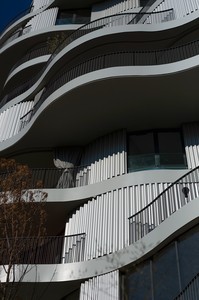
La Folie Divine of 2017, a nine-story apartment building in Montpellier, is a case in point. Its curvilinear balconies protrude like frills around the facade. Corrugated aluminum paneling gives way to rippling curtains, and the effect is a playful form that corresponds to the brief for a modern-day folie. But this is not decoration whose purpose is to enliven an otherwise conventional housing block—rather, the exaggerated curves are the expression of an experimental new living space with flexible, adaptable interiors and private outdoor space.
The exterior of La Folie Divine, a residential building in Montpellier, France. Architect: Farshid Moussavi Architecture. Photo: Paul Phung
FMA is working on two more projects in France. Although the country is geographically close to the United Kingdom, its architectural culture is very different, which Moussavi enjoys: “In France architects are expected to have a vision which is not just aesthetic but also political, urban, social, and environmental. They believe the architect is the best person to lead a project, and that the architect can be both an artist and an intellectual.”
Unlike some leaders of international practices, Moussavi is not a figurehead who leaves others in the office to do the work. In 2011, when FMA won its first commission for housing—at La Défense-Nanterre, just north of the city of Paris—she threw herself into researching experimental social housing and urbanism, taking groups of students to explore the neglected suburbs of Ivry and Aubervilliers. In the process she became a champion of the pioneering French architect Renée Gailhoustet, whose imaginative social housing designs from the 1960s–’80s have been a major influence on FMA’s work.
Moussavi relishes a new project at Saclay, south of Paris, and another in Montpellier. Both sites are new urban districts offering the possibility of projecting a new outlook on life and architecture. At the ZAC République in Port Marianne, a developing neighborhood of Montpellier, the practice is designing a building that unusually combines offices and homes, allowing the possibility of reversing those uses should the demand change. It’s a forward-looking approach that Moussavi believes stems from France’s productive system of public accountability combined with a dynamic private sector. In Saclay, a new research quartier, FMA is designing a primary school that will serve a community of academics and researchers. It offers the opportunity to respond to the scale of children with a means of construction that includes simple, playful details. The facade will be clad in circular ceramic tiles, layered like shingles, in three soft colors. “The impression is of clouds, fish scales, or maybe speech bubbles,” says Moussavi. “Hopefully children will feel they are in a unique, exciting place.” The challenge of such bespoke, one-off projects is that they draw Moussavi into an effort for each building to “belong to its context and time.” To allow this level of involvement, she is careful not to allow the practice to grow too large, and brings in extra capacity and specialist knowledge by collaborating with other architects and engineers.
The recent completion of the Ismaili Center in Houston was a major milestone for FMA. It is the first Ismaili Center in the United States—there are six others in Europe, Asia, and Canada—and occupies an eleven-acre site, where it provides not only spaces for Muslim prayer and religious gathering but also civic and cultural spaces for Muslims and non-Muslims alike. The project brings many of Moussavi’s ideas together in response to a sensitive brief set by the late Aga Khan Prince Karim, who sadly passed away in February 2025, before the building’s completion.
The interior of the Ismaili Center, Houston. Architect: Farshid Moussavi Architecture. Photo: Iwan Baan
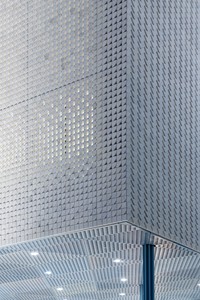
The commission might easily have been an opportunity for Moussavi to reflect on her Iranian identity, given that the Ismaili branch of Shia Islam has its origins in Persia. But Moussavi dislikes the stress on celebrating identity and prefers to see the project as a chance to bridge East and West. “I avoided a representational take on the project and wanted to find a way to renew certain Islamic practices of working with structure, light, and craft,” she says. The building references Islamic architecture through the practical provision of spaces rooted in the context and climate of Houston. A primary consideration was to mitigate the heat and humidity of the region by creating outdoor covered verandas, which echo Persian eivān-hā and connect the interior to the landscape outside. At the heart of the building is a high atrium, which recalls Islamic domes but actually consists of stacked cutouts with a rotating geometry. The building’s ornament is not applied decoration, as in traditional Islamic architecture, but generated by playing with new stonecutting techniques to create patterns in dialogue with the space.
Each project is a learning experience for Moussavi, who says she is “passionate about the knowledge that is transferable from project to project across time.” For a moment she is taken back to the late 1990s, when she and Zaera-Polo designed the Yokohama Port Terminal and learned for the first time to use computers for design and construction. She reflects, “It’s amazing we managed to see it through—it didn’t even look like a building!”
The exterior of the Ismaili Center, Houston. Architect: Farshid Moussavi Architecture. Photo: Iwan Baan
Moussavi wrote her most recent book, Architecture and Micropolitics (2023), as a consideration of how designs emerge and of the common perception in the profession that architects have lost influence. This is the closest she has to a manifesto, although it takes the form of a six-hundred-page pavement slab rather than a slim pamphlet. Featuring a bright red cover and a mirror glued to the front, the bold design, by the OK-RM studio, reflects the idea of agency that is so important to her, literally bringing the reader into the picture.
Most of the book is taken up with documenting in immense detail four FMA projects from 2011–22. There are pages and pages of intricate drawings illustrating the taxonomy of elements in a museum (FMA’s design for the Museum of Contemporary Art Cleveland) and exhaustive studies showing color, geometry, and analysis of the brief. Each project receives a rhizomatic diagram capturing the moment when key design decisions were made. The overall effect is like the complex folded facade of a Moussavi building. If you need convincing that Moussavi can handle complexity, there is for good measure an essay by the French philosopher Jacques Rancière outlining the connection between politics and aesthetics. The book is beautiful and compelling but is perhaps overcomplicated, particularly considering that Moussavi’s message is pretty simple—that the architect’s role is to find the opportunities. In response to the suggestion that she might be celebrating complexity, Moussavi explains, “Normally buildings are reduced to plans and maybe an architect’s sketch, but the book tries to capture the extensive space and dynamics of an architectural project to show that there are opportunities for micropolitics as the architectural process unfolds, often in unexpected ways. So, the message is simple but the task is not.”
As a woman in the predominantly male world of architecture, Moussavi has learned to hold her own in challenging situations and finds no contradiction between having strong opinions and working collaboratively. Other women architects who have similarly combined a fighting spirit with an open, collaborative way of working come to mind—notably Gailhoustet, whose work is receiving attention thanks in part to Moussavi’s efforts, and the Brazilian/Italian architect Lina Bo Bardi. “Women are good at holding the ship together, whether at the scale of a family or a business,” says Moussavi, who keenly champions the role of women in the field but is reluctant to be limited by the label of “woman architect.” In our current identity-driven culture, where both self- and group expression are so important, Moussavi stands out: “I’m not interested in expressing my background, whether as an Iranian or as a woman. In fact, I get irritated by architects who use their identity to talk about their projects.”
As if conscious that culture today is becoming entrenched in different positions—a direction alien to the beliefs of the late Aga Khan, who so inspired her—Moussavi proposed “dialogue” as the theme of last year’s Royal Academy Summer Exhibition. Taking on the role of “coordinator” of the exhibition—a position dating back to the Academy’s beginnings, in 1768—Moussavi proposed a radical restructuring, mixing architecture with art for the first time and encouraging conversation among artists from different cultural backgrounds. It was a risky approach, as the show is routinely panned by critics for its eclectic mix of high art and “puppy paintings,” but Moussavi’s curation was praised by many and succeeded in shifting the exhibition into new territory. Making change, at whatever level possible, is one of Moussavi’s greatest contributions to art, culture, and architecture—not in the “change the world” sense meant by Ben & Jerry’s, but in the sense of letting go of the past. “When you’re the child of refugees,” she explains, “you have to embrace change. I saw my parents having to start again, working hard. There’s optimism in the idea you can let go and start again.”
Vicky Richardson is a curator, journalist, educator, and architectural adviser. She is the former Head of Architecture at the Royal Academy of Arts, London, and director of the makerspace Grymsdyke Farm. She recently set up Pick Up Architecture Ltd.