Never have the potential political consequences of architecture been greater, and never has the political sensibility of architecture been less.
—Richard Sennett, Democracy and Urban Form, 1980
The contemporary city is a place affected by multiple, often compounding crises. City centers and high streets are hollowed out and turned into touristic playgrounds while inhabitants decamp to faraway suburbs. Snaking motorways tear at the urban fabric. Real estate prices and rents are exorbitant. High-rise financial citadels and single architectural set pieces barely mask the reality of living in what is just—bar a few pockets of affluence—an endless urban sprawl, while genuine public spaces, or whatever is left of them, are mostly the vestiges of civilizations past. This condition, by which metropolises have gone past the “scrambled” stage to turn into ill-defined suburban agglomerations, has been so naturalized that the popular solution has become an increasingly technocratic one that seeks to accelerate the current model, as if building more and more indiscriminately would deliver a different outcome rather than exacerbate problems as endemic as the housing crisis.
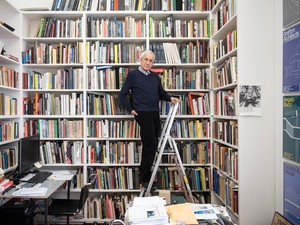
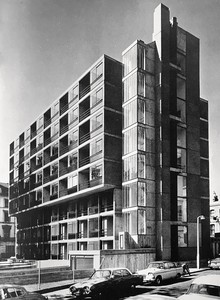
A writer who has never had patience for the turn contemporary cities have taken in the last half century, tirelessly criticizing their universal grammar of “freestanding high-rises” and “serpentine freeways” surrounded by a suburban hinterland, is Kenneth Frampton, emeritus professor of architecture at Columbia University and author of Modern Architecture: A Critical History, his incredibly influential textbook first published in 1980 and now in its fifth revision. Born in 1935 in Woking, a commuter town southwest of London, Frampton completed his studies at the Architectural Association School of Architecture, where the modernist cult of technology inherent in functionalism, the approach then on the rise, was balanced by the Arts and Crafts tradition, a long-standing humanist outlook seeking to undo some of the most alienating and destructive aspects of industrial civilization.1 In London in 1960–64, Frampton designed a residential apartment block inspired by both Russian Constructivism and Le Corbusier’s Unité d’Habitation. This structure—Corringham, in Bayswater—remains his only building as a practicing architect.
Frampton’s career took an unexpected and decisive turn in 1965, when he moved to the United States to pursue a career in teaching. An anecdote he tells, a sort of origin story to his radicalization, is the experience of traveling in a helicopter over Manhattan during his first trip to the United States and suddenly being confronted with the city’s nightscape, a “ferocious panorama” of lights, cars, and consumerism.2 Another, at around the same time, was reading Hannah Arendt’s book The Human Condition (1958), which, with its emphasis on ever-accelerating cycles of production and consumption eating away at genuine human freedom and action, proved a decisive influence on his work. Frampton would spend most of the subsequent decade and a half writing essays informed by Arendt’s thinking, as well as by the writings of Walter Benjamin and Herbert Marcuse—critical thinkers who likewise, while “acutely aware of the dark side of the Enlightenment,” never abdicated from the socialist promise inherent to what Frampton, following Jürgen Habermas, calls the “unfinished modern project.”3 (Modern Architecture famously opens with Benjamin’s passage on Paul Klee’s monoprint Angelus Novus (1920), which the latest edition, published in 2020, juxtaposes with another image of the wreckage left behind by progress: a nineteenth-century engraving of Paris in which the recently built Arc de Triomphe towers over the barrière de l’Etoile, then in the process of demolition.)
All these preoccupations would culminate in what to this day remains Frampton’s most influential and incisive piece of what some of his detractors called “operative” criticism—that is, criticism that doesn’t simply describe but seeks to influence architectural practice. First published in 1983, “Towards a Critical Regionalism: Six Points for an Architecture of Resistance” wasn’t merely an intervention against the eclecticism of postmodern architecture, which had been sanctioned three years earlier in Paolo Portoghesi’s exhibition The End of Prohibition and the Presence of the Past, the show that constituted the first Venice Architecture Biennale. More important, the essay attempted to show how this new kind of architecture—which renounced all socialist commitment while embracing technique and spectacle for their own sake—did nothing to correct the flaws inherent to the modern movement it reacted against. Rather, it worked merely as a “compensatory facade” to capitalism’s fundamental homogenizing thrust, its refashioning and flattening of the world into its own image.4
Against this “universal placelessness” Frampton pitched architecture as a critical practice openly fighting “the relentless onslaught of global modernization” by both trying to recuperate culturally rooted, site-specific forms of building and producing spaces in which people could meet and act together.5 Detailing what he was not afraid to call an “arrière-garde position,” almost a war of attrition, Frampton made clear that what he meant by “critical regionalism” was not the nostalgic return of some imagined tradition, vernacular, or codified style.6 Rather, it was a practice that sensitively combined modern building techniques with elements drawn from the repository of world culture in order to preserve architecture’s fundamental function as a “space of human appearance”—an Arendt coinage he had long made his own.7 As an example, Frampton cited Jørn Utzon’s Bagsvaerd Church in Copenhagen (1976), which, by combining an “optimal” modular exterior with “a far less optimal” reinforced-concrete shell vault reminiscent of a pagoda roof, delivered “a new basis for the spiritual” for our highly secular age.8
“Towards a Critical Regionalism” presented all the themes that are central to Frampton’s thought. Points 5 and 6 in particular, “Culture Versus Nature” and “The Visual Versus the Tactile,” contained—as it were, in nuce—ideas that grounded his argument and made it nuanced and compelling. Due to the dense nature of the writing and its reliance on continental philosophers such as Paul Ricoeur, whose quote about modernization constituting a “subtle destruction” not just of “traditional cultures” per se but of the very “creative nucleus of great cultures” serves as the essay’s epigraph, it is easy to see how it could come off as a little fuzzy—a collection of value statements rather than a workable program.9 As Mary McLeod reports in an illuminating essay, Fredric Jameson, for instance, dismissed the essay’s ideas on the grounds that “Frampton’s ‘arrière-garde’ critique was itself participating in the celebration of pluralism and difference so typical of both postmodernism and late capitalism.”10
Frampton dedicated most of his subsequent work to refining and developing his intuitions. At the risk of simplifying slightly, I would say that he focused his reflection on two ideas that, together, gave substance to his theory of a critical architectural practice. The first of these concepts is “tectonics,” namely the idea that a building, rather than having a disembodied facade circulating mainly as an image (think the “Bilbao effect”), should arise organically from and showcase the construction techniques, the craft, and the materials employed. (The term “tectonics” itself, which Frampton can be credited with reviving in architectural parlance, refers to the art and science of construction.) The natural corollary of this principle is the treatment of architecture not as divorced from its context but rather as the natural continuation of its surroundings, and thus in intimate dialogue with not just the local culture and way of life but also the topography, contingencies of climate, and qualities of light on the site. Frampton would develop this idea in his concepts of “megaform” and “urban acupuncture,” and in the belief—advanced, for instance, in “Seven Points for the Millennium: An Untimely Manifesto”—that “the cultivation of landscape” should take precedence over “concentrating exclusively . . . on the design of buildings as aesthetic objects.”11
The second concept is the idea of “phenomenology” or the “tactile,” that is, the idea that we experience a building through all five senses, not just sight alone. “Varying levels of illumination, ambient sensations of heat, cold, humidity and air movement, varying aromas and sounds” all the way down to “floor finishes” all have an influence on how we take in and interact with the environment.12 This might sound like a frivolous point, but it strikes at the heart of Frampton’s conception of architecture as a provider of habitats conducive to human flourishing. Indeed, the idea brings within itself a scathing critique of the current way of building that reduces everything to an Existenzminimum overdetermined by the diktats of real estate and housing markets. It also suggests a return to a more sustainable way of building that, in foregrounding the lived experience of the inhabitants, combines “long-life/loose-fit” buildings with “lower-rise, high-density” developments to offset some of the nefarious effects of contemporary motorized sprawl.13
Frampton never developed his ideas in a vacuum but rather in response to specific architects. These, of course, include the Portuguese Álvaro Siza and the Japanese Tadao Ando, both of whom he has graced with monographs. Another architect who features prominently in his writings is the Finn Alvar Aalto—“the one figure from the so-called ‘heroic core’ of the modern movement” whose practice always showcased a “phenomenological” attention to human well-being, which—together with the incorporation of vernacular sources and sensitivity to light—set him apart and make “his legacy . . . still ripe for further development.”14
As imagined in “Towards a Critical Regionalism” and Frampton’s other writings, architecture is a marginal activity, made obsolete by the instrumental thinking of capitalism and purposefully trying to mend its damages while subsisting at its edges. The introduction to the most recent edition of Modern Architecture concludes with the statement, “At best, what is left for the critical practice of architecture at a large scale are predominantly horizontal megaforms designed as artificial landscapes in order to encapsulate some vestige of the civic, and stand against the universal placelessness of the environment as a whole.”15 One can wonder if there is something quietist about this, but that impression is fundamentally contradicted by not just Frampton’s immense influence on architecture as a whole (in 2018, he received a Golden Lion for Lifetime Achievement at the Venice Architecture Biennale) but also the highly reflexive nature of his work, in which he constantly revises and refines his ideas. (The same revision of Modern Architecture, published when he was ninety years old, presents a whole new section called “World Architecture” in which he seeks to correct the Eurocentric bias of the previous editions.)
Although Frampton refers directly to Antonio Gramsci relatively rarely in his writing, his posture is close to Gramsci’s maxim “Pessimism of the intellect, optimism of the will.” Architecture’s room for maneuver might be limited but it can still have far-reaching effects. Indeed, in a world like ours, where design has turned positively hostile and seeks to cement rather than challenge the feeling of living in a crushing techno-dystopia (the Vessel in Manhattan’s Hudson Yards and Tesla’s Cybertruck are two great cases in point), Frampton’s operative criticism returns to the humanist roots of architecture, and in so doing provides, “against the prospect of cultural degeneration” that seems now more inevitable than ever, “a basis from which to resist.”16