Despite having major museum and commercial projects under construction worldwide, the Japanese architect Kengo Kuma still makes time for experiments. Meeting him in London as he took a break from his global tour, Vicky Richardson talked with him about a new relationship between building and nature.
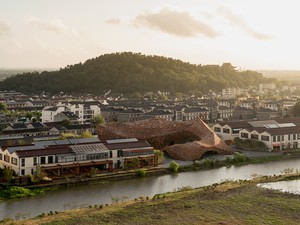
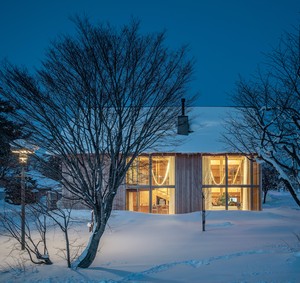
UCCA Clay Museum, Yixing, China, 2024, designed by Kengo Kuma & Associates. Photo: Eiichi Kano
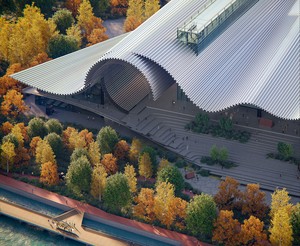
UCCA Clay Museum, Yixing, China, 2024, designed by Kengo Kuma & Associates. Photo: Eiichi Kano
Vicky Richardson is a curator, journalist, educator, and architectural adviser. She is the former Head of Architecture at the Royal Academy of Arts, London, and director of the makerspace Grymsdyke Farm. She recently set up Pick Up Architecture Ltd.
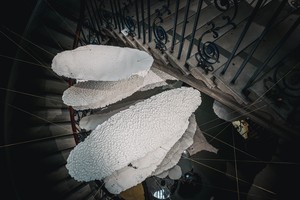
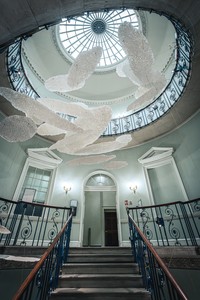
It is the first time Kengo Kuma has seen his installation Paper Clouds, a central element of the London Design Biennale. He poses for photos with the Japanese ambassador against the backdrop of the work, which is suspended in the grand Nelson Stair at Somerset House, an arts center that was originally built as a government building in the 1770s by the neoclassical architect Sir William Chambers. Kuma seems pleased with the delicate washi-paper installation and explains that the project is really all about East-West dialogue, as if he himself were the ambassador.
Kuma is midway through a journey that will take him to at least four European countries where his practice is building a variety of projects. In Albania he will meet with the prime minister, Edi Rama, who is a friend; in Paris he has a studio working on dozens of hotels, museums, and transport and retail projects; in Italy he will visit the site of a new pavilion he is designing to mark the 800th anniversary of the death of Saint Francis of Assisi, and in Hamburg he will see Matter of Relationships, a retrospective exhibition of the work of his practice.
To visit a project that someone else has designed in your name must be a common experience for an architect with such an array of work and with employees scattered across the globe: Kengo Kuma & Associates (KKAA), the practice he established in Tokyo in 1990, has offices employing more than 400 people working on around 300 projects in 50 countries. Kuma steers this ship wisely, placing trust in his teams and collaborators and balancing the commercial and smaller experimental projects with pragmatism. “Clients of large projects tend to be very safe and just want to repeat the previous design, so the small experimental projects are very important to us,” he says, referring to Paper Clouds, which he developed with colleagues at Sekisui House–Kuma Lab, the research department he has led at the University of Tokyo since 2009. When he turned sixty-five he was compelled to stand down as its director, but he handed over the reins to a former employee, Toshiki Hirano, whom he works with on research into materials and technology that feeds ideas into the practice.
Kengo Kuma’s Paper Clouds presentation at Somerset House for the 2025 London Design Biennale. Photo: Toshiki Hirano
Paper Clouds, a collaboration with the London-based Clare Farrow Studio, is an elegant sculptural installation made up of wafers of textured washi paper suspended on gold threads that cascade through the complex geometric space, seeming to float between the interlocking curved staircases. The outcome is poetic and ethereal, but the background research and fabrication process will play a practical role in future building projects for KKAA.
Hirano is a Kobe-born architect who is an expert in digital fabrication and last year was the guest editor of the “Post-Digitality in Architecture” issue of the journal A+U. His recent experiments have combined traditional washi paper with digital tools: 3D scanning, for example, linked to Computer Numerically Controlled (CNC) cutters that can produce complex molds. For Paper Clouds the challenge was to produce a washi panel that was light and thin while having the lateral strength to give the appearance of floating (given by its curved form and innovative combination of plant fibers with a binding agent).
Washi is traditionally made from kōzo plant fiber, which comes from the inner bark of the paper mulberry tree. It has been used architecturally for centuries in Japan to form room dividers that filter light. Kuma and Hirano are interested in exploring alternative ways of using the material, potentially even as part of the structure of a building. For the past two years a washi-paper experiment—a looped strip of washi—has been hanging on the facade of Tokyo University of the Arts (a building designed by KKAA) to test the durability of a new coating that will allow the use of the paper as an outdoor construction material. Kuma Lab’s next project will be to create a 3D-printed structure using the washi pulp that was developed for the London installation.
Kengo Kuma’s Paper Clouds presentation at Somerset House for the 2025 London Design Biennale. Photo: Toshiki Hirano
The combination of traditional craft with new technology lies at the core of Kuma’s approach. Another large-scale experiment of his was the use of carbon fiber to create a protective curtain at the head office of the Japanese textile company Komatsu Seiten. Working in collaboration with the client, KKAA developed carbon-fiber rods that allow light to penetrate the facade while protecting the original 1970s concrete building from earthquake damage. The result is a delicate web of thin strands that look like fabric threads but have great strength. The project could be a useful prototype for upgrading earthquake protection in existing buildings.
Despite such ongoing experiments, Kuma does not speak to me in detail about technology but grounds his approach in references to human culture. Yes, Paper Clouds is experimental, he tells me, but it is really all about the dialogue between Western and European culture that has been the central theme of his practice for forty years. “To have a work made from traditional light Japanese paper hanging in a typical European classical building, with its emphasis on solidity and verticality, is very special,” he says.
Kuma’s interest in dialogue goes back to his childhood in Nagasaki, where he grew up with a Buddhist father and a Christian mother who sent him to a European-style Christian school. He studied architecture at the University of Tokyo, and in the mid-1980s, accompanied by professors from the university, he had the chance to travel to sub-Saharan Africa, where he spent two months drawing and studying traditional buildings. He was disillusioned with modernism at the time, and during his visits to villages in Niger, Nigeria, and Ghana he became fascinated by the forms and materials used in vernacular buildings there. It was the first time he observed a direct relationship between materials, making, and place. Sub-Saharan Africa remains one of few regions where he hasn’t yet had the chance to build, and this remains an ambition.
Kuma’s emphasis on dialogue does not mean that he is shy of expressing strong opinions: his seminal book Anti-Object: The Dissolution and Disintegration of Architecture (published in Japanese in 2000 and in English translation in 2008) was a powerful critique of Western architecture and its desire to impose on its surroundings. He pursued the argument in Studies in Organic in 2009, where he wrote, “I continue to detest buildings that have been designed to stand out and to be symbolic by virtue of their opposition to their respective environments.”
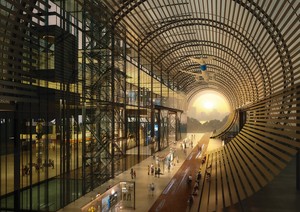
Kengo Kuma & Associates proposal rendering for the Shanghai Industrial Museum, China
As Kuma develops projects across the globe, the question of dialogue between cultures has become central to his practice, marking a new phase. Aged seventy at the time of our conversation, he looks back at his career with remarkable self-awareness, identifying distinct periods and changes of direction. In the 1980s, after two years working as a researcher at Columbia University, New York, he rapidly built a successful practice in Tokyo designing postmodern commercial buildings. But when Japan’s speculation-driven “bubble economy” burst in the early 1990s, he abandoned the city to live for a decade in the countryside, where he reconnected with traditional building crafts and worked on small rural projects. Returning to Tokyo in the 2000s, he entered a new phase marked by an interest in developing an organic approach to contemporary architecture.
The central theme of Kuma’s practice today is to build relationships among nature, place, and people. His travels around the world have given him an awareness of demographic and political change and have led him to a new way of thinking about where and how we build: “The world is facing a fall in population. In fifty years’ time the population of Japan will be halved, and in China it will reduce from 30 to 8 million people. This is the most important shift we’re facing, and it means we can go back to nature—we won’t need cities.” He warms to this theme, continuing, “In the Gulf countries they are still thinking about the future city when they should be thinking about the future of nature.”
Perhaps Kuma’s disaffection for the city is the result of getting older, I ask as delicately as possible. No, he tells me, his friends who have children also want to be close to nature. “Politicians are not thinking about the future—they only think of the next election. Only the mother with a child is thinking ahead. But we need to be planning for how architecture will support life in a hundred to two hundred years.”
As if to test his theories, during the covid-19 lockdown Kuma opened satellite offices in three small remote towns around Japan: in Okinawa, the country’s southernmost prefecture; Hokkaido, a northern island; and Okayama, a prefecture in the south. “I wanted to carry out an experiment about future lifestyles. The Internet and artificial intelligence mean that we don’t need to be physically together anymore.” Each satellite office has between two and four staff who have made new relationships with communities that, he says, would be impossible to build in the city. Kuma characterizes this new phase as “small things for small places.”
As for himself, he loves to spend time outside Tokyo closer to nature, but he has no plans to slow down. In fact he cites Frank Lloyd Wright as a model for his career, describing how the American architect began a new chapter in 1911 by moving from Chicago to Spring Green in Wisconsin to build his home, studio, and school Taliesin, and continued working into his nineties.
Kuma is particularly drawn to places where he feels a connection with Japan. In Scotland, for example, he discovered the diversity of British culture and landscape when designing the V&A Museum in Dundee from 2010 to 2018. He is now in the early stages of making a Chinese garden on the grounds of a Scottish castle.
Albania is another place where Kuma feels at home. He recently spoke at a gathering of two hundred architects in Tirana, the capital, organized by Rama (an artist who has led the transformation of the country since 2013). “I feel the similarity between Japan and Albania,” says Kuma. “It is a country of mountains and villages, where each valley has its own unique culture.” KKAA will soon complete a major landscape and architectural project at the UNESCO World Heritage Site of Butrint, on the coast, which is due to open in September 2025. Expressing principles close to Kuma’s heart, the building is made up of a series of low-lying linear forms that follow the contours of the landscape while a layered limestone roof seems to emerge from the ground. With wooden frames and rammed-earth walls, the architecture blends traditional Japanese elements with materials that relate directly to the site.
Kengo Kuma & Associates proposal rendering for the Shanghai Industrial Museum, China
Kuma is adept at keeping his eyes on both the past and the future. Much of his current work is in China, including the major Shanghai Industrial Museum, due to open in 2027. Compared to projects that have celebrated craft heritage or natural landscapes—the recent UCCA Clay Museum in Yixing, for example, whose design was inspired by handmade pottery from that city, “the ceramic capital” of China—the Industrial Museum takes Kuma out of his comfort zone. Construction started in late 2024 at the Jiangnan Arsenal, a former industrial and military site on the Huangpu River where China first manufactured steel in the 1890s, and the building will be made from steel and aluminum; this, says Kuma, is a “big challenge,” as he has become used to working with stone, wood, and paper.
Kuma recognizes, however, that “industrialism is in fact already part of China’s history and I wanted to show the beauty of industry and its relationship to society. . . . I’ve been trying to find new details in metal to show the variety of its uses. If you go into the toilets, each one will be made from a different type of metal.” In an unexpected break from our weighty conversation about the future, Kuma remarks whimsically that “toilets are the best place to see the beauty of piping and building services!” Pragmatism and humor, combined with a deep commitment to the practice of architecture, are at the root of his ongoing success. Whether or not he will abandon the city once again for life in nature remains to be seen. With a KKAA project bound to be coming to a city near you, it seems unlikely.
Vicky Richardson is a curator, journalist, educator, and architectural adviser. She is the former Head of Architecture at the Royal Academy of Arts, London, and director of the makerspace Grymsdyke Farm. She recently set up Pick Up Architecture Ltd.