From Sarteano, Italy, to Allentown, Pennsylvania, Alison Castle reports on Nicola Bulgari’s collection of quintessential American automobiles, highlighting his passion and vision for the future.
Alison Castle is a writer, editor, and filmmaker. She holds a BA in philosophy from Columbia University and an MA in photography and film from New York University. She has edited and written many books on photography, film, and design for Taschen.
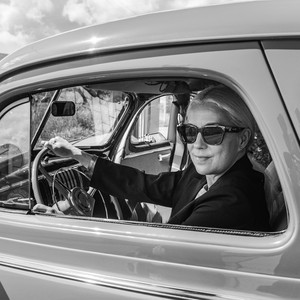
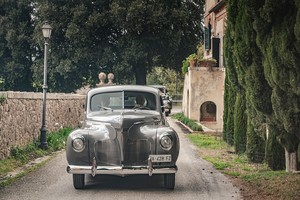
In the verdant hills around Sarteano, Italy, it’s not uncommon to spot, humming along the zigzagging cypress-lined roads, a retinue of shiny vintage American cabriolets, sedans, and coupes. These nonindigenous creatures, with their voluptuous fenders, majestic hood ornaments, grandiose grilles, and spotless whitewall tires, would be cars from the Tuscan outpost of Nicola Bulgari’s automobile collection getting their “exercise,” as he calls the regular outings that keep them fit. One fine spring day not too long ago, I had the honor of partaking in one such procession, at the wheel of a 1940 DeSoto Coupe that Bulgari had handpicked for me to drive. Following the Cadillac in front of me, hands wrapped around the smooth Bakelite wheel, I let any worry about driving a museum piece be drowned out by the magnificent scenery and the throaty purr of the engine. I needn’t have worried much—not only because Bulgari’s operation includes a team of highly talented mechanics and restorers for whom repairing a dent would be routine, but simply for the fact that he wants these cars to enjoy doing what they were meant to do, preciousness be damned. And I think Bulgari would agree with me when I say that the cars do very much enjoy their lives in his care. They are treated like his adopted children.
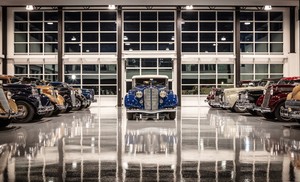
You would be forgiven for wondering why an Italian luxury magnate (he is vice chairman of the jewelry and fashion house founded by his grandfather in 1884) has laser-focused his collection of nearly 300 cars on American models from the 1920s through the ’50s. No vintage European race cars, no flamboyant supercars for Bulgari. “There are enough Ferraris in the world,” he told me. “People spend so much money on a Lamborghini or Pagani just to have it. This is not a vanity thing for me.” Indeed, impressive and stately as they may be, Bulgari’s cars aren’t flashy. Yet there are many stars in the collection, such as the 1940 Buick Woody featured in Now, Voyager (1942) that was acquired from the production and driven for many years by Bette Davis. Or the 1929 GMC yellow cab from It’s a Wonderful Life (1946), or the 1930 Graham Model 46 Standard Six sedan in highly original condition that was formerly owned by Peter Yarrow of Peter, Paul and Mary. (It was pictured on the cover of their 1967 LP Album 1700.)
The Woody and the Graham, which reside in Allentown, Pennsylvania, were the first of Bulgari’s cars I had the chance to drive. Allentown? Let’s rewind a bit. In 1995, Bulgari was in search of someone to repair a 1942 Buick Model 49 Special Estate Wagon (aka a “Woody,” owing to the wood siding) that had met a sad fate after being parked on a slope in the Hudson Valley without its parking brake properly engaged. He asked around for someone in the region who could help and ended up having the car sent to a restorer in Allentown who was recommended by an old friend. When the Woody came back pristine, Bulgari knew he’d found “the guy.” Keith Flickinger, who was born and raised in Allentown and describes himself as a “Pennsylvania Dutch kid with typical Ozzie and Harriet parents,” told me that it was several months after sending back the wagon before he heard from Bulgari. Flickinger was the owner of a car-restoration business with a huge waiting list of customers, but when Bulgari finally called him back (he had been out of the country), it was to ask him to take on another job, which led to another, which eventually led to Flickinger letting go of his clients to dedicate his skills full-time to Bulgari’s endless parade of restorations. He is now chief operating officer and curator of the collection. “It’s been an amazing ride,” he told me.
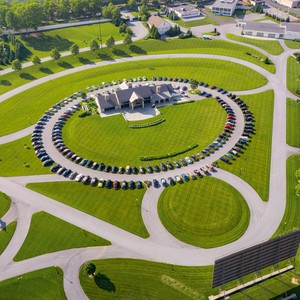
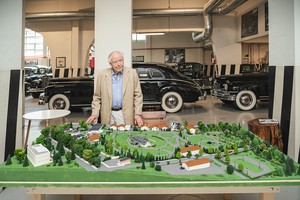
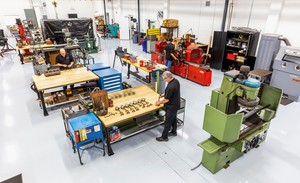
Flickinger’s original shop was located near a derelict drive-in movie theater on the outskirts of Allentown. That shop is now one of many buildings on the enclosed twenty-seven-acre campus of the NB Center for American Automotive Heritage, a property including six collection buildings, three restoration buildings, a gauge-rebuilding business, a machine shop, and a full-service repair shop specifically for vintage vehicles. The drive-in screen was restored and faces a reconstructed Pennsylvania Dutch barn that houses screening rooms, a music performance space, and archives. Most thrilling, perhaps, is the fully private two-mile track on which all the cars get to stretch their legs in regular rotation. There is even a vintage Sinclair filling station with a working pump that is used to fill the cars’ tanks. Viewed on Google Earth, the campus looks like a kid’s train set. Incidentally, Bulgari had two highly detailed dioramas of the campus made, each roughly four by six feet, complete with working streetlamps, flowing creeks, and of course model cars. (One of the dioramas is in the visitor center in Allentown, the other at Bulgari’s garage in Rome.)
“Three on the tree, four on the floor,” Jonathan Klinger, executive director of the Allentown collection, told me as I prepared for my first test drive. He explained that in the late 1930s, when three gears were still the standard for American cars, manufacturers began putting the gearshift lever on the steering column, freeing up space for a third person to sit in the front bench seat. When four-speed transmissions were introduced, their gearshifts went back on the floor, and both configurations coexisted until three-on-the-tree models became extinct in the 1980s. As this was my baptism in a three on the tree, Klinger instructed me to “picture a capital H, with the top left being reverse, first being straight down, second up and right, and third down and right.” OK! Wearing a wool scarf to stave off the late-winter chill, Bulgari watched me with genuine relish as I drove a 1939 Buick Century around the Allentown track. After I circled back around and parked it, he presented me with a 1941 Cadillac Series 61 “for comparison.” He explained that although the Buick was a lot of car for the original price, the Cadillac was considered a class above—and priced accordingly. After taking the Cadillac for a spin, I could see that Bulgari was eager for my impression. When I reported that the Buick felt as cushy, powerful, and luxurious as the Cadillac, he seemed exceedingly satisfied.
What is it about Buick that makes it Bulgari’s favorite marque? When I posed this question to Paolo Ciminiello, the curator of Bulgari’s collection in Italy, his response was that it’s like trying to explain your favorite color, which is to say you can’t. But nostalgia clearly plays a big part. Bulgari distinctly remembers seeing an ad for a 1935 Buick 96S in an old issue of National Geographic in the late 1940s (he would have been around nine years old) and thinking it was the most beautiful car he’d ever seen. Around this time, the young Roman was also noticing the cars the Vatican chose for its motorcades, for the most part 1930s and ’40s American limousines: Packards, Buicks, Cadillacs—even a Checker. Young Nicola was awed by these cars and impressed that the Vatican had opted for US cars rather than European ones. Buicks seemed to embody the American dream: outsized, affordable, dependable, top quality, big bang for your buck. It wasn’t America’s movie stars or music that appealed to Bulgari in his youth, it was its cars—the everyday workhorses that ferried people to work, to church, to the grocery store.
Photo: courtesy Fondazione Nicola Bulgari
Bulgari doesn’t have a favorite car, or so he says, but he does admit to a special fondness for his maroon 1935 Buick 96S, the same model he had seen in National Geographic as a child. (Only forty-one were made, of which one was exported to Europe—he wonders if it’s possible he ever spied it driving around Rome.) When he was in his twenties he learned that the Vatican was updating its cars and managed to purchase a decommissioned 1938 Buick Series 90. He didn’t stop there: his collection now includes most of the existing American Vatican limousines (eleven total) from the period 1932 to 1965, including the 1947 Cadillac 75 Fleetwood (essentially the OG popemobile) that was the primary vehicle used by Popes Pius XII and John XXIII; it had a cut-out roof to allow for waving to crowds, a precursor to the bubble-top popemobile that later became ubiquitous. Bulgari doesn’t deny the appeal of the Cadillacs of the era; although they were marketed as luxury automobiles, they were not completely out of reach for the middle class. Duesenbergs, on the other hand, don’t interest him at all—they were reserved for the wealthy and engineered more for speed than for comfort. “I love the cars that built America, not the unaffordable cars,” he told me.
When people ask Bulgari why his collection features so few Fords, widely considered the most iconic American autos, he explains that it’s because it doesn’t need to. The collection’s handful of Fords includes a Model T and a Model A and he appreciates their importance in automotive history, but he never felt a calling to acquire more. “They are overrepresented,” he told me. “The world doesn’t need more collectors to preserve them.” What does drive his decision to acquire a car? Emotion is important—he has to love it. But he also considers factors like condition, originality, and rarity, as well as input from trusted sources. Bulgari will often dispatch Flickinger to visit a newly discovered car, frequently a dilapidated barn find, to see if it’s worth saving. “Keith has a nose for analyzing a car, like a magician,” he told me. Flickinger told me, “He shines the light on the midrange cars of the era that have been lost and forgotten and he feels a calling to restore them.” Sometimes Flickinger will balk at a car that he’s not so sure about and Bulgari will say to him, “But look, Keith, it’s crying.”
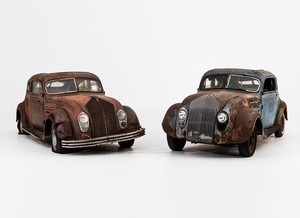
There are currently two rusty 1934 Chrysler Airflow coupes crying as they await rehabilitation in one of the restoration buildings in Allentown. Work on the Airflows will start after completion of the current project, the 1930 Studebaker President Eight seven-passenger sedan that fabricator and body-restoration-technician Scott Guranich was rebuilding from the wood frame up when I visited. The Airflows, which will be simultaneously restored side by side like twins, will take at least two years’ work. Nearby, employees were working on re-creating a floor mat from a 1934 Nash Ambassador 8 Brougham. An original in good condition being impossible to source (what some would call “unobtanium”), restoration manager Jon Haring and his team reconstructed the car’s deteriorated mats enough to be used as blanks for a silicone mold; the resulting, freshly demolded rubber mat looked (and smelled) as if it had just come off the assembly line.
Photo: courtesy Fondazione Nicola Bulgari
What makes Bulgari’s approach so compelling is that it is a creative act in its own right—a form of craftsmanship on a par with art conservation. Just as a restorer repairing a Renaissance fresco must honor the spirit and materials of the original artist, Bulgari treats each car as a historical and aesthetic artifact. He insists on seeking out period-correct parts, reviving lost techniques, and carefully choosing when to restore and when to preserve a “survivor” in its original condition. And crucially, Bulgari does not stop at restoration and preservation; he insists on driving these cars, allowing them to perform their intended function and move about the world as living testaments to a vanished era. And move about they do: from wherever he may be at a given time, Bulgari calls his garages daily to inquire about which cars have gone out and which ones need to have a turn. He loves to hear reports of visitors to the collection. Patrik Ullman, the head of Fondazione Nicola Bulgari, told me, “Nicola shares so much passion with people, he even loves watching others enjoy the cars, or even hearing about them enjoying his cars if he’s not there.” Indeed, though he wasn’t present for my first visit to Allentown, Bulgari called several times while I was there to ask how it was going before asking to speak to me directly about my impressions. I could sense an urgency in his curiosity, the kind that can only be driven by a passion bordering on obsession.
Now in his eighties, Bulgari increasingly focuses on spreading awareness and appreciation. As we sat together in the hall of the Allentown lodge, he spoke wistfully about the dwindling champions of American autos. He reminisced about automotive journalist and historian Beverly Rae Kimes: “I really miss that woman. She was a walking encyclopedia. She understood what I was trying to do and she was excited about it.” (She literally did write an encyclopedia of American cars from 1805 to 1942—Bulgari gave me a copy of the 1,600-page tome.) It excites him when someone “gets” his collecting ethos, which does not always happen. Some people struggle to understand the narrow focus of his collection and its complete lack of European cars. But really the collection is a work of art, and his collecting is an act of cultural stewardship, driven by a love not just for the objects but for the ideas, histories, and craftsmanship they embody.
Photo: courtesy Fondazione Nicola Bulgari
It’s not only about spreading the gospel among car aficionados. Bulgari wants to teach the wider public, in particular younger generations, about the cars in his collection. He understands the important role that popular culture, particularly films, can play in transmitting his cars’ histories, and lending cars to film productions helps to fulfill this goal. His cars were featured most recently in Luca Guadagnino’s 2024 film Queer (with employees, including Ciminiello, driving them in period 1950s costumes). Further, he seeks out young people to apprentice in his workshops—I met several men in their late teens and early twenties whose reverence for the cars, inspired by getting their hands dirty repairing them, seemed beyond their years.
In his commitment to passing this collection to future generations, Bulgari joins a long tradition of collectors who transform private passion into public legacy. This philosophy of active stewardship places him squarely in the company of visionary art collectors whose passions reshaped cultural landscapes. Figures like Peggy Guggenheim did not simply hoard canvases; they championed movements, spurred public dialogues, and created legacies that extended far beyond their lifetimes. In this vein, Bulgari imagines a lineage of caretakers who will not merely preserve these cars behind velvet ropes but will understand the importance of keeping them in motion, of letting their engines roar to life and their stories be shared.
In the end, Bulgari’s project is about far more than chrome and horsepower. It is a meditation on time, memory, and the beauty of things made (and remade) by human hands. He understands that preservation is not simply about freezing objects in amber but about keeping them alive—through restoration, through use, and through the transmission of knowledge and passion to those who will follow. His cars remind us of what it means to care for the past without locking it away. They remind us that a personal passion, when pursued with rigor, can open wide windows onto culture, history, and human imagination. And they challenge all of us to consider what we too will choose to preserve—and how we will keep it alive.
Alison Castle is a writer, editor, and filmmaker. She holds a BA in philosophy from Columbia University and an MA in photography and film from New York University. She has edited and written many books on photography, film, and design for Taschen.