Peggy: A Novel (2024) by Rebecca Godfrey
If the great art-world novels capture what history, press, and news fail to, in the case of Peggy it’s the minute sense perceptions of a person unrelatable to most due to her status. The subject of Peggy is the legendary heiress, collector, and patron Peggy Guggenheim. Its first lines sound like an invocation, as if Rebecca Godfrey’s keyboard were a Ouija board and she was calling on the spirit of Guggenheim to possess her: “I am the daughter of two dynasties; I am believed to have more money than anyone in this city, second only to our neighbor, Rockefeller.”
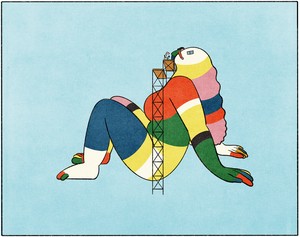
Godfrey dedicated ten years to working on what would turn out to be her final novel. In 2018, in the midst of writing Peggy, she was diagnosed with stage 4 lung cancer and given a prognosis of six months. She lived almost four more years, during which she continued to work on her novel. At fifty-four, Godfrey died with a partial manuscript; her friend and colleague Leslie Jamison, author of the essay collection The Empathy Exams (2014), completed Peggy following her wishes. So there’s a double invocation: Jamison channeling Godfrey channeling Guggenheim. The text is seamless; you’d never know there were two authors. And there’s something incredibly generous and optimistic about the whole thing. Tracking Guggenheim’s first forty years as a prolonged coming of age (“It is nice to bloom late in life,” Guggenheim muses near the end), the book feels at once lived in and nostalgic. Godfrey summons Guggenheim’s struggles with an abusive husband, anti-Semitism, and multiple shocking family deaths while indulging in the sensual pleasures of her wealth and access. Art and artists appear (Man Ray, Samuel Beckett, Mina Loy), but it’s more about heart: family, friends, lovers, guides. I would absolutely nonderisively categorize Peggy as chick lit and a beach read.
To the nonartist, dedicating one’s life, let alone one’s final years, to writing, an activity that from the outside looks as if you’re doing nothing, might seem absurd, abstract, a shadow of life. But that’s the big mystery of artists and the greatest secret at the heart of the art world: not who slept with whom, how some deal was made, or who stole whose ideas, but that animating pulse that evades definition by its very existence, hiding in plain sight within the word “heart.”
Skinny Legs and All (1990) by Tom Robbins
Ellen Cherry Charles wants to be an artist, and not just any artist—a career artist with critics and collectors, dealers and galleries, a discerning audience, and artist peers. It’s the 1980s, she’s in her twenties, and she’s just been run out of her small Southern town of origin by her father and his Evangelical friends, who christened her “Jezebel” for painting nude models. Where else would she move but New York? Ambivalently newly wed, she and her new husband, Boomer Petway, drive into Manhattan in a giant roast turkey. A welder by trade, Boomer crafted the thing out of an Airstream he’d inherited from his late father. Ellen Cherry thinks her husband knows “nothing about art.” He’s a grease monkey who wears Hawaiian shirts and gets into bar fights! Boomer’s less confused about his feelings for Ellen Cherry. He crafted the turkey for her as an engagement gift and is moving to New York for her so she can be an artist. They move into the Ansonia, the Upper West Side’s “palace of muses,” once home to Sarah Bernhardt and Igor Stravinsky. Ellen Cherry soon discovers that the New York art world is as ambivalent about her surreal landscape paintings as she is about her working-class husband. Boomer’s turkey Airstream, though, catches the attention of a hot female dealer, Ultima Sommervell, who sells it out the literal gate (it’s parked in a gated lot) to the Museum of Modern Art.
Ellen Cherry is jealous, less that her husband, with whom she has nine-out-of-ten sex, might be thrusting into Ultima than that he’s been thrust into the coveted art-world position she wanted. Processing her resentment as rejection, Boomer moves out, leaving Ellen Cherry with a couple’s worth of rent to pay and no better option than to accept a job at a restaurant, Isaac & Ishmael, that keeps being bombed. Isaac & Ishmael, better known as the “I & I” (echoing the Rastafarian concept of oneness), is the brainchild of Roland Abu Hadee, an agnostic Muslim, and Spike Cohen, an agnostic Jew, who share a love of Jerusalem, “the most beautiful city in the world.” Installed across from the United Nations, their restaurant is a peace offering, an attempt to demonstrate that cooperation, friendship even, is possible between the ancient warring populations of the disputed Holy Land. Bomb threats, shootings, and the occasional bomb won’t deter them. Lunch and dinner services are on. Further animating this novel from the late Tom Robbins is a band of objects—a dirty sock, a can of beans, a spoon, a painted stick, a conch shell—that come to life to restore the ancient goddess-worshipping cultures of Astarte/Ishtar/Inanna (same goddess, different cultures), which predated the Abrahamic trifecta of Islam, Judaism, and Christianity. Meanwhile, Ellen Cherry’s acne-riddled uncle, the Reverend Buddy Winkler, a fundamentalist Christian radio personality with TV ambitions, is rubbing religious radicals together in the hope of igniting a holy war in the Middle East that will bring about the Second Coming of Jesus Christ. Sacrilegious? Playful. Were it adapted into a movie, Skinny Legs and All would look best as part of that rare magical-realist genre where live actors are paired with cartoons or puppets (Who Framed Roger Rabbit, Labyrinth, Cool World, Casper). The prose is geeky and lush. Donald Trump cameos. There’s tennis, a shoe fetish, and a residency at Saint Patrick’s Cathedral. And just as we’d hope for ourselves today, the story has a happy ending.
Cigarettes (1987) by Harry Mathews
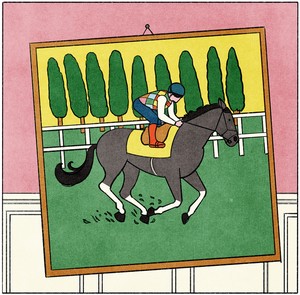
Just as Hollywood loves to lift the veil on itself, flashing its public audience with brief backstage private access, the art world lives for a self-referential moment but the great art-world novels go beyond the usual institutional critique or satire; they are literally worldly. Harry Mathews’s Cigarettes is a perfect example. This 1987 novel, republished this year by Dalkey Archive with a new introduction by Lucy Sante, tracks the intersecting affairs and ambitions of two upper-class families: A set of empty-nester parents and their twentysomething bohemian-leaning children and their friends. It takes place in Manhattan and Saratoga Springs in 1963, with flashbacks to the parents’ youth in 1936. In an early chapter, a racehorse named My Portrait and another named Capital Gains wink at the events to come. An early portrait painting of a “wild,” “sensual” woman, and reproductions of it, will circulate, revealing truths about our many characters. The portrait’s painter, as he abstracts his work, will gain a reputation as a midcentury master and become a mentor to one of the families’ daughters, an idol to her brother, and the lover of those siblings’ childhood friends. Financial crimes add to the drama. There’s a young romantic gay BDSM relationship described in far more elegant words than that and a father/daughter dynamic that isn’t Electra-like at all; it’s a different pattern, a genuine complex that’s yet to be diagnosed.
Mathews came from the worlds he depicts. East Coast private school and Ivy educated, married for years to his childhood friend the artist Niki de Saint Phalle, he traded manuscripts with John Ashbery and Georges Perec and wrote experimentally when writing was still widely considered under the umbrella of art. As Sante notes in her introduction to the new edition of Cigarettes, Mathews’s “books, stories and poems . . . for many years could not have financially sustained a part-time waiter in a tenement flat.” His privilege was not wasted: In 1983 he gave us Singular Pleasures, sixty-one vignettes about masturbation that read like Alice in Wonderland, and in 2005, My Life in CIA, an autofiction in which he’s a spy that does little to dispel the real-life rumor that he was indeed CIA. Cigarettes was his most accessible book of all, a best-seller in its time; it’s Gossip Girl for those who can read at a Jane Austen level. Elegant, romantic, and wry, Cigarettes even manages to end well. Its last pages are perfect.
The Wicked Pavilion (1954) by Dawn Powell
Dawn Powell didn’t move through life as effortlessly as Mathews seems to have. Born thirty-four years before him, in 1896, she did very well considering her time, sex, and tragic upbringing, but she had to grind. That grind is everywhere in her 1954 novel The Wicked Pavilion, recommended to me by the writer Audrey Wollen after I made a call-out for the greatest art-world novels of all time.
“How had I never heard of this?” I asked Wollen, twenty obsessed pages in. “How is she not more famous?”
“She’s a genius,” Wollen concurred. “Absolutely reads like now. The restaurant scenes . . .”
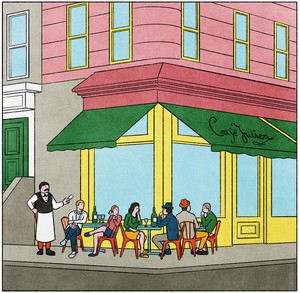
The Wicked Pavilion centers around the Café Julien, said to be a fictional version of the defunct Café Brevoort on Fifth and 8th above Washington Square Park, but it could be the Odeon or Lucien in New York or Paris Bar in Berlin, not in their heydays but in a moment right after, before the decline has been officially called, when the atmosphere’s like stale bread, runny butter, and warm dregs of Pernod. Powell wrote a whole other novel set around the art-world-famous Cedar Tavern (The Golden Spur, 1962), and elements of the Cedar sneak into the Julien as well. Artists and art-adjacent types, from collectors to journalists, flock there in the hopes that something will happen for them; in Powell’s version of events, missed connections are more common, and comic.
A failed painter with just enough money for a single drink and a train ticket out of New York installs himself at the Julien in the hope that his fortune will change. When fellow scenesters join his table and start ordering drinks on his bill, he resigns himself to paying for it all, recognizing that the illusion of success is more valuable than his last dollars and cents. Distracted by judgmental peers, the painter misses out on a commission opportunity. A pair of young lovers, similarly, cannot get it together: Terrified by the purity and force of their mutual attraction, each one acts out, triggering the other. Having met for the first time at the Julien, the man in this would-be perfect couple keeps going back there, hoping that the adorable girl with an art studio nearby will drop in. But she never does. Then there’s the unexpected friendship between Jerry and Elsie, neighbors with apartments near the Julien: Jerry, an aging good-time girl, never more beautiful in her thirties, and Elsie, a Boston society matron with a brother as uptight as the closet door he keeps firmly shut. When Elsie discovers that Jerry’s been asexually dating a beloved politician, the most coveted bachelor in their social bubble, she sets out to maneuver the two into marriage to increase her own social capital and thwart her classist brother. In the midst of all this, collectors and curators are hunting down paintings from a former Julien regular who died under mysterious circumstances in Mexico. Disregarded before his death, this painter now has a market so hot that his bereaved artist friends consider faking their own deaths.
The Wicked Pavilion is eerily contemporary. The writing itself isn’t contemporary, it’s too good! Too casually skillful. You can tell that Powell was immersed in a world of craft-serious readers and writers; that’s of another time. Her characters and their hijinks, though, have ego-doppelgängers all over New York and the international art world now.
Wollen and I speculated on why Powell isn’t better known. Too ahead of her time? Did she write too close to home? Were her elite characters based on real elites? Did she make enemies? Wollen noted a frankness about sex, including homosexuality and premarital sex, that’s banal now but certainly wasn’t during the Hays Code and McCarthy eras; perhaps she was censored. The Encyclopedia Britannica even has an explanation, citing “a general distaste for her harsh satiric tone” as responsible for her “relative obscurity.”
Gore Vidal championed Powell. In a long 1987 review for the New York Review of Books, he tried to make sense of her obscurity relative to her genius, which was, like his, harsh, satiric, and bawdy. The critic Diana Trilling objected to Vidal’s “lengthy, ill-written essay” in a letter to the editor, remarking that Vidal had selectively quoted from her negative commentary on Powell, omitting a glowing 1942 review in which she had proclaimed, “Miss Powell is one of the wittiest women around and our best answer to the familiar question, ‘Who really says the funny things for which Dorothy Parker gets credit?’”
You can find references to Powell’s obscurity and “rediscovery” on the popular television show Gilmore Girls circa 2001 and in the New York Times in 2023. Her books have fallen out of print multiple times, only to be republished in an optimistic surge, as Vidal made happen in the 1980s. Perhaps this—being forgotten—is not a curse or an injustice but one of an artist’s many joyous fates. Rediscovery is generous, endowing the author’s perennial readers with a sense of ownership, the feeling that they’ve stumbled upon some precious secret.
The Blazing World (2014) by Siri Hustvedt
Secrecy is one of the grand allures of the art world, or worlds. There are many great art novels internationally: The Moon and Sixpence by W. Somerset Maugham (1919), loosely based on the life of Gauguin and his travels in Tahiti; Boredom by Alberto Moravia (1960), about a spoiled Italian; Cat’s Eye by Margaret Atwood (1988), set in Toronto’s art world; An Episode in the Life of a Landscape Painter by César Aira (2000), the surreal fictional microbiography of a nineteenth-century German artist’s passage through South America; The Map and the Territory (2010) by the French writer Michel Houellebecq, who himself is a great visual artist (see his 2016 show at the Palais de Tokyo, Paris); Killing Commendatore by Haruki Murakami (2017), in which a Japanese portrait painter unveils a mystery (the book is legally deemed obscene in Hong Kong); and finally, another mystery novel, Lote by Shola von Reinhold (2020), which centers around the rediscovery of a fictional Black modernist poet and artist who was connected to Britain’s Bloomsbury Group of the early twentieth century. Veils, fantasies, fakes, gossip, speculation, and secrets fuel these books, as they do the art world of New York, which we’ll continue to focus on since it’s no secret that, from World War II to, perhaps, this very troubling year, New York has been the globe’s most central art hub. In Siri Hustvedt’s Blazing World (2014), Harriet Burden, the widow of one of the men who made New York’s postwar art world what it’s been, starts exhibiting her own art under the guise of different male avatars. A working artist before marrying her late husband, a prominent dealer, she disappeared into motherhood following their union, a fulfilling-enough place to hide. Wife-and-mother—this ready-made social role for a body, a beauty, like her own—was more convenient, if not easier, than pursuing the creative acclaim she craved. Burden cares what other people think; she’s been deep inside that side of the art world, networking, sales. Her rage at the baseline misogyny of her powerful husband’s industry is channeled into an intellectual obsession with bias, perception, and phenomenology. After he dies, she grieves both him and her thwarted ambition. Convinced by a therapist that it’s not too late—she’s only in her sixties, and rich—Burden comes up with a scheme in which her work can be experienced outside the debasing lenses of “wife of” and “woman artist.” The experiment ends in scandal and death.
The story is told through fictional documents: press interviews and reviews, journals and notebooks, letters and oral histories, the kinds of texts that make up art history and the art world. Masterfully put together, these assorted texts serve better than an omniscient narrator to reveal multiple lovable, infuriating characters as they navigate a changing art system.
The status of “minority” artists has changed tremendously in the shift from the twentieth century into the twenty-first. Burden has one foot in each, with more weight leaning on her back leg, her past; all the better to carve into a wave that will carry others forward. Her Y2K-era experiments with male avatars—two attractive young white men and one queer Black performance artist—reveal prejudices as stale as the bread on the table at the Café Julien; they crumble in Burden’s wake.
A digestif for the movement that was identity politics, The Blazing World is also a 9/11 novel, as, it turns out, a good many art-world novels are. It makes sense that novelists would process the violent visual spectacle that was 9/11 by writing on visual art, and the result is some of the best writing on both topics. In addition to The Blazing World in this canon, you’ll find William Gibson’s Pattern Recognition (2003), David Foster Wallace’s novella “The Suffering Channel” (2004), the Bernadette Corporation’s Reena Spaulings (2005), Don DeLillo’s Falling Man (2007), Amy Waldman’s Submission (2011), Thomas Pynchon’s Bleeding Edge (2013), and Ottessa Moshfegh’s My Year of Rest and Relaxation (2018). The Bleeding Edge and Pattern Recognition are my personal favorites. Set in the aftermath of the dot-com bubble, both feature unassuming female spies—one cool hunter and one private eye—tasked with corporate espionage. The art is online, the conspiracies are international, and the grief from the fall of the Twin Towers is personal for both.
Lee and Elaine (2002) by Ann Rower
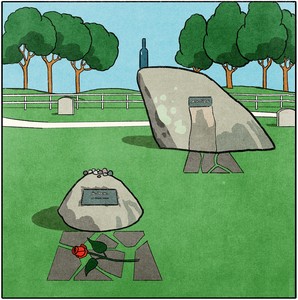
First published in 2002, Ann Rower’s Lee and Elaine has nothing to do with 9/11. It’s set in 1993 and brings us back to the topic of women. If anyone needs a reminder on how far white women artists have advanced in the art world, read Lee and Elaine, in which a writer named Ann Rower fantasizes about a love relationship between Lee Krasner and Elaine de Kooning. Ann, in this book, has created a residency for herself in the Hamptons. Ostensibly there to finish a biography of her uncle, Leo Robin, the real-life songwriter who wrote the lyrics to “Diamonds Are a Girl’s Best Friend,” she gets distracted when her frenemy, the real-life artist Hannah Wilke, dies and turns up in the nearby Green River Cemetery. Ann starts visiting the cemetery obsessively, sometimes with a female student she’s having a cringe-inducing affair with. Ann has long adored the work of Jackson Pollock—also interred at Green River—but knows little about his wife, the painter Lee Krasner, whose tombstone is almost identical to his, only a fraction of its size. Of equal mystery to Ann is fellow Green River Cemetery resident Elaine de Kooning, whose more-famous artist husband is still alive.
In one of my favorite scenes in the novel, Ann imagines herself meeting Lee and Elaine at a Krasner solo show in the 1950s. Ann is with her camp mate and secret girlfriend. They’re fourteen. Lee and Elaine are vague in this fantasy; the scene is really about Ann and her first girlfriend, whose innocent, instinctive bond is vastly different from the murky middle-aged affair in which Ann is mired. We soon learn that Ann has been with the same doting man for twenty years and wants to kill the relationship but can’t; she’s so passive, she’s almost like a corpse. That’s why she keeps returning to a cemetery. When her long-term relationship finally does end, midway through the novel, she embarks on a research mission, interviewing people who knew Lee and Elaine, determined to prove that they were friends, if not lovers.
It’s a privilege of my generation to have come up looking at Hannah Wilke’s images ignorant that she had a fraught relationship with Claes Oldenburg. And when I hear “Krasner” or “de Kooning,” my first thoughts aren’t Pollock or Willem. In 2018, Pulitzer Prize nominee Mary Gabriel gave us Ninth Street Women: Lee Krasner, Elaine de Kooning, Grace Hartigan, Joan Mitchell, and Helen Frankenthaler: Five Painters and the Movement That Changed Modern Art, a five-way biography that reinstated female artists’ prominence within the histories of Abstract Expressionism and the New York School. Before Ninth Street Women, Rower was researching the same topic in a clumsy, self-fulfilling way. Lee and Elaine is really Ann’s story, and that’s where the humor is. The closer she gets to their truth, the closer she gets to her own, and they’re not the same. Until recently, it was almost impossible to find Rower’s experimental novel. Thanks to Semiotext(e), Lee and Elaine will be available once again in the spring of 2026.