About an hour outside Oslo, near the small Norwegian town of Jevnaker, Kistefos has been assembling a world-class sculpture park and exhibition program. Alice Godwin visits the art museum—once a wood-pulp mill—and reports on the varied architectural, sculptural, and natural treasures to be found on its grounds.
Alice Godwin is a British writer based in Copenhagen, whose focus is the Nordic contemporary art world. An art history graduate from the University of Oxford and the Courtauld Institute of Art, she contributes to publications such as ArtReview, Frieze, the New York Times, and Wallpaper.
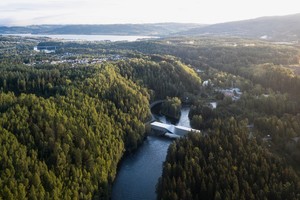
Kistefos lies an hour outside Oslo on the banks of the Randselva river, cushioned by a forest of spruce and pine and the sounds of water. The relative isolation of its sculpture park is one of the contributing factors behind its particular atmosphere, its sense that you’ve stumbled on some secret garden filled unexpectedly with pieces of art and an old industrial wood-pulp mill. Before I embark on my journey to Kistefos, through fjords and verdant hills, the museum’s chief curator, Kate Smith, explains, “We’re in the middle of nowhere, so you have to specifically want to visit Kistefos.” This feeling of intention, of the need for the time and space to explore, is integral to a place like this.
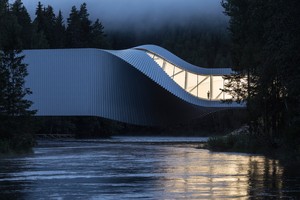
Kistefos has garnered an international reputation in recent years thanks, in part, to the Twist: a building part temporary-exhibition space, part bridge, and part sculpture in its own right, unveiled in 2019. The Twist looks a like a giant accordion arching over the river. Significantly, the year after it opened, the New York Times named Kistefos one of the “52 Places to Go in 2020.” Smith reflects, “The Twist really catapulted Kistefos into the limelight. It has become our calling card in many ways—we get a lot of architectural pilgrimages.” As visitors disembark by bus from Oslo, they experience an undeniable gravitational pull toward the Twist. The dense Norwegian forest opens up to a clearing that reveals the building’s meld of curving steel, timber, and glass over the gurgling river below.
David Zahle, a partner at the Danish architectural firm behind the Twist, the BIG–Bjarke Ingels Group, explains that the building answered a problem Kistefos didn’t actually know it had. “We found the flow of the park wasn’t really working anymore,” Zahle says. “Kistefos was planning on expanding a lot more, but all the expansions were ending up as dead ends.” Instead of coming up with a new building, BIG presented an idea for a bridge that would connect the two sides of the river with 1,000 square meters of exhibition space.
The exterior of the Twist at Kistefos, Jevnaker, Norway. Photo: Laurian Ghinitoiu
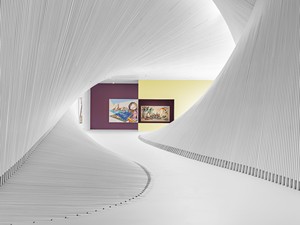
This year the Twist has hosted a show by the Los Angeles painter Christina Quarles. Her ethereal figures in flux, warped and squeezed into place, express how it feels to occupy a body, a gender, a race. Vivid burgundy walls interrupt the space of the Twist and encourage visitors to linger with the art before sprinting off to admire the building’s architectural feats. The show is titled after the vast Living in the Wake (2025), which Quarles poignantly began before and completed after the wildfires in California this year burned down her home. It’s an enormous painting—the largest stretched canvas she had yet attempted—that is indelibly tainted by the emotion of that time and by the artist’s physical exertion, straining to paint beyond the scale of her own arm span, a measure that typically guides her practice.
Hung low on the high walls, the paintings added to the otherworldly sensation of the Twist and even echoed its dizzying contortions. The bodies wriggled and writhed, bent and flailed over one another. For Smith, the result was “almost uncanny. We didn’t realize just how intense that association would be until the works arrived in the space.” Zahle was also delighted to hear about the unforeseen connection between Quarles’s paintings and the architecture: “It’s always both interesting and thrilling how people interact with your building in ways you hadn’t expected. That’s the beauty of it.”
From the Twist, two windows look out to the forest and toward the original water-powered wood-pulp mill—one of roughly a hundred that still exist in Norway but the only one to have almost all its infrastructure and equipment intact. The old mill contains several artworks, which have inevitably absorbed and been impacted by the industrial history of the place. The residue of the workers who lived on site with their families, their tools, and their lives pervades Kistefos in a way that separates it from other prominent sculpture parks. Tatiana Trouvé’s Bench and The Guardian (both 2024) allude to the laborers at rest, wanting to be left in peace, while Fabrizio Plessi’s Movimenti della memoria (Movements of memory, 2005) sees tree trunks attached to different items, such as chairs and buckets, that were left lying dormant after wood-pulp production stopped fifty years ago and have now been brought back to life.
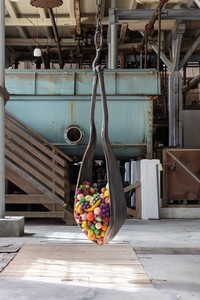
For the 2025 season, space in the old mill was cleared for a survey of the American sculptor Kathleen Ryan, a show that also spread into the nearby Nybruket Gallery—once the only dedicated exhibition space at Kistefos. Ryan’s array of scavenged objects, imbued with references to consumerism and manifesting hours of painstaking labor, made for a curious juxtaposition with its industrial surround. A string of bowling balls, like an enormous necklace, was looped over a rafter in the wood-pulp mill, alongside a pair of cast-iron calipers containing pieces of found, beaded fruits.
In Ryan’s Bad Fruit series (2018–), outsize lemons, melons, cherries, and the like are coated in semi-precious stones and beading. Notably, the cheapest acrylic and glass beads are used for the healthiest bits of the fruits’ flesh while the most expensive stones are reserved for the rotting sections. These molding pieces of produce formed another interesting counterpart to the industrial history of Kistefos, with its stilled factory and discarded tools. For Smith, Ryan’s sculptures “are largely about this idea of fallen decadence, luxury, decay, rot, and decline, so they work beautifully in this abandoned industrial site.”
Alongside the temporary exhibitions at Kistefos are the permanent works of art embedded in its landscape. The commissioning curator, William Flatmo, explains that since 2010 the park has added roughly two sculptures a year, and there are plans to continue that rhythm. He suggests the park can accommodate twenty-five additional works, with potentially more in the historic buildings. Flatmo is currently occupied with projects by artists Marguerite Humeau and Dana Schutz. “There are often multiple projects in the pipeline,” Flatmo says. “So if one is delayed, another can be fast-tracked. It’s an ongoing roulette.”
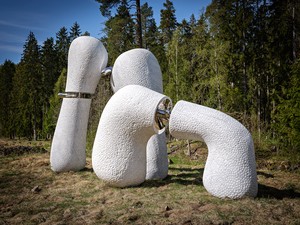
The latest addition to the park is Nairy Baghramian’s Resting Arms (2025), a monumental version of the Iranian-born artist’s series of knees and elbows whose suggested fragility is wonderfully belied by their durability in Carrara marble. Baghramian was drawn to the human history of Kistefos and its community of laborers. Resting Arms suggests a release in tension after a long day’s work, as the body rests and regains its strength. The sculpture lies in a fairly new area of the park, flanked by woodland and overlooked by a towering road bridge. Profoundly related to thresholds and structures of support, it is well placed in this “liminal zone,” as Smith describes it. Somehow the artwork holds its own against the impressive landscape. “That is something we stress to artists,” Flatmo explains: “nature’s capacity to absorb scale.”
The role of nature at Kistefos is inescapable. Water and trees and open skies are the lifeblood of this place, once the backbone of the wood-pulp industry and now the creative essence that has inspired artists making site-specific works here since 2005. And any commissions at Kistefos need to be able to handle the Norwegian climate—the changing seasons and the bracing winters. Flatmo talked to me about the idea of “permanence,” and the way a sculpture will respond to the landscape in the long term. Should Kistefos try to maintain the original quality of a work or allow it to transform over time? That decision is made by each artist installing there, Flatmo notes. In the case of Baghramian’s Resting Arms, the marble will be kept a purposeful, radiant white. Though quite how conservators will tackle this in the harsh climes of Norway is another question altogether.
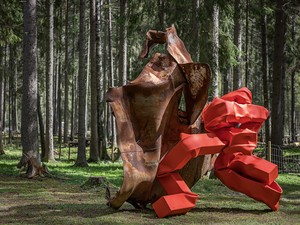
There is, then, a marvelous friction between the natural world and the interloping artworks that pepper Kistefos’s fifty acres of land. There are surreal moments, such as Claes Oldenburg and Coosje van Bruggen’s colossal tacks rolling down the hillside, like the castoffs of a giant (Tumbling Tacks, 2009). Perhaps one of the most surprising encounters is with Yayoi Kusama’s Shine of Life (2019), which erupts from the water like a massive sea monster with white-spotted red tentacles. Notably, Kusama is one of the few artists who did not come to Kistefos and spend time there while working on her commission, as the nonagenarian is no longer able to travel.
I’m struck during my visit by the overarching power of nature here, made overt by the warning signs placed along the riverbank, which caution visitors about the river’s strong currents. With Pierre Huyghe’s Variants (2022) it is the water (and perhaps, too, the temperament of a colony of bees hanging from a tree) that decides when the artwork is visible. Occupying a once-inaccessible piece of land, Variants is reachable only when water levels allow. It is made up of two realities—a virtual simulation of the island, shown on an LED screen and controlled by artificial intelligence, and the physical island itself. Each informs the other like an echo of the digital infiltration of our daily lives.
The role of nature at Kistefos is inescapable. Water and trees and open skies are the lifeblood of this place, once the backbone of the wood-pulp industry and now the creative essence that has inspired artists making site-specific works here since 2005.
Conversely, Marc Quinn harnesses the power of the water in an extraordinary forty-ton bronze-and-stainless-steel oval through which thunders the Randselva river (All of Nature Flows through Us, 2011). At first sight, the sculpture could be a three-dimensional impression of the earth, but it is in fact the iris of Christen Sveaas, the Norwegian businessman and collector who founded Kistefos in 1996.
Flatmo, who is also the director of Sveaas’s collection, observes, “Any madman can create a sculpture park, but only Christen Sveaas can create a sculpture park at Kistefos.” Sveaas’s grandfather was the original founder of the pulp mill, which shuttered in the 1950s. Sveaas grew up hearing stories about the place around his family’s kitchen table, and in the 1990s he bought back a majority ownership of the site, with the wish from the municipality that he would create an industrial museum there, manifested today through the preserved wood-pulp mill.
Over the years, the roster of invited artists has evolved from local, Nordic names to international figures. There are now some fifty-six sculptures at Kistefos, including fan favorites such as the Danish artist Jeppe Hein’s labyrinth of steel slabs and fountains, which seemed to delight children endlessly during my visit (Path of Silence, 2016). In 2019, Sveaas established the nonprofit Christen Sveaas Art Foundation. The following year he donated what was then half of his private collection to this foundation, the idea being that artworks would never need to be sold to fund Kistefos’s operations in the future.
Kistefos’s growing reputation speaks to a concurrent shift in the Norwegian art scene with the opening in Oslo of both the long-awaited Munchmuseet in 2021 and the new Nasjonalmuseet in 2022. To accommodate the huge uptick in numbers, Kistefos will open a new visitor center in June 2026, designed by the architectural firm Lundhagem Arkitekter on the park’s south side. The infrastructure is intended to blend seamlessly with the landscape and the heritage of Kistefos, using timber for a series of wooden columns that will look as if they might just have washed up on the riverbank.
Imminently, Kistefos will also be announcing the winner of another competition to build a brand-new building for Sveaas’s collection, with seven times as much exhibition space as the Twist. “It is a very sympathetic response to the need, but respecting Kistefos’s deeply ingrained history,” Smith explains. “That’s the heart of what Kistefos is about—that juxtaposition between industry and history and art and, of course, nature.” The building is scheduled to open in 2031 and eight architectural firms are currently in the running, including BIG–Bjarke Ingels Group. Zahle cannot say much about BIG’s plans when we speak over the summer, except, “We would love to keep working in the sculpture park; we’ll just have to come up with something that is as unique and surprising as the Twist.”
Photos: courtesy Kistefos, Jevnaker, Norway
Alice Godwin is a British writer based in Copenhagen, whose focus is the Nordic contemporary art world. An art history graduate from the University of Oxford and the Courtauld Institute of Art, she contributes to publications such as ArtReview, Frieze, the New York Times, and Wallpaper.