By the mid-twentieth century, photography permeated everyday life, serving as scientific evidence, family keepsake, journalistic record, and commercial image. Its boundaries were porous, remaining fluid even among those who argued that the medium could also function as a fine art.
At a gathering of leading figures organized by New York’s Museum of Modern Art in 1950 to discuss the state of photography, Irving Penn proclaimed that “the end product of [the photographer’s] efforts is the printed page, not the photographic print. . . . The modern photographer does not think of photography as an art form, or of his photograph as an art object.”1 It was the golden age of the magazine, and the thirty-three-year-old Penn had reached the height of his influence, having risen from Alexander Liberman’s design assistant at Vogue to become one of its star photographers.
By the early 1960s, however, Penn found himself increasingly dissatisfied with editorial work, particularly with how his pictures looked and functioned in print. During workshops led with his peer Richard Avedon, he observed that “the printed page seems to have come to something of a dead end for all of us,” conceding his uncertainty about how to proceed.2 Amid what he perceived as a broader decline in magazine production values—exemplified by Condé Nast’s 1964 shift from rotogravure to offset lithography—Penn began seeking a different outlet for his most serious creative ambitions.
The year before, while visiting the George Eastman House (now Museum) in Rochester, New York, Penn was unexpectedly “staggered by the prints made by the old photographers,” struck by their devotion to the print itself. This encounter prompted him to study early photographic literature and obsolete printing techniques in search of ways to endow his own work with greater presence and personal meaning. As he explained, his interest now lay in the “area of manipulation, of control, breakdown, [and] reconstruction in the making of a print.”3 Wanting to move beyond the constraints of assignments and standardized materials, Penn sought to pursue photography as an autonomous practice capable of producing enduring, materially expressive objects.
Platinum and gum bichromate—two nineteenth-century printing processes prized for their tonal depth and tactile surfaces—intrigued Penn most. Both peaked around the turn of the twentieth century, when Pictorialist photographers such as Alfred Stieglitz, Edward Steichen, and Gertrude Käsebier produced prints whose visible handiwork evoked oil on canvas or charcoal on paper. Working around the demands of his editorial career, Penn devoted himself to sustained experimentation with these processes, rigorously testing formulas, methods, and materials. Central to this new ethos was his embrace of the negative as a generative source capable of yielding multiple meanings through prints that varied in texture, scale, and tone, allowing him to reanimate and reinterpret key images from his oeuvre.
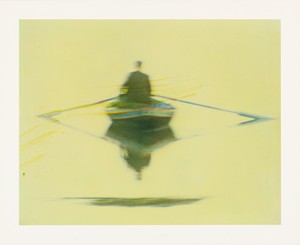
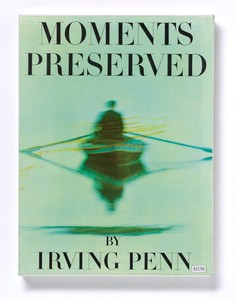
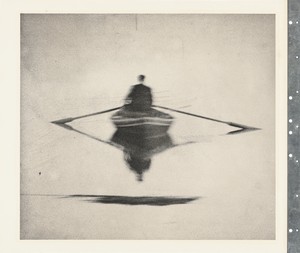
Among these was a color photograph Penn made in late summer 1951 of a man rowing on the Seine. When it appeared in Vogue in April 1953, the image was printed in a high key, suppressing extraneous detail and isolating the blurred figure against a hazy field. A wisp of bright streaks trails across the frame like an apparition—a flaw in the negative that Penn chose to accentuate rather than retouch. The photograph became a significant motif: He later tinted the background emerald green and selected it for the cover of his first monograph, Moments Preserved (1960). For exhibition, he produced a series of dye transfer prints, manipulating individual color channels to create variations whose emotional tenor shifts as the background moves from ivory white to pale yellow.4
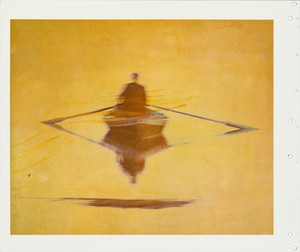
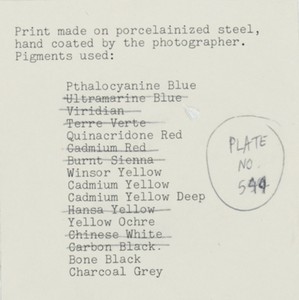
In 1969, Penn—by then, as he put it, a “victim of a printmaking obsession”5 —returned to Seine Rowboat, recasting the image as a gum bichromate print made by coating a surface with sensitized mixtures of pigment and gum arabic and exposing them through contact internegatives. The grain, already pronounced through extreme enlargement of a 35mm frame, was further intensified for pointillist effect. Drawing upon his training in high-end magazine production, Penn repeatedly coated and printed the image onto a single surface (here, porcelainized steel) using various pigments, producing an atmospheric, Turneresque composition.
Five years later, Penn returned to the motif once more, this time working in platinum metals on hand-coated paper. Using a bespoke pin-registration system he had developed to allow multiple coatings and exposures from different internegatives, he softened the image’s contrast while preserving its tonal density, imbuing the composition with a quieter, more contemplative intensity.
Taken together, these shifts, made over a period of two decades, embodied Penn’s conviction that the final object matters as much as the image it bears, demonstrating that a photograph can be at once commercial and uncompromising, reproducible and singular. Penn went on to produce a prolific and unsurpassed body of master prints that convey gravitas, permanence, and an almost sculptural sense of form. “Finally I arrived at the serene pleasure,” he later wrote, “of making the print itself.”6