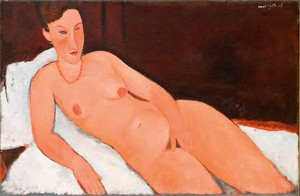
In December 1917, a modest gallery on the rue Taitbout in Paris became the setting for one of the more notorious episodes in the history of modern art. The occasion was Amedeo Modigliani’s first—and only—solo exhibition during his lifetime. This is how Berthe Weill, the gallery’s owner, would later remember the preview: “When the daylight faded, we turned on the spotlights. Intrigued to see so many people in the shop, a passerby stopped and stared. He was joined by a second, then a third; eventually, a crowd gathered. The division police commissaire, whose precinct was across the street, got upset. ‘What’s that? A nude?’ . . . He sent over a plainclothes cop with a friendly manner. ‘The commissaire orders you to remove that nude.’ ‘Really, why?’” Summoned to the police station, Weill was asked to “remove all that filth.” She boldly replied, “Fortunately, some connoisseurs don’t share that opinion. Besides, what’s wrong with those nudes, anyway?” “Those nudes! . . . Those disgus— . . . they . . . they . . . h-h-h-have hairs!” was the commissaire’s answer.1
By then Modigliani had spent several years in Paris, immersed in the bohemian milieu of Montparnasse. Known among peers for his sensuous, elongated figures uniting sculptural grace and modern eroticism, the young Italian painter and sculptor remained largely unknown to the general public. The exhibition presented around thirty paintings, four of them large female nudes unlike anything the Paris art world had seen. Visible through the gallery window, they confronted passersby with a directness that many found provocative, even obscene. Declaring the paintings indecent under censorship laws, the police ordered their removal, and when Weill resisted, they forced her to close the show, cutting it short before anything could be sold. Its impact however was profound, symbolizing the clash between avant-garde art and the conservative social mores of early-twentieth-century France.
For Modigliani, who was struggling with poverty and ill health, Weill’s exhibition represented a fleeting moment of recognition during his lifetime. Just three years later, aged only thirty-five, he would die of tuberculosis exacerbated by malnutrition and alcohol and drug consumption. His pregnant partner, Jeanne Hébuterne, would commit suicide a day later. Fame would come for Modigliani posthumously, and it proved both international in reach and lasting in impact. The intrepid young gallerist who organized his Paris debut, on the other hand, has until recently remained marginalized by history.
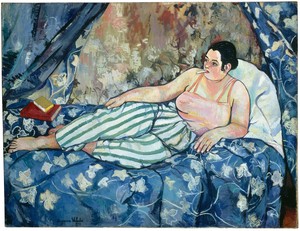
Make Way for Berthe Weill: Art Dealer of the Parisian Avant-Garde, a traveling exhibition curated by Sophie Eloy, Anne Grace, Lynn Gumpert, and Marianne Le Morvan, has finally shed light on this visionary dealer’s crucial role in advancing the early-twentieth-century avant-garde.2 Weill’s gallery was indeed the first in Paris devoted entirely to emerging artists, the only space, writes the art historian Michael C. FitzGerald, “exclusively committed to contemporary art.”3 The list of those who debuted there is impressive: André Derain, Kees van Dongen, Raoul Dufy, Henri Matisse, Maurice de Vlaminck, and Francis Picabia, to name just a few, while the Mexican Diego Rivera made his first Paris appearance there. Weill’s support of female artists is also noteworthy: Nearly a third of her exhibitions, and one in five solo shows, featured women. Among them were the African-American sculptor Meta Vaux Warrick Fuller, who found refuge from racism in Paris, as well as the support of Auguste Rodin, and Suzanne Valadon, former model of Pierre-Auguste Renoir and Henri de Toulouse-Lautrec, who defied convention as the first woman to paint male nudes.
Born in Paris in 1865 to a Jewish family of Alsatian origin, her father a ragpicker, her mother a seamstress, Weill grew up with limited means but remarkable independence of spirit and intellectual curiosity. In 1901, after apprenticing with an art and antique dealer, Salvator Mayer, she used her small dowry to open a tiny gallery on the rue Victor Massé in Montmartre. “I started out with just fifty francs in hand and went into debt to pay the costs involved in opening a shop. Obviously, the situation wasn’t ideal, but I couldn’t back out now. Besides, what was the worst that could happen? Not being able to hang on? I will hang on!!!”4
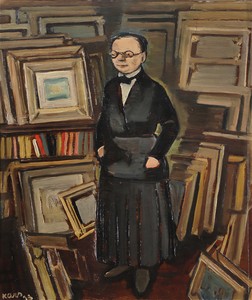
At first the venture specialized in books, prints, and posters, but it gradually turned toward contemporary art—a bold and risky move, particularly for a young Jewish woman. In France, these were times of rising and virulent anti-Semitism. The infamous Dreyfus Affair had shaken the nation to its core: In 1894, Alfred Dreyfus, a Jewish army officer, had been falsely accused of treason and condemned to exile on Devil’s Island, a remote penal colony off the coast of French Guiana. The wrongful conviction exposed deep fractures in French society, dividing the country into fiercely opposing camps. Launching a gallery in this climate was an act of courage for Weill, who, “standing barely five feet tall, with light blue eyes behind oval glasses, . . . deployed a keen wit, biting humor, and sharp eye for talent. She also cut a striking figure in an all-male guild, and her brash outspokenness clashed with the hushed, reserved murmurs of the commercial art world.”5
Driven by her conviction that the radical young artists of the time deserved to be seen, Weill persevered in her mission. Her business model differed sharply from that of her contemporaries. “For a debut exhibition,” writes Le Morvan,
the gallerist Eugène Druet would charge the artist for renting the space (18,000 francs, paid in paintings), as well as a 20 per cent commission, deducted from sales, to cover the cost of producing and sending out catalogs and of printing posters. Likewise, the Galerie La Licorne would deduct the cost of postage, promotion, press, posters, and frames from any profits made. So, before they could even exhibit, an artist had to lay out a substantial sum. Berthe Weill, on the other hand, did not charge for exhibitions, refusing any artist’s offer to pay; she even went so far as to give those in dire need her share of the takings and to share her table with them. She also refused to draw up exclusive contracts, considering them unfair on the artist.6
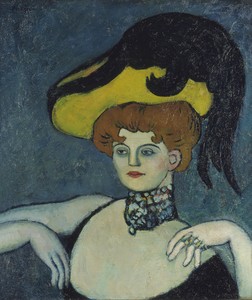
Weill’s vision was cosmopolitan and inclusive: “She was a superb talent-spotter, and what caught her eye evidently had little or nothing to do with an artist’s nationality, religion or ethnicity,” observes the history professor Charles Dellheim.7 Over the forty years of her gallery’s existence, about four hundred artists passed through it.8 When her finances allowed, she produced small catalogues, and in November 1923 she even started a publication of her own, Bulletin de la Galerie Berthe Weill. Unlike her wealthier rivals, Weill lacked the capital to acquire and hold works for future resale—a strategy used by Ambroise Vollard, for example, to create and monopolize Paul Cezanne’s market—so despite its ambitious program, her gallery always struggled amid scarce sales and few collectors.9 Its cultural significance and pioneering role, however, cannot be overstated. It was Weill who made the first sale of Pablo Picasso’s work in Paris, soon after he arrived from Barcelona for his first stay in the city, in October 1900: three small pastels depicting bullfighting scenes. Acquired from the Catalan industrialist-turned-artists’-agent Pedro Mañach for 100 francs for all three, they were immediately resold for 150 francs to Adolphe Brisson, the publisher of Annales Politiques et littéraires. Aged nineteen, virtually unknown, and speaking little French, Picasso had to rely on fellow Spanish expatriates to enter the Paris art scene. Mañach organized his debut at Vollard’s in 1901, but it was at Weill’s in April 1902 that his first Blue Period works appeared—none of which sold.
Facing chronic financial difficulties, Weill’s gallery relocated multiple times in response to shifting urban geographies and rising rents: from Montmartre to the rue Taitbout, then in 1920 to the rue Laffitte, and finally, in 1934, to the rue Saint-Dominique. During the 1920s it supported artists such as the Russian-born Marc Chagall, whose work combined modernist innovation with lyrical, folkloric imagery, and the Polish Moïse Kisling, who merged post-Impressionist colorism with classical forms. In 1933, Weill published her autobiography, Pan! . . . Dans l’œil! . . . ou trente ans dans les coulisses de la peinture contemporaine (1900–1930) (Pow! . . . Right in the Eye! . . . Thirty Years behind the Scenes of Modern French Painting), which appeared in English only in 2022.10 Its frontispiece featured a portrait of her by Picasso—testimony to their lasting mutual esteem, though by then the artist had found representation elsewhere, first with Daniel-Henry Kahnweiler and later with Paul Rosenberg.
By 1939, the combined pressures of economic hardship, the resurgence of anti-Semitism, and the looming threat of World War II forced Weill to close her gallery permanently. The enthusiasm and fearlessness that marked her extraordinary enterprise emerge vividly through her own words: “A flood of new ideas and concepts was busting out of Montmartre, a flowering that would blow away the pundits . . . and the world. The jokes flew and money was scarce . . . but what the hell!”11