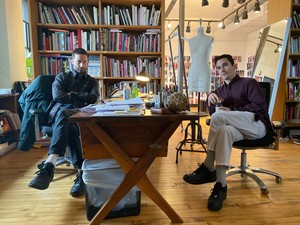
Fashion and Art: Proenza Schouler
Derek Blasberg speaks with Lazaro Hernandez and Jack McCollough, the designers behind the New York fashion brand Proenza Schouler, about their influences and collaborations, from Mark Rothko to Harmony Korine.
March 16, 2022
The artists chat about Korine’s luminous new paintings based on teddy bears, touching upon the color yellow, the fresh smell of gas, and the relationship among presidents, golf, and little stuffed animals.
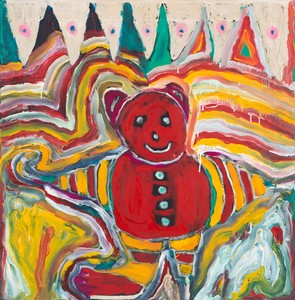
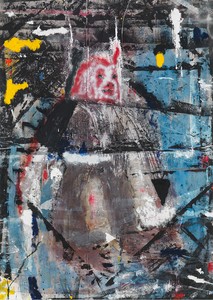
Harmony Korine, DoDo Bear, 2021, acrylic, house paint, and oil stick on canvas, 47 × 46 inches (119.4 × 116.8 cm)
Harmony Korine, DoDo Bear, 2021, acrylic, house paint, and oil stick on canvas, 47 × 46 inches (119.4 × 116.8 cm)
Rita AckermannAre your bears modeled after the Michelin guy?
Harmony KorineNo, but I like the connection. They have a similar body type. Like a busted bag of donuts.
RAThey’ve got those tire-like muscles for arms.
HKYes. I’m a fan of competitive arm wrestling. My favorite arm wrestler of all time was Cleve Dean. I based the body and style of the teddy bear paintings on Cleve’s vibe. He was from Georgia and could palm a baby sheep in one hand. He was known as the “arm breaker,” but all who knew him loved him. He was a teddy bear.
RAI used to love the Michelin guy when I was a kid.
HKYeah. The Michelin guy was a eunuch and a gas-huffer.
RADid you like trucks, gas stations, and the smell of gas when you were a kid? I got high on the smell of fresh gas . . . and nauseated right away.
HKYes, in the ’80s at a monster truck camp I went to in Daytona, I huffed a bag full of white-out and gas and it made me pass out.
RAWhen is the best time for you to catch ideas?
HKMostly while fishing or on the gun range.
RADo you paint while fishing?
HKNo, I can’t do both at once. But last year I caught a small teddy bear while fishing next to Fisher Island. I hooked its leg real good. That’s how I got the idea to paint it. It was so cute and it kept floating. You can’t kill those little bastards. They are eternal.
Your teddy bear paintings go deep . . . They are Van Goghian, worshiping the light and the sun.
Rita Ackermann
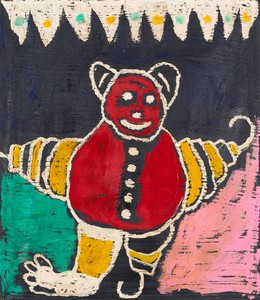
Harmony Korine, Huffy Bear, 2021, acrylic, house paint, and oil stick on canvas, 37 × 32 inches (94 × 81.3 cm)
RAWhat is your favorite color?
HKI love yellow. And neon yellow is the best. Lights up the world.
RAMy favorite color is yellow too! Your teddy bear paintings go deep, deeper than any other paintings I see . . . They are Van Goghian, worshiping the light and the sun.
Do you find that buttons can be elemental in a painting?
these teddy bear paintings couldn’t exist without buttons. Buttons are the punctuation marks of clothing.
Harmony Korine
HKYeah, these teddy bear paintings couldn’t exist without buttons. Buttons are the punctuation marks of clothing. The term “cute as a button” was popularized by Shirley Temple. I once saw a picture of Shirley Temple drinking a Shirley Temple; it was amazing to witness.
RAThere is no good painting without buttons, I think . . .
HKAgreed.
RAAre your teddies radiating?
HKYes, I try to make them radiate. I wish there was a way to insert actual radiation into the paint.
RACan we consider the teddy bear paintings a new chapter after the president paintings?
HKYes, a new chapter in comedy art. I’ve actually been thinking about having teddy bears playing golf.
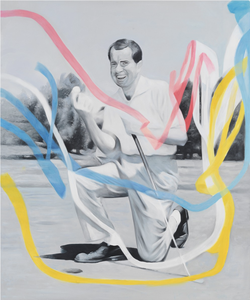
Harmony Korine, 37, 2019–21, oil on canvas, 73 × 61 inches (185.4 × 154.9 cm)
RAWhat are the connections between the presidents and the bears?
HK I wanted to paint presidents playing golf because I couldn’t believe how every president just keeps playing golf—no matter what happens in life, they play golf. It’s the most significant pastime for a president. I began to investigate why many golfers also begin sleeping with teddy bears later in life. I know a famous caddy from Delaware who claims that all the local golf pros sleep with teddy bears. There is a crossover at work, something most people are unaware of.
RAAre these teddies friendly golems to protect us from propaganda?
HKI think they’re mostly happy. They have never read a newspaper. They reject the metaverse. They don’t use human growth hormones. They seem religious. Mostly sweet.
RADamn, our conversation makes me love these teddies even more!
No wonder we get along so well with paintings . . . Send me back quick those paintings we are working on together and don’t forget to put some teddies in there with hook arms.
Artwork © Harmony Korine
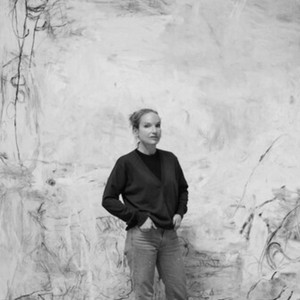
Rita Ackermann is a Hungarian-American artist currently based in New York City. Her depictions of New York’s downtown culture in the mid-1990s first brought attention to her work. Ackermann’s paintings, drawings, and collages combine Neo-Expressionist and figurative elements. Her work has been the subject of solo exhibitions at institutions such as the Museum of Contemporary Art, North Miami, Florida; Ludwig Museum, Budapest; Triennale di Milano; and Swiss Institute, New York.
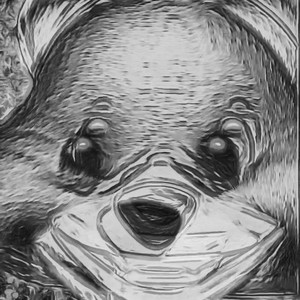
Harmony Korine is a film director, screenwriter, and artist who rose to prominence after penning the film Kids (1995). In the years since, he has created critically acclaimed cult classics, including Gummo (1997), Mister Lonely (2007), and Spring Breakers (2012), as well as the lauded street-art documentary Beautiful Losers (2008). Korine’s creative practice extends to photography, drawing, and figurative and abstract painting.
Derek Blasberg speaks with Lazaro Hernandez and Jack McCollough, the designers behind the New York fashion brand Proenza Schouler, about their influences and collaborations, from Mark Rothko to Harmony Korine.
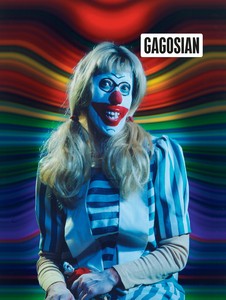
The Spring 2020 issue of Gagosian Quarterly is now available, featuring Cindy Sherman’s Untitled #412 (2003) on its cover.

From Kids to his new film The Beach Bum, Harmony Korine has continually revolutionized the art of cinema. In a wide-ranging discussion with film critic Emmanuel Burdeau, Korine reflects on the rewards and challenges of filmmaking and reveals what’s in store for the future.
The artist discusses his latest exhibition in New York with the Gagosian Quarterly, telling the story behind the works and their connection to his larger practice.
The artist sat down with Alicia Knock, curator of his exhibition at the Centre Pompidou, to discuss the power of mistakes, outsiders, and the marginal.

Ahead of Persephone, an exhibition of new paintings by Mary Weatherford inside Hong Kong’s historic Pedder Building, the Quarterly’s Wyatt Allgeier met with Weatherford and the architect Mark Lee to talk about their collaboration. Here, they discuss how custom architectural interventions—from mirrored columns to strategic light play—transform the gallery, evoking Persephone’s mythic journey through the underworld and back into the light of spring.

Ahead of her exhibition over the summer at the National Portrait Gallery, London, Jenny Saville met with the novelist Douglas Stuart to discuss Glasgow, the beauty and blemishes of bodies, and their respective creative processes.

Join Gagosian for a conversation between Derrick Adams and Ekow Eshun, author, curator, and chair of the commissioning group for the Fourth Plinth in Trafalgar Square, London. The pair discuss Adams’s latest paintings depicting visions of Black Americana—featured in the exhibition Situation Comedy at Gagosian, Davies Street, London—within the context of British contemporary culture.

To coincide with her exhibition Setsuko: Kingdom of Cats, at Gagosian, New York, the artist speaks with architect Peter Marino about her recent sculptures, paintings, and works on paper.

In conjunction with the exhibition Japanese Art History à la Takashi Murakami at Gagosian, London, Takashi Murakami and Hans Ulrich Obrist, curator and artistic director of Serpentine, London, sit down to discuss the artist’s exploration and contemporizing of ancient Japanese artworks and movements. The two delve into Murakami’s investigation of Iwasa Matabei’s seventeenth-century masterwork Rakuchū-Rakugai-zu (Scenes in and around Kyoto) and the Kyoto-based style of Rinpa painting, among other examples.

Join Gagosian for a conversation between Julian Rose, historian and critic of art and architecture, and Nicholas Serota, chair of Arts Council England and senior independent director on the BBC board, to celebrate the publication of Building Culture (2024), Rose’s new book about museum architecture. Rose and Serota discuss the ways in which museums are shaping the future of art, architecture, and public space.

Gagosian and Sadie Coles HQ hosted a conversation between Urs Fischer and film curator and writer Róisín Tapponi about fearless creativity and the artist’s most recent monograph, Urs Fischer: Monumental Sculpture.