
Spring 2024 Issue

Sofia Coppola: Archive

MACK recently published Sofia Coppola: Archive 1999–2023, the first publication to chronicle Coppola’s entire body of work in cinema. Comprised of the filmmaker’s personal photographs, developmental materials, drafted and annotated scripts, collages, and unseen behind-the-scenes photography from all of her films, the monograph offers readers an intimate look into the process behind these films.

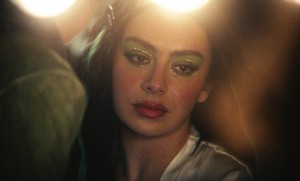
Kirsten Dunst on the set of The Virgin Suicides (1999), directed by Sofia Coppola. Photo: Sofia Coppola, from Archive (MACK, 2023)

Kirsten Dunst on the set of The Virgin Suicides (1999), directed by Sofia Coppola. Photo: Sofia Coppola, from Archive (MACK, 2023)

Kirsten Dunst on the set of The Virgin Suicides (1999), directed by Sofia Coppola. Photo: Sofia Coppola, from Archive (MACK, 2023)

Art making, and in Sofia’s case specifically film making, exists largely outside the realm of words. The work she creates comes into being by harnessing a kind of visual intuition with a rhythm and form that is mysterious and undulating, even tidal.

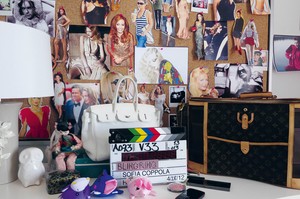
The set of The Bling Ring (2013), directed by Sofia Coppola. Photo: Sofia Coppola, from Archive (MACK, 2023)

Sofia Coppola on the set of Marie Antoinette (2006) directed by Sofia Coppola. Photo: Sofia Coppola, from Archive (MACK, 2023)

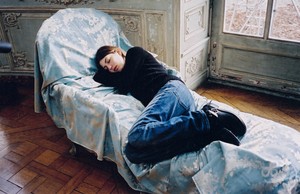
Scarlett Johansson on the set of Lost in Translation (2003), directed by Sofia Coppola. Photo: Andrew Durham, from Archive (MACK, 2023)

With each film, she conjures a magical world that is both complex and quiet. In the process, she finds her own language that is separate from the dominant strain, in harmony with the imagery.

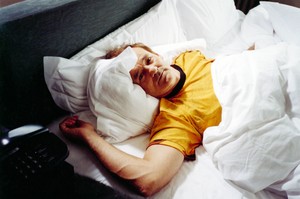
Bill Murray on the set of Lost in Translation (2003), directed by Sofia Coppola. Photo: Sofia Coppola, from Archive (MACK, 2023)

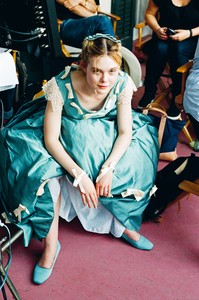
Elle Fanning on the set of The Beguiled (2017), directed by Sofia Coppola. Photo: Andrew Durham, from Archive (MACK, 2023)

This book is a peek into Sofia’s instrument at work.

—Rainer Judd

Photos: courtesy the artist and MACK

The “Gagosian & Film” supplement also includes: “Adaptability,” Not Running, Just Going,” “Whit Stillman,” “On Frederick Wiseman”, and “You Don’t Buy Poetry at the Airport: John Klacsmann and Raymond Foye

Sofia Coppola, Sofia Coppola: Archive 1999–2023 (MACK, 2023)

Francis Bacon: Reinventing Realism

Francis Bacon: Reinventing Realism

Francis Bacon lived and worked in Paris for a decade starting in the mid-1970s. The city and the art he encountered there provided a profound backdrop for his austere late style, which often brings together smooth, colorful backgrounds, spare architectural signifiers, and sculptural human forms. Here, three striking paintings from that period are considered by Sebastian Smee.

Divine Emanations: Nymphs, Poets, and the Painter’s Palette

Divine Emanations: Nymphs, Poets, and the Painter’s Palette

Janne Sirén considers Anselm Kiefer’s new paintings, the subject of an exhibition at Gagosian, New York, entitled Seal My Ears Shut and I Shall Hear You Still.

Giuseppe Penone: The Reflection of Bronze

Giuseppe Penone: The Reflection of Bronze

Adam D. Weinberg has been working with Giuseppe Penone on an exhibition of the artist’s new sculptures, The Reflection of Bronze, that opens at Gagosian, New York, on April 22. The works explore the character and possibilities of bronze. Here, Weinberg considers Penone’s enduring engagement with the alloy and addresses the conceptual underpinnings of the exhibition’s three-room structure.

Donald Judd: Patiently Constructed

Donald Judd: Patiently Constructed

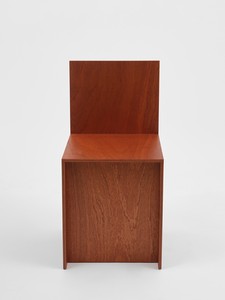
From their respective fields, three international cultural figures—artist and designer Ronan Bouroullec, fashion visionary Michèle Lamy, and chef and restaurateur Enrique Olvera—reflect on Donald Judd’s work in furniture, the subject of recent exhibitions in South Korea and Japan.

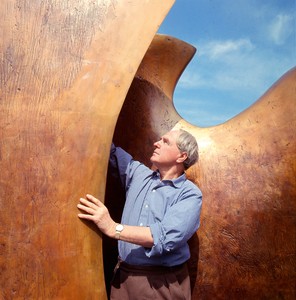
Henry Moore: Monumental Nature

Henry Moore: Monumental Nature

Laura Bruni writes about a major exhibition celebrating the work of the British sculptor Henry Moore at the Royal Botanic Gardens, Kew, London.

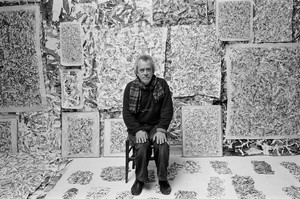
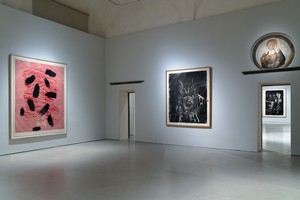
Georg Baselitz and the Possibilities of Print

Georg Baselitz and the Possibilities of Print

On the occasion of Baselitz: AVANTI! at the Museo Novecento in Florence, Italy, Holly EJ Black considers the roots and reverberations of Georg Baselitz’s printmaking.

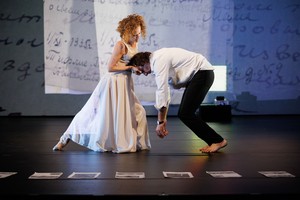
Portrait of the Artist as a Young Choreographer: Emily Coates Dances Early Balanchine

Portrait of the Artist as a Young Choreographer: Emily Coates Dances Early Balanchine

Mark Franko considers how Emily Coates resurrects the spirit of George Balanchine’s American beginnings through archival research, spoken dialogue, and movement in her performance Tell Me Where It Comes From.

Francesca Woodman: Brushing with Infinity

Francesca Woodman: Brushing with Infinity

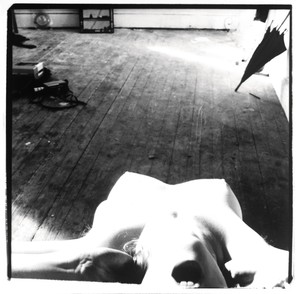
On the occasion of the exhibition Francesca Woodman: Lately I Find a Sliver of Mirror Is Simply to Slice an Eyelid at Gagosian, Rome, Alyce Mahon explores the artist’s engagements and affinities with Surrealism, from the writings of André Breton to the photographs of Hans Bellmer. Mahon focuses on the time Woodman spent in Rome while she was a student at the Rhode Island School of Design.

Ellen Gallagher: Submergent Visions

Ellen Gallagher: Submergent Visions

Sharad Chari reflects on a recent visit to Ellen Gallagher’s studio in Rotterdam, Netherlands, thinking through the artist’s intertextual interrogation of the oceanic and the ways in which her practice is informed by a wider Black intellectual and artistic world, an abiding interest in Herman Melville’s Moby-Dick, and the imperatives that surround this studio by the Port of Rotterdam.

The American Library in Paris

The American Library in Paris

Christian House reports on Paris’s American Library, a storied collection of English-language books in the French capital, tracking its evolution and enduring role in a cosmopolitan literary milieu from World War I to the present day.

Beatrice Wood

Game Changer
Beatrice Wood

Salomé Gómez-Upegui honors Beatrice Wood, the “Mama of Dada,” an underappreciated trailblazer within the movement who went on to become a brilliant ceramist.

Archigram: How Beautiful It Was Tomorrow

Archigram: How Beautiful It Was Tomorrow

D.A.P. and Designers & Books have published the first authorized facsimile of the highly influential and heterodox magazine Archigram, produced by the architectural collective of the same name between 1961 and 1974. This new edition faithfully duplicates the original nine and a half issues, complete with pop-ups, electric resistors, gatefolds, and all, and accompanies them with a collection of essays by key figures from the world of architecture. Here, Dan Fox considers the legacy of this innovative, irreverent, and prophetic magazine.