Carlos Valladares writes on the life and work of the legendary American filmmaker and documentarian.
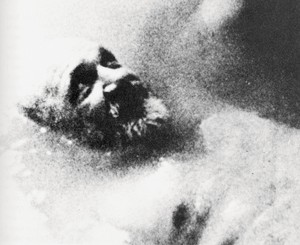
Still from Titicut Follies (1967), directed by Frederick Wiseman. Photo: RGR Collection/Alamy Stock Photo
Still from Titicut Follies (1967), directed by Frederick Wiseman. Photo: RGR Collection/Alamy Stock Photo
Carlos Valladares is a writer and critic from Los Angeles. He studied film at Stanford University and began his PhD in History of Art and Film & Media Studies at Yale University in fall 2019. He contributes regularly to Art in America, n+1, and Frieze. He lives in New York. Photo: Jade Sacker
“The measure of social change is if in a hundred years my films become comedies.”
At this remark from Frederick Wiseman—for me, the finest and most important working filmmaker of our time—the audience at the American Library in Paris breaks out in laughs.
Ahead of our conversation, we shared what we were both reading. Fred was in the middle of In Memory of Memory (2021), by Maria Stepanova, who had spoken at the American Library the night before. I told him I’d just finished Sodom and Gomorrah (1921), the fourth of Marcel Proust’s seven-volume novel À la recherche du temps perdu.
“Ahhhh . . . Proust!” cried Fred, with a sigh of delight. “What else is there to read after that?” He read it ages ago—around the time he was at Yale Law School, well before he made his documentary feature debut, Titicut Follies, the watershed 1967 exposé of the cruel and appalling conditions suffered by mental patients in the Bridgewater State Hospital in Massachusetts. The shocking film, whose exhibition was banned in Massachusetts for twenty-four years, announced Wiseman as a major voice in documentary cinema. But Follies bears little of the style that has marked his subsequent works, which are less sensational, quieter, and certainly much, much longer. All for the better.
Since 1967, Wiseman has made absorbing documentary after absorbing documentary in a cycle worthy of La recherche. It has no official name but could justly be called the Institutions series. The structural conceit behind these films has not changed: Wiseman (who records his own sound), a cinematographer (usually John Davey), and an assistant to the cinematographer record the day-to-day tasks of the workers and citizens inside an institution—usually American, usually places that provide a specific public service. In a 2020 profile, the New York Times considered the idea that Wiseman may be the true author of the great American novel. Indeed, to watch Wiseman’s forty-five films (I’ve only seen twenty-five of them) is to understand the history of the United States and of the transition of the twentieth century into the twenty-first, to know how we organize ourselves into these strange collectives we call “societies,” to feel the weight of the full complex range of human emotion and behavior. Welfare centers, zoos, hospices, domestic-violence clinics, shopping malls, juvenile courts, high schools, libraries, army training camps, neighborhoods such as Jackson Heights in Queens, New York, cities in the West such as Boise and Aspen, cities in the Midwest such as Monrovia, cities in the East such as Boston, European institutions such as London’s National Gallery and Paris’s Comédie Française—Wiseman has been to these all.
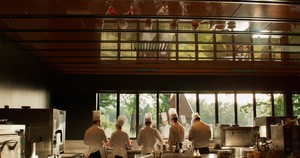
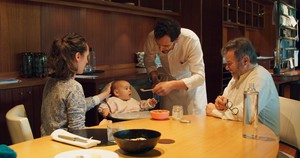
Still from Menus-Plaisirs—Les Troisgros (2023), directed by Frederick Wiseman. Photo: courtesy Zipporah Films
Wiseman’s Institutions series is neither stuffy nor tedious; these are engrossing movies. He charges town hall meetings with the energy and tension of football overtime kicks, though you wouldn’t know that from the descriptions provided by his production company, Zipporah Films, named after his late wife. Here’s how they sell his latest documentary, Menus-Plaisirs—Les Troisgros (2023), our main topic of conversation at the American Library:
The MENUS-PLAISIRS is a film about the Troisgros family and their three restaurants, Troisgros, Le Central and Colline, located in three neighboring locations in central France.
Troisgros, a restaurant founded 93 years ago, has had three Michelin stars for 55 years and in 2020 was awarded a Michelin green star for exemplary sustainable practices. Much of the film takes place at Troisgros.
The present chef, Cesar Troisgros, is the fourth generation of the family to be in charge at Troisgros. The film shows the day-to-day operations involving the purchase, preparation and service at this restaurant.1
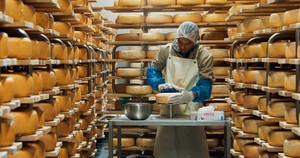
All good and right, but this overly neutral description doesn’t begin to convey the hypnotic thrill of one of the film’s early montages, a ten-minute stretch of various appetizers, mains, and desserts being prepped by the chefs in a cavernous kitchen as silent as a monastery: dessert plates dotted with chocolate and strawberries and glazed honey, crayfish, eels with the spines broken, lamb cutlets with two bones jutting tantalizingly out. Still later, we observe the Troisgros father and son talk with their suppliers to ensure they’re getting the best, most sustainable produce possible—we see them check in with the owners of vineyards where grapes are picked, with farmers who use an ominous pumping machine to milk twenty goats at a time, and with the owners of pastures where cows eat grass and chew their cud in calm. No, we don’t visit an abattoir, though perhaps if we remember Wiseman’s 1976 documentary Meat, which “traces the process through which cattle and sheep become consumer goods,” we won’t have to strain too much to imagine how the cow turns into beef Wellington.
Still from Menus-Plaisirs—Les Troisgros (2023), directed by Frederick Wiseman. Photo: courtesy Zipporah Films
Still from Menus-Plaisirs—Les Troisgros (2023), directed by Frederick Wiseman. Photo: courtesy Zipporah Films
The great comic set piece in Menus-Plaisirs—there’s always one—is when Michel Troisgros, the stalwart patriarch of the Troisgros family, taste-tests a main that for his palette is far too spicy. He complains every other sentence about the dish’s pepperiness, but he can’t stop scarfing it down! He loves the passion fruit, he loves the meat, but it’s too spicy. Yet he can’t stop eating. He finishes every last bit of the culprit, its spicy sauce packed with sriracha, practically licking it off the plate. In moments like this, Michel’s care and love for his cuisine peek out. He doesn’t work to maintain the quality abstractly projected onto him by a few Michelin stars (though the stars certainly sparkle), nor does he consciously work to maintain a slavish devotion to the family tradition (though surely he wants to honor the memory of his fathers and grandfathers). He cooks for the here and now, for the pure love of cooking. And he cooks because he has to.
Proust, too, wrote because he had no other alternative. Wiseman, too, films because he must. For my money, to talk with and be in the presence of Wiseman—even for that brief night in Paris—is something like standing in the company of Proust. And the two are quite linked: both are involved in intricately well-proportioned projects of longueur. “What is time, memory, love?” asks Proust. “What is society, how do I relate to a group, why do we act in the way we do?” asks Wiseman. Much of both artists’ strength is caught up in their serene, sharp, slow-tango pace. Sure, we might question, at times, their length. A naive—let’s say, unhabituated—newcomer to Wiseman’s work might very well ask, to paraphrase an editor who infamously rejected The Way by Swann’s (1913) for publication, “I fail to understand why a man needs ten minutes to show how a farm feeds a cow.” Well, sure. From one angle, it may be excessive. But that is the life of a man, one particular man, this farmer, who exists independent of the fine-dining drama that has initially enticed us to observe. A sommelier, extolling the qualities of a wine to a customer, describes the process of winemaking as “comme l’écriture”—just like writing. There is a “progression” in how it is grown, the sommelier says, there is “an order, a tradition, that must be passed down.” This is no mere sales prattle. What does the sommelier describe if not the very act of creation—whether writing a novel, fermenting a cheese, painting a portrait, or filming a documentary?
Wiseman, like Proust, has an elastic delight with his chosen medium; he is enamored with it; and the scenes he captures (momentarily) today will reverberate with scenes across all his movies, creating lyrical rhymes, returns, repetitions across his work. There are the ubiquitous meetings where we seem to spend ages of time, the conversations hammering out the minutiae of how to run a French strip club or whether undocumented immigrants will be able to get driver’s licenses in the state of Idaho. But Wiseman never follows his subjects back to their homes to watch them cook or make love or watch The Real Housewives of Salt Lake City. Just as Proust can never know what Swann or Gilberte or Albertine are really thinking, Wiseman knows that he can never uncover the whole truth—only bits, the bits that he finds interesting, the bits that I might have been tempted to dismiss as banal and irrelevant to a story. What we see in a Wiseman documentary has only the illusion of feeling comprehensive, then, but the more you watch, the more you realize that he can’t be here and elsewhere. One is here, others are there. He is a subject in a web of other subjects. He is fated to biases. The goal is to see and hear as far as one can muster. And oh, can Wiseman muster.
When I asked how he edits his films, Wiseman replied, “The greatest film-editing textbook I have come across is the correspondence between Gustave Flaubert and George Sand.” And it is in A Couple (2022)—Wiseman’s strangest film of all, a sixty-three-minute dramatization of Sophia Tolstoy reading aloud the letters that she wrote to her husband, the famous Count Leo—that we might find something of a skeleton key, a tuned fork or a madeleine, into a Wiseman view of the world. A Couple was made soon after the death of Wiseman’s longtime wife, Zipporah. I don’t presume to know the specifics of any given relationship, even the ones that my friends tell me about in deep detail—let alone Wiseman’s. But it seems to me that in A Couple he has made a film that can be a stand-in for what he wants to say in all of his other films. The root of a relationship, a relationship of any kind, is talk. Not always literal talk, but gaps and breaks and the gestures of communication. Why do we communicate in a different way with the people in our lives than we do when we consciously create for public consumption, whether a bit for our friends at a bar or a magnum opus like War and Peace or La recherche? Our lives are built around conversations, the bread and butter of all Wiseman’s films. A Couple—which is a confession, a prayer, an unsent love letter, an apology, an appeal, an elegy, a wish, a farewell, a welcome, an outtake, a hope—asks the central question that implicitly haunts Wiseman’s Institutions series: how can we talk more clearly? How can we understand that the math teacher’s simple appeal for more “information” on a pencil-sketched graph also doubles as a compact line of cinematic poetry? How can we filter the endless information that fries our tiny brains? In what ways do our words have consequences, whether for a woman at the welfare center asking for more money to feed her children in a loveless capitalist system, or for the person we wake up next to every day and ask ourselves “How deeply do I love you today”?
I don’t have answers, Wiseman doesn’t pretend to either. But these are the questions that should keep us up at night. Clearly, Wiseman’s interests are not limited exclusively to film. He takes a passionate interest in the world around him, its literature, its examples of how to organize a society, how to love. What goes on behind the librarian’s desk, the Dantean depths of an American public hospital, the hospital room of a terminally ill grandmother who’s about to say “I love you” for the last time? Wiseman’s questions are those of the most passionately interested dilettante in the world, the most intensely involved amateur, and I mean this as the highest compliment, not the bastardized negative connotations that words like “amateur” suggest. After all, the base of the word “amateur” is “amour”: love.
1 “Menus-Plaisirs—Les Troisgros,” 2023, description on the website of Zipporah Films. Available online at http://www.zipporah.com/films/34 (accessed January 11, 2024).
Carlos Valladares is a writer and critic from Los Angeles. He studied film at Stanford University and began his PhD in History of Art and Film & Media Studies at Yale University in fall 2019. He contributes regularly to Art in America, n+1, and Frieze. He lives in New York. Photo: Jade Sacker