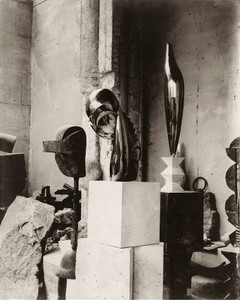
In the Studio: John Elderfield and Peter Galassi
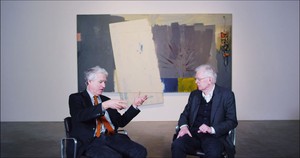
Curators John Elderfield and Peter Galassi discuss their major exhibitions In the Studio: Paintings and In the Studio: Photographs.
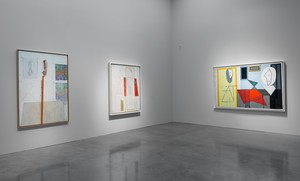
Installation view
Artwork, left to right: © Jasper Johns/Licensed by VAGA, New York; © 2014 Estate of Pablo Picasso/Artist Rights Society (ARS), New York. Photo: Rob McKeever
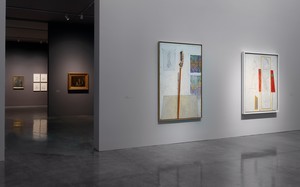
Installation view
Artwork, left to right: © Jasper Johns/Licensed by VAGA, New York; © 2014 Estate of Pablo Picasso/Artist Rights Society (ARS), New York. Photo: Rob McKeever
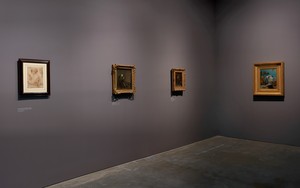
Installation view
Photo: Rob McKeever
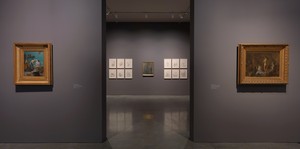
Installation view
Photo: Rob McKeever
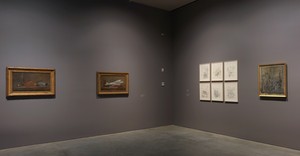
Installation view
Photo: Rob McKeever
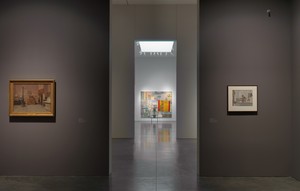
Installation view
Artwork © Robert Rauschenberg Foundation/Licensed by VAGA, New York. Photo: Rob McKeever
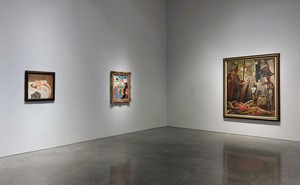
Installation view
Artwork, left to right: © The Lucian Freud Archive/Bridgeman Images; © 2014 Succession H. Matisse, Paris/Artists Rights Society (ARS), New York; © 2015 Banco de México Diego Rivera Frida Kahlo Museums Trust, Mexico, D.F. / Artists Rights Society (ARS), New York. Photo: Rob McKeever
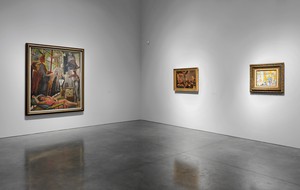
Installation view
Artwork © 2015 Banco de México Diego Rivera Frida Kahlo Museums Trust, Mexico, D.F. / Artists Rights Society (ARS), New York. Photo: Rob McKeever
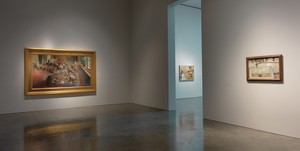
Installation view
Artwork, left to right: © Robert Rauschenberg Foundation/Licensed by VAGA, New York; © The Lucian Freud Archive/Bridgeman Images. Photo: Rob McKeever
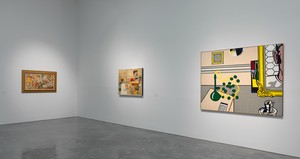
Installation view
Artwork, left to right: © 2014 The Willem de Kooning Foundation/Artists Rights Society (ARS), New York; © Robert Rauschenberg Foundation/Licensed by VAGA, New York; © Estate of Roy Lichtenstein. Photo: Rob McKeever
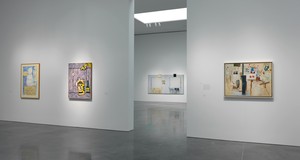
Installation view
Artwork left to right: © Jasper Johns/Licensed by VAGA, New York; © Estate of Roy Lichtenstein; © Estate of Larry Rivers/Licensed by VAGA, New York. Photo: Rob McKeever
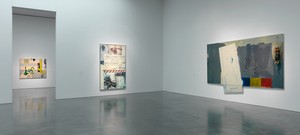
Installation view
Artwork, left to right: © Estate of Roy Lichtenstein; © Robert Rauschenberg Foundation/Licensed by VAGA, New York; © Jasper Johns/Licensed by VAGA, New York. Photo: Rob McKeever
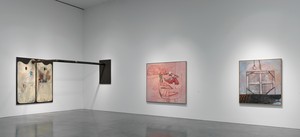
Installation view
Artwork, left to right: © Jim Dine/Artists Rights Society (ARS), New York; © The Estate of Philip Guston. Photo: Rob McKeever
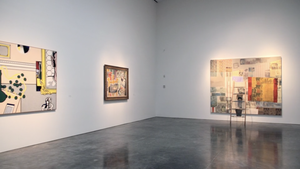
Installation video
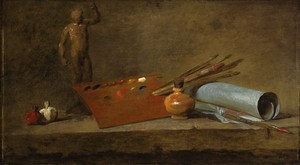
Jean-Baptiste Siméon Chardin
Attributs du peintre (Attributes of the Painter), c. 1725–27
Oil on canvas, 19 ⅝ × 33 ⅞ inches (50 × 86 cm)
Princeton University Art Museum, Gift of Helen Clay Frick
Photo: Bruce White
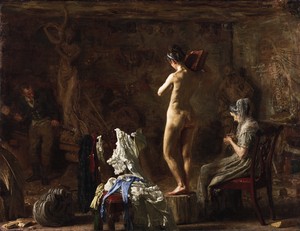
Thomas Eakins
William Rush Carving His Allegorical Figure of the Schuylkill River, 1876–77
Oil on canvas (later mounted on Masonite), 20 ⅛ × 26 ⅛ inches (51.1 × 66.4 cm)
Philadelphia Museum of Art, Gift of Mrs. Thomas Eakins and Miss Mary Adeline Williams
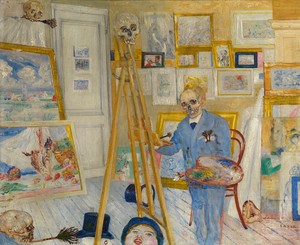
James Ensor
Squelette peintre (The Skeleton Painter), c. 1896
Oil on panel, 14 ⅝ × 17 ¾ inches (37 × 45 cm)
Koninklijk Museum voor Schone Kunsten, Antwerp
© 2014 Artists Rights Society (ARS), New York/SABAM, Brussels. Photo: Hugo Maertens
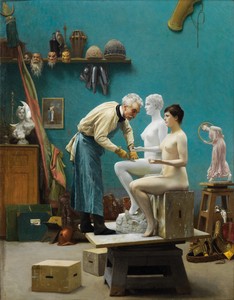
Jean-Léon Gérôme
Le travail du marbre, or L’artiste sculptant Tanagra (Working in Marble, or The Artist Sculpting Tanagra), 1890
Oil on canvas, 19 ⅞ × 15 ½ inches (50.5 × 39.4 cm)
Dahesh Museum of Art, New York
Photo: Rob McKeever
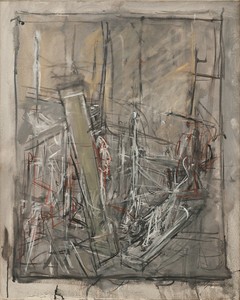
Alberto Giacometti
L’atelier (The Studio), 1951
Oil on canvas, 29 ½ × 23 ½ inches (74.9 × 59.7 cm)
Carnegie Museum of Art, Pittsburgh, Gift of Mr. and Mrs. Charles Zadok
© Alberto Giacometti Estate/Licensed by VAGA and ARS, New York
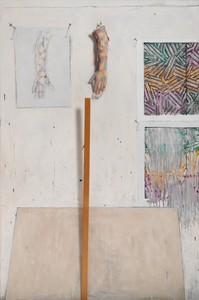
Jasper Johns
In the Studio, 1982
Encaustic and collage on canvas with objects, 72 × 48 × 5 inches (182.9 × 121.9 × 12.7 cm)
© Jasper Johns/Licensed by VAGA, New York. Photo: GraydonW
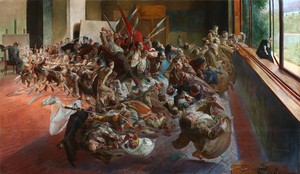
Jacek Malczewski
Melancholia (Melancholy), 1890–94
Oil on canvas, 54 ¾ × 94 ½ inches (139 × 240 cm)
Muzeum Narodowe w Poznaniu, Poznań, Fundacja Raczyńskich
Photo: Adam Cieslawski
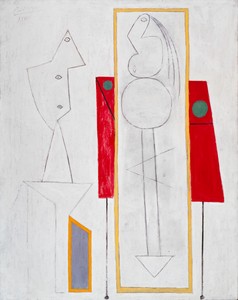
Pablo Picasso
L’atelier (The Studio), 1928
Oil and crayon on canvas, 63 ⅝ × 51 ⅛ inches (161 × 129.9 cm)
The Solomon R. Guggenheim Foundation, Peggy Guggenheim Collection, Venice
© 2014 Estate of Pablo Picasso/Artists Rights Society (ARS), New York
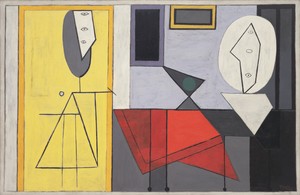
Pablo Picasso
L’atelier (The Studio), 1927–28
Oil on canvas, 59 × 91 inches (149.9 × 231.2 cm)
The Museum of Modern Art, New York, Gift of Walter P. Chrysler, Jr.
© 2014 Estate of Pablo Picasso/Artists Rights Society (ARS), New York
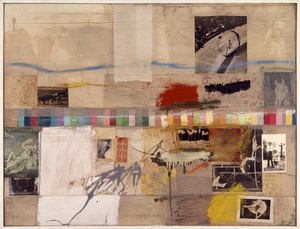
Robert Rauschenberg
Small Rebus, 1956
Oil, pencil, paint swatches, paper, newspaper, magazine clippings, black-and-white photograph, map fragments, fabric, and three-cent stamps on canvas, 37 ⅜ × 46 ¼ inches (95 × 117.5 cm)
Museum of Contemporary Art, Los Angeles, The Panza Collection
© Robert Rauschenberg Foundation/Licensed by VAGA, New York
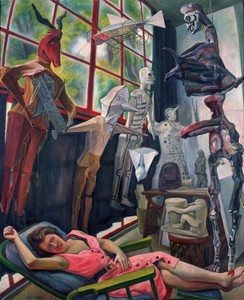
Diego Rivera
Estudio del pintor, or Lucila y los judas (The Painter’s Studio, or Lucila and the Judas Dolls), 1954
Oil on canvas, 70 × 59 inches (178 × 150 cm)
Acervo Patrimonial, Secretaría de Hacienda y Crédito Público, Mexico City
© 2014 Banco de México Diego Rivera Frida Kahlo Museums Trust, Mexico, D.F./Artists Rights Society (ARS), New York
Gagosian is pleased to present a pair of major exhibitions, curated by John Elderfield and Peter Galassi, devoted to images of artists’ studios, in paintings and in photographs. The subject of the artist’s studio in works of art is a very large one with a long history: the spaces where art is made, and the means by which it is made in that space, have proved fascinating to both its creators and its viewers. The aim of this pair of exhibitions is to explore important themes in the development of the subject within these two mediums.
Curated by John Elderfield, Chief Curator Emeritus of Painting and Sculpture at the Museum of Modern Art, New York, In the Studio: Paintings, on view at 522 West 21st Street, spans from the mid-sixteenth through the late twentieth centuries and includes over fifty paintings and works on paper by nearly forty artists. The earliest and longest standing motifs—the painter at the easel, pedagogical scenes, and images of artists and models—can be observed in works by Wilhelm Bendz, Honoré Daumier, Thomas Eakins, Lucian Freud, Jean-Léon Gérôme, William Hogarth, Henri Matisse, and Pablo Picasso. Focus on the appearance of the studio itself, which came later in the history, is represented here in paintings by Constantin Brancusi, Alberto Giacometti, Louis Moeller, and Alfred Stevens. Fictional or imaginary studios, a popular subject beginning at the end of the nineteenth century, include canvases by James Ensor, Jacek Malczewski, and Diego Rivera. Emphasis on artists’ materials can be traced from eighteenth-century works by Jean-Baptiste Siméon Chardin to nineteenth-century works by Carl Gustav Carus and Adolph von Menzel, through postwar American artists Jim Dine, Philip Guston, and Jasper Johns. Representations of the wall of the studio, illustrating both the artist’s own work and that of others, were also prevalent in the postwar period, as seen here in paintings by Richard Diebenkorn, Helen Frankenthaler, Roy Lichtenstein, Robert Rauschenberg, and Larry Rivers.
Several paintings in this exhibition have not previously been seen in New York, including Jacek Malczewski’s Melancholia (1890–94, Muzeum Narodowe, Poznań, Poland) and Diego Rivera’s The Painter’s Studio (1954, Acervo Patrimonial, Secretaría de Hacienda y Crédito Público, Mexico City). A pair of paintings by Picasso, both titled L’Atelier (1927–28, on loan from the Museum of Modern Art, New York, and the Peggy Guggenheim Collection, Venice), have never been exhibited together in the United States.
Curated by Peter Galassi, former Chief Curator of Photography at the Museum of Modern Art, New York, In the Studio: Photographs, on view at 980 Madison Avenue, includes nearly 150 photographs by over fifty artists—spanning from the origin of the medium to the late twentieth century—and is divided into three particularly rich themes within the broader subject of images of the artist’s studio. The first of these identifies the studio as an arena for “Pose and Persona,” an artificial zone for the display of the body, and includes works by artists ranging from Eadweard Muybridge, Brassaï, and Walker Evans to Richard Avedon, Lee Friedlander, and Cindy Sherman. The nudes and portraits assembled here are exemplary because they acknowledge the role of the setting, accentuate the deliberateness of a pose, or highlight the purposeful enactment of a persona. In the second section, “Four Studios,” in-depth selections of photographs by Constantin Brancusi, André Kertész (photographing Piet Mondrian’s Paris studio), Lucas Samaras, and Josef Sudek show the studio as a total aesthetic environment. For these photographers (as well as for Mondrian), the studio was home as well as workplace and became an all-encompassing aesthetic environment—an embodiment of a unique artistic identity and perhaps an instrument for realizing it. In the third and final section, “An Embarrassment of Images,” photographs by John O’Reilly, Robert Rauschenberg, Weegee, and others engage the studio wall as a site for the accumulation and display of images.
Curators John Elderfield and Peter Galassi discuss their major exhibitions In the Studio: Paintings and In the Studio: Photographs.
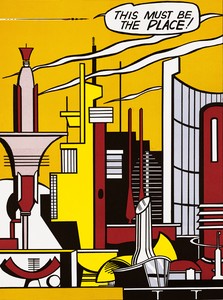
Avis Berman’s biography of Roy Lichtenstein, Becoming Roy Lichtenstein: The Path to Pop, will be published this fall by Abbeville Press, aligning with a major retrospective at the Whitney Museum of American Art, New York, in October. For the Quarterly she has adapted part of her text to focus on the artist’s formative experiences in New York in the 1920s and ’30s.

On January 22, Gagosian, in partnership with Castelli Gallery, opened an exhibition of historic works by Jasper Johns at the 980 Madison Avenue gallery in New York. A survey of the crosshatch paintings and drawings that dominated his practice from 1973 to 1983, the presentation united works that have rarely been seen with loans from sources including distinguished American museums. The exhibition commemorates the fiftieth anniversary of this body of work’s debut at Castelli Gallery in 1976. Here, Larry Gagosian speaks with the Quarterly’s Alison McDonald about the impetus for this project, his memories of seeing the exhibition in 1976, and the enduring impact of these paintings on artists and collectors.
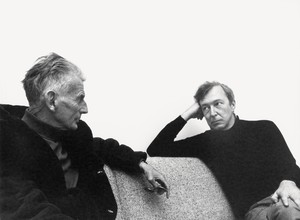
Nearly fifty years ago, Samuel Beckett and Jasper Johns met in Paris and began a collaboration on what would become Foirades/Fizzles, a deluxe limited-edition artist’s book published by Petersburg Press in 1976. Now, on the occasion of the Jasper Johns retrospective at the Philadelphia Museum of Art and New York’s Whitney Museum of American Art, Gagosian Quarterly looks back to the genesis of this project with a conversation between independent researcher Anthony Atlas and Gagosian director Bob Monk. Their discussion focuses on the creative encounter between the artist and the writer and on how the book and related works became a generative source in Johns’s art.

The Summer 2025 issue of Gagosian Quarterly is now available, featuring Pablo Picasso’s Nu accoudé (1961) on the cover.

On April 18, the exhibition Picasso: Tête-à-tête opened at Gagosian, New York. Including works from 1896 to 1972, the full span of the artist’s career, the show is presented in partnership with Paloma Picasso, the artist’s daughter. Here, Michael Cary, one of the organizers of the exhibition, traces the historical precedents that informed the conversational nature of the curation. He also introduces a translation of a 1932 interview with Picasso by the publisher and critic E. Tériade, often quoted in English in part but not in full.

On the occasion of Willem de Kooning: Endless Painting, curated by Cecilia Alemani and comprising paintings from 1944 through 1986 and two sculptures, the Quarterly revisits a conversation between Albert Oehlen and John Corbett from 2013. The pair reflect on de Kooning’s late work and its lasting influence on them.

In the second part of a two-part essay, art historian John B. Ravenal considers Jasper Johns’s continued engagement with the motif of woodgrain.

As American identity once again comes into question during a politically charged election cycle, the Quarterly revisits the motif of the American flag in art. Here, John B. Ravenal contextualizes Robert Lazzarini’s new wall-based flag sculptures and elucidates the tensions they lay bare in the symbol of our nation.

In the first part of a two-part essay, art historian John B. Ravenal considers Jasper Johns’s continued engagement with the motif of woodgrain.
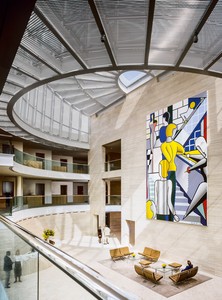
Michael Ovitz, cofounder of Creative Artists Agency (CAA), looks back to 1989, the year he and the architect I. M. Pei commissioned Roy Lichtenstein to create the Bauhaus Stairway Mural for the then new CAA Building in Los Angeles. Through the experience of working with Lichtenstein, Ovitz formed a meaningful friendship with the artist.
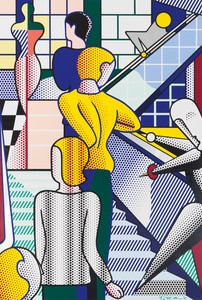
Alice Godwin and Alison McDonald explore the history of Roy Lichtenstein’s mural of 1989, contextualizing the work among the artist’s other mural projects and reaching back to its inspiration: the Bauhaus Stairway painting of 1932 by the German artist Oskar Schlemmer.
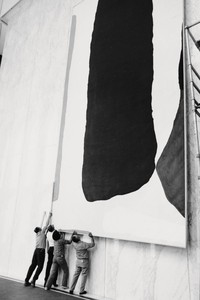
John Elderfield and Lauren Mahony of Gagosian speak with the National Gallery of Art’s Harry Cooper about the new and expanded version of Elderfield’s 1989 monograph on Helen Frankenthaler that Gagosian, in collaboration with the Helen Frankenthaler Foundation, will publish this summer. The conversation traces Elderfield’s long interest in Frankenthaler’s work—from his time as a young curator at the Museum of Modern Art, New York, to the present—and reveals some of the new perspectives and discoveries awaiting readers.
The Summer 2024 issue of Gagosian Quarterly is now available, featuring a detail of Roy Lichtenstein’s Bauhaus Stairway Mural (1989) on the cover.
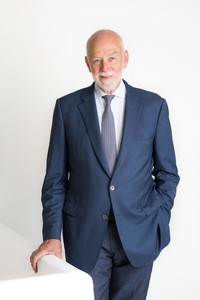
Richard Armstrong, director emeritus of the Solomon R. Guggenheim Museum and Foundation, joins the Quarterly’s Alison McDonald to discuss his election to the board of the Helen Frankenthaler Foundation, as well as the changing priorities and strategies of museums, foundations, and curators. He reflects on his various roles within museums and recounts his first meeting with Frankenthaler.
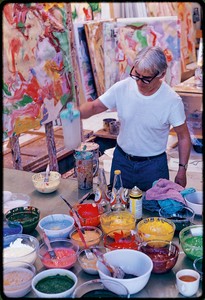
In tandem with the 60th Biennale di Venezia, the city’s Gallerie dell’Accademia is featuring the exhibition Willem de Kooning and Italy, an in-depth examination of the artist’s time in Italy and of the influence of that experience on his work. On September 20 of last year, the curators of the exhibition, the American Gary Garrels and the Italian Mario Codognato, engaged in a lengthy conversation about the exhibition for a press conference at the museum. An edited transcript of that conversation is published below for the first time.
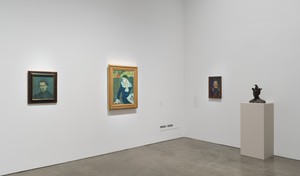
Join president of the Picasso Museum, Paris, Cécile Debray; curator, writer, biographer, and historian Annie Cohen-Solal; art historian Vérane Tasseau; and Gagosian director Serena Cattaneo Adorno as they discuss A Foreigner Called Picasso. Organized in association with the Musée national Picasso–Paris and the Palais de la Porte Dorée–Musée national de l’histoire de l’immigration, Paris, the exhibition reframes our perception of Picasso and focuses on his status as a permanent foreigner in France.
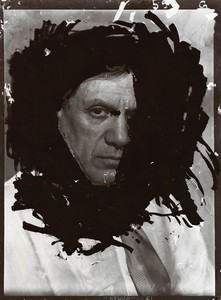
Cocurator of the exhibition A Foreigner Called Picasso, at Gagosian, New York, Annie Cohen-Solal writes about the genesis of the project, her commitment to the figure of the outsider, and Picasso’s enduring relevance to matters geopolitical and sociological.
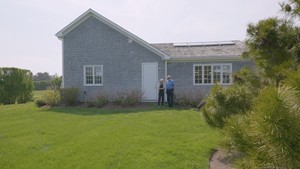
In celebration of the centenary of Roy Lichtenstein’s birth, Irving Blum and Dorothy Lichtenstein sat down to discuss the artist’s life and legacy, and the exhibition Lichtenstein Remembered curated by Blum at Gagosian, New York.
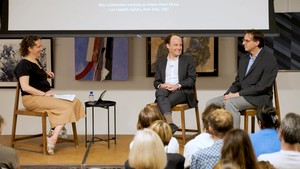
Gagosian and the Art Students League of New York hosted a conversation on Roy Lichtenstein with Daniel Belasco, executive director of the Al Held Foundation, and Scott Rothkopf, senior deputy director and chief curator of the Whitney Museum of American Art, New York. Organized in celebration of the centenary of the artist’s birth and moderated by Alison McDonald, chief creative officer at Gagosian, the discussion highlights multiple perspectives on Lichtenstein’s decades-long career, during which he helped originate the Pop art movement. The talk coincides with Lichtenstein Remembered, curated by Irving Blum and on view at Gagosian, New York, through October 21.