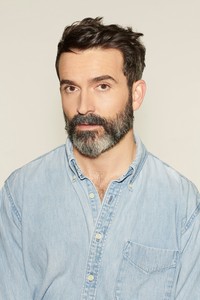
Born in San Diego in 1992, Kahlil Robert Irving has an MFA from the Sam Fox School of Design and Visual Arts, Washington University, St. Louis, and a BFA from the Kansas City Art Institute. In 2019, Callicoon Fine Arts mounted his second solo exhibition in New York, Black ICE. He was awarded a Louis Comfort Tiffany Foundation Biennial Award in 2019 and a Joan Mitchell Foundation Grant in 2020.
Cameron Welch was born in 1990 in Indianapolis, and lives and works in New York.
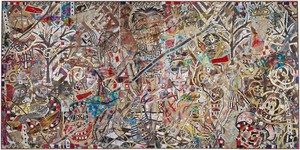
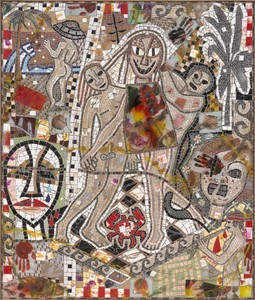
Cameron WelchOne thing I really value about your work is that you’re always searching within new material sets. I find new things every time I encounter your work. It seems fair to say that we’re both curious about materials: lately I’ve been using a lot of marble and stone, harking back to an earlier era of craft and representation, such as the mosaics of ancient Greece, Rome, and Africa. By using these materials I’m able to hold a certain space without having to illustrate something overt. And next to those elements you might find a gilded leaf behind glass, or a glazed ceramic that speaks to different locales and weaves them together to create a new affect.
Kahlil Robert IrvingWhat got you to start making large mosaics in the first place?
CWWell, I used to make them with my grandmother when I was a kid. My mom would bartend so my sister and I would go over to my grandmother’s house to spend the night a lot, and she used to take us to a craft-supply store where we’d buy kits to make mosaics. Also, my stepfather’s family is from Italy, so I’d go there when I was a kid. I’m from Indiana, so I hadn’t experienced objects that held so much history until that point.
That’s the origin, but as an adult I’ve been trying to tap into ways to speak to history and mythology while posing ideas around new mythologies. I have daydreams about the work being buried and then excavated a thousand years from now—what would people think was happening in our time?
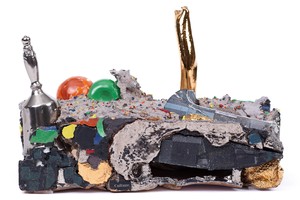
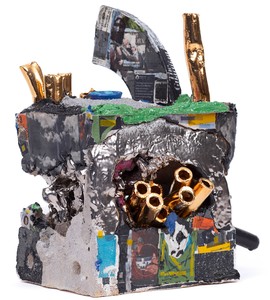
KRII think my work approaches something similar, but from the opposite perspective. Even though they’re very opulent, the sculptures resemble a fragment of something that’s been destroyed. Once viewers learn that a work is made by hand, rather than some kind of found object, it often prompts a reframing, and this slip of cognition is something I’ve been trying to balance. There’s the opulence of using overglaze enamels, which connect to the history of European ceramics and represent a certain kind of hierarchy, or access to capital, over another community—European decorative porcelain and ceramics were designed to corner a market and replace Asian ceramic production. And I try to balance that association with the ability to hold a bit of room for contention.
CWI was curious about control and authorship in your work. Is that something you value, or would you rather the works feel like you happened upon them without any trace of your hand?
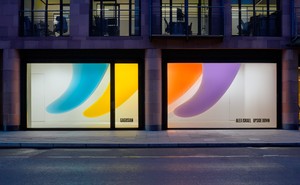
KRIThat gets complicated. For instance, I’m making sculptures that look like asphalt, but I’m not trying to make the street. How can a sculpture hold meaning, and a relationship to either visceral or mundane acts, such as the passing of time on something like a street? I don’t know if I necessarily have the answer to that question because it has to be negotiated through the experience of the work. My sculptures in the Social Works II exhibition in London reference fragments of Antioch mosaics, they use that as a model, but they’re not Antioch mosaics; they’re not mosaics at all, they’re hand-pressed ceramic tiles that sit on the floor, untethered to a specific site. So in terms of authorship, I made them, but the metaphor they speak to is broader.
CWI think a lot about how an object feels, as opposed to what it’s illustrating, and about the fine line of trying to create something that feels as though it’s been affected by time passing.
KRIWhat we’re doing relates to a certain kind of engagement with intuition as well. Some artists get settled into the idea of what it means to be making art versus it actually being a part of them. There’s a gap between the moment of intuitive engagement and its presentation as visual art. When someone is performing on stage, by contrast, they just have to go for it—the audience might be in a trance in relation to the passion they’re feeling.
CWTotally. In that respect I relate so much more to music. It’s often easier to find that connection when making music, maybe because it’s happening in real time.
Aside from a handful of sculptures, I’m making work for the wall, and I’ve been thinking about how the stone will outlive most paintings—the weave of linen or canvas could deteriorate far sooner than stone will deteriorate. Do you think about the permanence of the objects you create?
KRII think about that. In my new work I’m including apples and oranges, but if I were to start embedding explicit references to Monsanto and genetically modified agriculture, that would bring a contemporary reference. But how do you make that reference without being didactic or cliché? How do you cite the moment you’re in while allowing something to hold meaning into the future? The work we make is often analogous to life outside the studio, and eventually it makes its way into the work. We mentioned the lag between inspiration and whatever you’re trying to get into the work; sometimes that can happen immediately and other times it can be a years-long conversation. I’ve been thinking recently about how a lot of motifs from earlier bodies of work are coming in and colliding with newer materials and motifs and ways of working that I’m finding surprising.
I’m trying to collapse multiple histories in one space, and also an array of materials and aggregates that are speaking to a lot of different spaces and histories, so it’s impossible to absorb everything in one sitting.
Cameron Welch
CWIn your work there are often points where I can identify something immediately, and then a breaking apart happens. There’s a moment of recognition and then it sort of falls away again. You’re rewarded for looking longer.
KRIThanks, I appreciate that. I started collaging on the sculptures in part because of what I had to do as a student to complete other assignments. For me a lot relates to photography. The sculptures are covered in images that are either taken by me or found on the Internet, and that might relate to current issues, such as the climate crisis, but also recall an ancient or historical position. And I’m interested in how a pixel exists as a fragment of a greater image.
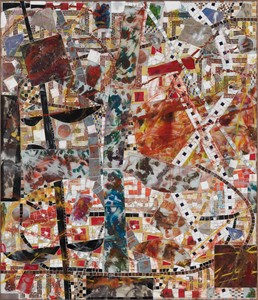
CWThat’s a fascinating relationship, the connection between the process of making collage, or mosaics, and halftone printing—thinking about that on a granular level, the solidity of objects is inherently not solid. It makes you contemplate what material can hold in terms of recordkeeping. There’s metadata stored in digital images. I’ve been thinking a lot about a fear of negative space recently, but also what’s filled in each space is taken from very disparate locations, sites, cultural spaces, and histories. And collapsing these on top of one another where time becomes elastic is interesting.
KRIThe elasticity in the work is renegotiated over and over just through the act of making. I’ve painted the same picture of [the rapper] Kodak Black four times; there’s a material concern but also an issue of legibility that then makes me have to keep painting it. But then I’m going to obscure it even more, and do I even want you to know that it’s Kodak at all?
KRILately I’ve been trying to figure out how to make the paintings as luscious and full as the sculptures.
CWI’ve been more and more interested in painting as well. I’ve been working with marble and stone, and then colliding that with painting. And I’ve been painting behind glass and putting that in the work. It has a slightly vacuous luminosity to it, and then these two are sort of working with and against each other in a way where the surface quality becomes poignant.
KRIHow do you approach the presentation of your work? That’s a point of contention for me. Like presenting a room of sculptures or presenting a room of paintings versus presenting a room of experience.
CWI think about it a lot. In the past I’ve had ideas about displaying works on the ground. But I really think that in my heart I’m a painter’s painter. I’m really interested in this idea that wall-mounted mosaics both get to participate in an archaeological and cultural dialogue and also are in a dialogue with painting and painting’s history. And having the two wrestle with each other on the surface of the work, and how they’re displayed, is something I’m really interested in.
KRIYeah, because negotiating what materials can do, where materials come from, how something’s seen, where something’s extractive, how does that really become physical even if it’s passed over, how does that still become a thing that one has to fight with—
CWI’m interested in the idea of inundating the viewer, of people not being able to take all of the work in at once—partly depending on the scale, of course, but also you won’t get to see it all unless you sit there for a long time. It’s like going to a museum and you can’t see everything in a day. I’m trying to collapse multiple histories in one space, and also an array of materials and aggregates that are speaking to a lot of different spaces and histories, so it’s impossible to absorb everything in one sitting.
Born in San Diego in 1992, Kahlil Robert Irving has an MFA from the Sam Fox School of Design and Visual Arts, Washington University, St. Louis, and a BFA from the Kansas City Art Institute. In 2019, Callicoon Fine Arts mounted his second solo exhibition in New York, Black ICE. He was awarded a Louis Comfort Tiffany Foundation Biennial Award in 2019 and a Joan Mitchell Foundation Grant in 2020.
Cameron Welch was born in 1990 in Indianapolis, and lives and works in New York.