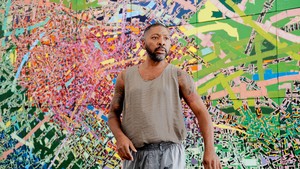
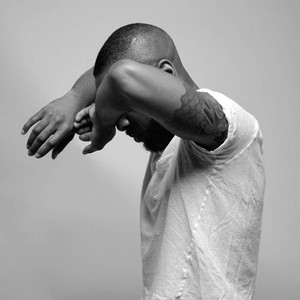
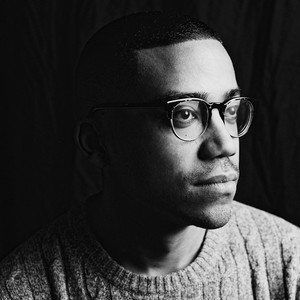
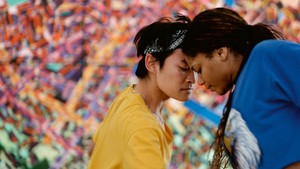
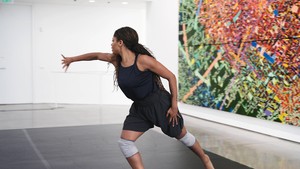
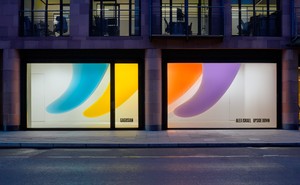
Choreographer Kyle Abraham put on a special performance inside the exhibition Social Abstraction in Beverly Hills this past July. Ahead of that event, Cameron Thompkins met with Abraham at New York’s Park Avenue Armory to discuss the relationships between dance, visual art, and abstraction.
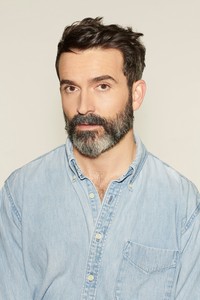
Kyle Abraham is the founder and artistic director of A.I.M by Kyle Abraham. He has shown his work to international audiences and acclaim since 2006. Abraham is the recipient of a National Dance Critics Award for Choreography (2024), a Dance Magazine Award (2022), a Princess Grace Statue Award (2018), a Doris Duke Award (2016), and a MacArthur Fellowship (2013). Two new evening-length works of Abraham’s premiere in 2024, Cassette Vol. 1, in Hamburg, Germany, in late August, and Dear Lord Make Me Beautiful at the Park Avenue Armory, New York, in December. Photo: Tatiana Wills
Cameron Thompkins is an event and creative producer based in New York, where he has developed multiplatform and interdisciplinary arts and cultural programs for a wide array of prominent institutions, including the Museum of Modern Art, Gagosian, Brooklyn Bridge Park, New York Public Radio, and others.
Cameron ThompkinsKyle, we’re at a rehearsal for your upcoming debut at the Park Avenue Armory, and you have another performance coming up for Social Abstraction in LA.
Kyle Abraham[Laughter] Yes, I’m often working on many projects at once. The Armory commission is called Dear Lord, Make Me Beautiful and will premiere in December. Dear Lord, Make Me Beautiful is an evening-length dance work created collaboratively with the visual artist Cao Yuxi (james), the lighting and scenic designer Dan Scully, the costume designer Karen Young, a cast of sixteen dancers, and all set to a commissioned score composed and performed by yMusic. I’m processing what it means to age and what it means to change . . . or to pray for a change . . . personal change . . . and explore, in the most present way, what those transitions feel like and physically look like.
CTI’m looking forward to it! How about the performance you’re planning for Social Abstraction? How has your approach there developed?
KAI was thinking about, a) the term “social abstraction” and what that means for me being a Black, queer choreographer, and b) the relationship between dance and the art that will be behind, next to, and in front of it. The first work from the exhibition that I saw was Devin B. Johnson’s Congealed & Stuck [2024]. I started thinking about its color palette and that sparked some new ideas—as random as this sounds, I thought about a baritone saxophone, about deep but experimental sax sounds like those of the composer Shelley Washington. I dove through her catalog to find a world in which I wanted to create movement.
Another motivation was to demonstrate choreographic range as a way to introduce a new audience to my work. I was thinking about how to bring dance into this primarily visual-art conversation—I wanted to add a new, embodied layer, and to view abstraction in a Black queered context. So I’m presenting an excerpt of this new duet that we’re currently calling 2x4, with music by Shelley Washington in a draft form. And then we’re also presenting a work of mine called Show Pony [2018]. As I engaged with more of the art in the exhibition, I thought about what colors, what textures, come alive, and how can I represent that through dance? Donovan Reed, one of the senior company members, will perform that work. The costume is a metallic unitard that I thought would be striking, but in a way very different from the Nina Simone solo that I’m going to be dancing myself, which is “Ne Me Quitte Pas” [1965]. It’s a solo that I made for a Carrie Mae Weems exhibition, a retrospective, in Nashville, Tennessee, back in 2012. That was choreographed in response to the beautiful sense of poetry and isolation you get in her work—a solo study in figure. When I decided in 2020 to make a suite of works to Nina Simone’s music, I was interested in “Little Girl Blue” [1957], which is a piece of music that I’d made a solo to in graduate school, many, many years before that—nobody needs to know how long [laughter]—but many years before that. I wanted to revisit that idea with Gianna Theodore, who dances in my company, because Gianna is immersed in B-girl and hip-hop culture and all things social dance. This allowed me to think about what story I could tell not only through her hip-hop vocabulary but also through contemporary, postmodern, release technique, ballet, just the kitchen sink of dance. Put all that in there to connect with a sense of longing and love and innocence. And then for the new duet, I’m not sure what the costume is going to be just yet, but I’m leaning toward a 1940s kind of vibe.
I was thinking about how to bring dance into this primarily visual-art conversation—I wanted to add a new, embodied layer, and to view abstraction in a Black queered context.
Kyle Abraham
CTCould you say more about how the color and tone of not just visual work but also music translate for you? Is there a specific process that comes alive in your body that you then translate to others?
KATone is really at the heart of all things. If you’re a real music person, and you love Brandy like I love Brandy, it’s the tone that really sets her voice apart. In the case of the new duet, that’s been a big part of the story for me; I needed to figure out what the tone is. And responding to Johnson’s work, as I was mentioning, I see this textured brown tone that makes me feel kind of guttural. And that’s also what I’m hearing in that baritone sax—that guttural sound. Now it’s become a consideration for the costuming. I want it to really connect.
CTTo match the textures of what’s on the body as well?
KAWell, usually I like to play with the relation to the artwork’s tone and textures rather than to translate directly. You see that with Donovan’s costume for Show Pony; it’s this metallic unitard that’s ridiculous in the best way. And I think it’s going to complement Rick Lowe’s paintings, with their intersecting lines of color.
CTDo you have any early experiences or memories with color or visual art that stand out to you?
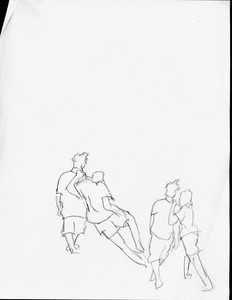
A sketch from rehearsals by Kyle Abraham
KAOh, jeez. Well, I knew as a very young person that my favorite two colors were gray and pink, and they still are gray and pink. I was taking a lot of art classes growing up and my sister and I were going to Carnegie Mellon as kids, doing special Saturday classes and things. I’ve always loved visual art and I think there was probably a period in my life when I thought that was where I was going. My IB [International Baccalaureate] project in high school was all visual art and poetry; that was what I was working on at the time. So I think it’s all part of my journey of becoming a choreographer. Color in particular—I guess there’s some irony because people will say gray’s not a color, but it’s my favorite. That also could tell you about the contrarian that I am [laughs].
CTIt’s interesting you say gray’s your favorite color. Queerness as I understand it embraces ambiguity or “gray areas.” There’s this settling into ambiguity instead of reaching for something predetermined or black and white.
KADefinitely. Yesterday I was doing some writing about all my self-identifiers, such as Black and queer, and realizing that in this free-write exercise there were many contradictions and I had to be aware of them. For example, using the word “coarse” as a descriptive term and thinking about the positives and the negatives of how people over time would use that word in relationship to Blackness. I will say that as a queer person in art and life, I just like people. I don’t feel like I’m confined by a type of dancer to work with or a type of person to be romantically intimate with. There are so many things that make an experience rich. So I don’t want to ever be confined by any one thing.
CTWhen you’re working with dancers I imagine they really need to trust each other both physically and emotionally. How do you help build this trust and bring the audience along on the journey?
KAI’ll begin with different types of workshop ideas with the dancers. Maybe we do some trust exercises. We’ll do some internalized storytelling where there are no words; you’re just communicating with your eyes, or maybe just holding someone’s hand without actually saying anything, and seeing what happens. We’re going to do some of those exercises the second half of the day; they don’t know that.
With this new duet, one of the things is playing with tension and support between these two dancers, and the gender dynamics are variable. Four dancers have learned the duet, and for this particular engagement I put two of them together. But I have a feeling when we actually premiere the full-length work, it won’t be the same pairing and the genders will be different. I usually cast based on the qualitative way people move, not anything else.
As a movement practitioner and maker, anything i experience—whether i’m looking at my friends at church camp moving around the floor, looking crazy, doing whatever they considered to be social dancing—i might put in a dance.
Kyle Abraham
CTI’m curious, as you’re thinking about how these performances will appear in the gallery, what kinds of dialogues are developing between the artwork, the space, and the performers?
KAI’m thinking about several things. One is space and proximity. How close will people be to the dancers? How close will we be to the artwork? Knowing that is a delicate and dangerous thing. I’m thinking about order: How do I want to introduce your audience to whatever I’m sharing? What journey can we take them on in a way that’s surprising but not jarring? The music in Show Pony is Jlin, but if you know Jlin, that’s a really strong sound.
CTYeah, she comes right out the gate every time.
KAAnd that solo comes out the gate, so [laughs] it’s in contrast to Nina Simone and what we’re working with there, the subtlety and vulnerability—they’re very, very different. I mean, there’s some subtlety that we’re playing with in Jlin, for sure, but it’s at a different temperature.
CTAre there any key elements in an A.I.M performance? You’ve spoken about love being a consistent theme before. Are there others that come to mind?
KAI do think there’s a bit of a sense of isolation in my work, however one might choose to take it. That always makes its way through. I also like to include multifaceted ways of representing Black queer culture. I don’t think it’s monolithic, so whatever it is you’re seeing, even if you’re seeing one of my ballets, it’s still very that. My choreography will have moves like face snatches or the nae-nae for New City Ballet. We can mix all these genres. We can put it in [Alvin] Ailey and in these A.I.M pieces. When Donovan is doing Show Pony there will probably be a little vogue moment in there too. I like to look at movement and culture in a way that doesn’t have to be so literally black and white, it can—oh, look at the gray here [laughter]. I’m saying that this is my experience. I was joking with one of my friends earlier in the day about the raunchy rap groups I used to listen to back in the day, BWP, HWA—I probably forgot what those acronyms are for—Jacki-O, just like raunchy, raunchy, but at the same time I was also listening to Morrissey and the Smiths. None of these things makes me any less Black or any less queer or any other thing. As a movement practitioner and maker, anything I experience—whether I’m looking at my friends at church camp moving around the floor, looking crazy, doing whatever they considered to be social dancing—I might put in a dance. I’m not going to say it’s my culture but I’ll say it’s part of my cultural experience, because it’s something that I grew up witnessing over the years, at social events. When I began learning dance formally, I had the space to explore and make outside of a set vocabulary of steps. If there’s something that I don’t feel well-versed in, I’ll probably ask someone to try and make sense of it; if there’s a calling, I’ll go there.
Kyle Abraham is the founder and artistic director of A.I.M by Kyle Abraham. He has shown his work to international audiences and acclaim since 2006. Abraham is the recipient of a National Dance Critics Award for Choreography (2024), a Dance Magazine Award (2022), a Princess Grace Statue Award (2018), a Doris Duke Award (2016), and a MacArthur Fellowship (2013). Two new evening-length works of Abraham’s premiere in 2024, Cassette Vol. 1, in Hamburg, Germany, in late August, and Dear Lord Make Me Beautiful at the Park Avenue Armory, New York, in December. Photo: Tatiana Wills
Cameron Thompkins is an event and creative producer based in New York, where he has developed multiplatform and interdisciplinary arts and cultural programs for a wide array of prominent institutions, including the Museum of Modern Art, Gagosian, Brooklyn Bridge Park, New York Public Radio, and others.