According to the philosopher Thomas Nail, “Everything in the cosmos is in motion.” In fact, for Nail there are no “things,” only motion. No static chunks of matter. No nouns. A chair is not solid, nor is it made of many tiny particles. It’s a whirlpool of energy that, to us, appears “metastable.”
The totalizing motion that Nail describes is also completely indeterminate, which means it unpredictably zigs and zags, forever. In scientific/philosophical parlance this is called “swerving,” which is another way of saying that motion itself is in motion.
This is the fundamental idea at the core of Nail’s philosophy of movement, a philosophy with vast implications in every field: politics (migration), science (quantum physics), psychology (identity), ecology (climate change). As for art, Nail considers it not as a series of discrete objects or images but as an ongoing movement between body, mind, viewer, and the world around us. He points to Abstract Expressionism, aleatory music, improvisational dance, and Earth art as clear expressions of kinesthetics—the esthetics of bodies in motion.
Nail breaks down movement into levels of magnification—concepts he calls flows, folds, and fields—and draws on many thinkers, from Virginia Woolf through Karl Marx to the classical philosopher Lucretius. Ultimately Nail calls into question the underlying foundations of Western thought. To him, our belief in determinate objects is an ideology and a prejudice, like nationalism or anthropocentrism, and this calcified thinking is harming us, causing social and environmental problems. He even argues that his own theory is unstable, as are the thoughts and words that construct it. Nothing is fully determinate.
Nail is a prolific writer who has produced many books, but his newest, The Philosophy of Movement: An Introduction, is perhaps the most lucid and comprehensive document of his thought. As an artist, I have enjoyed the wonder that Nail’s ideas impart to my relationship with objects, and I believe his philosophy has something liberating to offer to anyone tired of static ideology and ready for their thinking to swerve.
An Action Transposed into a World
Ross SimoniniIt seems like the whole English language, with its nouns and subjects and objects, makes it almost impossible to speak (or even think) about a world of total movement.
Thomas NailYes. I’m glad you’ve noticed. And it’s not just the English language; I would venture to say it’s nearly all Indo-European languages, which include more than half of the languages spoken on this planet. The emphasis on nouns is absolutely not universal in all linguistic systems. It’s an artifact of history, and therefore can change. In my work I try to use concepts and words that capture the processlike nature of things, like “flow” and “fold” and “cycle” and “field,” but these only get us so far because they’re still nouns.
RSIt’s almost easier for language to make someone feel movement than to comprehend it. Have any writers made you feel this?
TNVirginia Woolf and Lucretius have. They use many beautiful images from nature: rivers, clouds, trees, stars, things that, for me, don’t easily fall into determinate categories.
RSThomas Bernhard accesses the endless movement of thought with ongoing unpunctuated run-ons.
TNAnd there are other ways of getting at movement linguistically. I’m looking at non–Indo-European languages right now, for instance ancient Sumerian. In ancient Sumer there was no concept of nature, there was no epistemology or ontology or similar way of unifying and homogenizing singular ways of being and knowing. The Sumerians had a whole different animist vocabulary. This is why I’m interested in ancient Egyptian and ancient Chinese texts now, like the Daodejing and the pyramid texts, to study their different ways of understanding movement, indeterminacy, and pattern without concretizing it into “nature” or “being,” which risk erasing all the unique differences of the cosmos.
RSIs art generally well-suited to express a philosophy of movement?
TNAbsolutely. For example, sound and music can really resist our attempts to make something discrete of them, because you can’t just take a snapshot of music or you’ll destroy it. Art’s emphasis on sensuous qualities can also help get us away from the idea that the world is made of discrete quantities. Art offers different ways of seeing. For example, if an artwork could let you see the world with thermodynamic vision, you could watch all the waves and eddies of heat swirling around us and it would be obvious to you that everything was a changing process. But the faster we move, the less we look. We need art to slow us down. The more instrumental our behaviors, and the more capitalist urbanism dominates our lived reality, the fewer processes we tend to see.
For example, when the wind is blowing and you’re in a place like a forest, you really get a sense of how everything is responding to everything else in this very fluid and relational way. Virginia Woolf called these moments “moments of being.” She says that suddenly she would receive a “shock” and see “that behind the cotton wool [of discrete objects] is hidden a pattern; that we—I mean all human beings—are connected with this; that the whole world is a work of art; that we are parts of the work of art.” She says that “all artists I suppose feel something like this.”
RSDance seems an especially relevant art form.
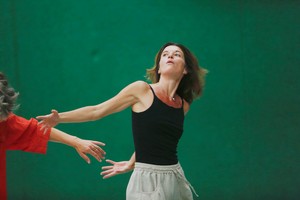
TNYes, dance, in a broad sense, is a focused attention and direction to the movements of the human body, which typically remain unconscious to us. Our whole bodies are constantly rippling with micromovements, rhythms, cycles, and waves that we mostly ignore in order to do other things. But the art of dance can bring all that to the surface and show us all the processes that are happening and thus show us new ways for them to happen. As the French poet Paul Valéry wrote, “Dance is an art derived from life itself, since it is nothing more nor less than the action of the whole human body; but an action transposed into a world, into a kind of space-time, which is no longer quite the same as everyday life.”
Dance can transform everyday life. It may even open up a “moment of being” where the ocean of movements around us, including our own, can be seen as the patterns of flow and iteration that they are. The Italian dancer and choreographer Irene Sposetti does incredible work in her BeingMotion project and I especially love her contact improvisational dance, which really emphasizes the indeterminate, relational, and patterned elements of movement.
Chaos Breeds Images
RSChaos feels like a primary medium of all art, and seems central to a philosophy of indeterminacy.
TNAgreed, as long as chaos does not mean disorder. All of the world’s oldest original language cosmogonies began with chaos as indeterminate, moving, fluid, and generative darkness. One of the oldest ideas about the beginnings of things was that everything came from chaos and returned to it.
RSRight. Many mystical philosophies all point back to chaos.
TNIn the Daodejing, for instance, “hundun” is the name of indeterminate, turbulent, dark waters, or “chaos.” Hundun gives birth to the dao-order of the cosmos. But around the sixth century bce, the cosmogonies that began with chaos all started to change and shift, and chaos in its primordial form was removed from all the oldest Eurasian cosmogonies. For instance, the Daodejing begins the world with chaos (hundun), but then Confucianism rejects this starting point and goes on to be the more dominant religion in China for over a thousand years. The Rigveda, too, begins with chaos and movement, but then the Upanishads removed chaos and replaced it with the static god Brahman.
RSChaos becomes evil. The devil.
TNYes. Movement and chaos become the source of “disorder” relative to the new order and god. In the Hebrew Bible his name was Elohim.
RSIn stories, villains want chaos because it’s anticivilization.
Our whole bodies are constantly rippling with micromovements, rhythms, cycles, and waves that we mostly ignore in order to do other things. But the art of dance can bring all that to the surface.
TNTrue chaos is the generative source of all cosmic novelty, and thus is a perpetual threat to all systems of order that desire permanence. Political anarchism, as I understand it, is the recognition that nothing is above movement, and that chaos is why and how things become different from what they are. It’s unstoppable. It’s no accident that the most interesting black metal music often returns to ancient cosmogonies of chaos, like the Mayan Popol Vuh or the Norse Poetic Edda, as sources for artistic creation and novelty in a world dominated by the hegemony of monotheism.
The Irish/British painter Francis Bacon said in an interview, “For me, chaos breeds images.” He said the way he worked was by scrubbing and scratching and destroying his paintings; then he’d see images and patterns beneath “the cotton wool,” to use Woolf’s phrase, and then paint on top of that, and then he’d scratch it away again and paint on that. Through this process of iteration he made these really worked-over, highly ambiguous, pareidolia-inducing images.
Ways of Knowing
RSWhat’s your definition of art? You describe it in your books as “what humans do when they focus on the qualitative dimension of things,” and you also write, “Art is not a representation of the world, and neither is our experience of it.”
TNIndeed. To continue my favorite quote from Virginia Woolf, if I may: “The whole world is a work of art; . . . we are parts of the work of art. Hamlet or a Beethoven quartet is the truth about this vast mass that we call the world. But there is no Shakespeare, there is no Beethoven; certainly and emphatically there is no God; we are the words; we are the music; we are the thing itself. And I see this when I have a shock.” So yes, to me, what we call “art” is when we emphasize the qualitative dimension of reality in contrast to its quantitative dimension. With this odd-sounding definition I’m trying to expose the fact that it is not universal among all cultures to isolate certain types of human-made activity and then call them “art.” That’s a very specific historical invention. For most of human history, there was likely nothing called “art” that was separate from the cosmos itself. In my research on the world’s oldest texts, I find that what “we” call “art” is what they understood to be the human microcosmic iteration of macrocosmic patterns. The words “religion,” “art,” and “nature” are much later historical inventions.
RSWhen you say “qualitative,” you’re referring to the distinction we make between the term “art” and everything else?
TNYes. What we call “art” as a kind of behavior or object distinct from science or politics, for example, has a specific history. Before we had this isolated thing people called “art,” what were we dealing with? The ancient Minoans did not have “art.” For them, these activities were ways of knowing, ways of being, ways of iterating larger cosmic patterns that were already present in the natural patterns of the ordered world. Humans are always participating in the cosmic order when they make art. It’s not like there’s nature on the one hand and then humans make some art that looks like nature on the other. That’s representation. That’s what I mean by “art is not representation,” in the larger scheme of things. Art doesn’t represent, it iterates. When we say “humans do art,” this divorces art from nature. That’s why I’m so interested in improvisation, generative art, and fractals like those found in Jackson Pollock’s paintings. Pollock once said, “I am nature.” The unity of art and nature (not representation) is the deeper historical insight found in Woolf, Pollock, Nietzsche, Lucretius, and others.
RSYou’ve said that art doesn’t have to be made by humans. Is a Picasso painting no different from a beehive or a flower?
TNI think there’s a tension to be clarified. On one hand I’m giving a definition as it pertains to the Euro-Western usage of the word “art.” On the other, I’m trying to undermine that usage and say “Art is nature,” via Woolf. But when you say something like “Ethics is nature,” or “Knowledge is natural,” everything kind of falls apart from the modern perspective.
RSRight. If art is everything, why make distinctions?
TNWhen Woolf says “we are the thing itself,” that completely undermines the distinction between art and nature in the Western tradition. It’s a simple thing to say, but the consequences are quite complex and unclear.
RSWoolf is an artist saying this, so there’s a poetic freedom for her, whereas you are a philosopher, and the implication is that you’re stating definitions and truths. It’s an interesting example of how the space that we give art, even if it’s a kind of artificial, contemporary distinction, still allows for a suspension of our critical faculties, which, in turn, allows us to access a complex thought like “art is nature.” And we’re both receptive to accepting it from Woolf, who can put it so beautifully, but if I hear it from a philosopher, I bring my critical mind to the conversation.
TNYes, I think that’s a big difference, because with philosophers you often expect there to be a definition, which by the etymology of the word “define” means delimit, making something discrete. But when you make something discrete, you cut it off from everything else. That’s what philosophy often does: it cuts everything up into a series of propositions that all fit together in some kind of coherent way. But that’s also a very narrow understanding of what philosophy can be or has been.
RSDefinitely. Some philosophers even seem to model themselves as artists, while others feel like they’re coming out of science. Nietzsche and Gilles Deleuze, for instance, very much feel like artists to me. Where do you place yourself in that?
TNThat’s a good question. I’m totally with you for somebody like Nietzsche—I think he imagines himself part poet, part philosopher. But for me, I engage with science in a way that Nietzsche doesn’t. I try to integrate science. And Deleuze absolutely has his own kind of literary conceptual playfulness with the terms of science. He says stuff like “Light moves at infinite speed,” but come on, man! [laughs] Light does not move at infinity, you can’t just say that! But he’s not interested in being consistent with scientific vocabulary. I, however, am interested in art just as much as in science, politics, and ontology. I spent about a decade of my adolescent life really into making art—drawing, painting, and playing guitar in punk-rock bands. From punk I got into political activism for another decade and then into political theory, philosophy, and ontology. And in the last eight years or so of my life, I’ve been much more interested in the sciences and in collaborating with physicists, psychologists, and mathematicians.
In my book, I’ve proposed some definitional distinctions between philosophy, art, and science as they work in the modern world. But then there’s another part of me that’s already into a very different way of thinking, and trying to push myself and my thinking beyond those distinctions. For me, philosophy has been the act of clarifying the distinctions that have been made previously and adding a few new ones. I’m not committed to my distinctions in an “I got everything right” way, but I do think that if you cut things up slightly differently, you can get really different historical and aesthetic outcomes. So my hope is that the way I’ve proposed the distinctions in my philosophy, we may get some different outcomes that are going to be better than what we have now.