Amit Noy is a choreographer, dancer, and writer who lives in Marseille, France. He makes performances (which often involve multiple generations of his own family), dances for the choreographer Michael Keegan-Dolan, and writes obsessively on dance for publications including Artforum, bomb, and the Brooklyn Rail.
The end of the world begins with the sound of rain. Halfway between a whisper and a racket, it trudges knowingly into my eardrums, carrying the dual promises of rot and renewal. Rain makes a laughing stock out of the word “ancient,” yet here its noise is rendered through the sound waves of industrial speakers. In an age of content, transformation is the sacred custom: we make rain from electricity, belief from disillusionment, and the glittering dope of futurity from the smog of the present.
Or perhaps the end of the world is a piece of theater. If so, it could be Age of Content by the French collective (LA)HORDE. Founded by artists Jonathan Debrouwer, Marine Brutti, and Arthur Harel in 2013, (LA)HORDE vivisect the zeitgeist with dance and choreography as their tools. Across theater, cinema, music, and visual art, they create and disseminate work with the speed and prolificacy of politicians or pop stars. In the past three years alone, their work has ricocheted among major international theaters, they have held outdoor performances in Marseille to crowds of twenty thousand, and they have collaborated with Madonna, Sam Smith, and Burberry. Created for and performed by Ballet National de Marseille—the nineteen-strong state-funded dance company and choreographic center that (LA)HORDE has directed since 2019—Age of Content premiered in 2023 at Lyon’s Biennale de la Danse and is currently touring internationally. 1 This October, (LA)HORDE opened Van Cleef and Arpels’s Dance Reflections festival in Kyoto, Japan, with its 2020 performance Room With a View.
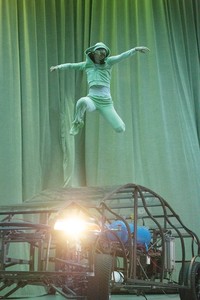
In January 2024, I watched Age of Content in the suburbs of Paris. Before the show began, I sat in the audience and marinated in my own rain. I was fifteen minutes late due to a fiasco on the Métro, and during my subsequent sprint to the theater I ran through an entire shopping mall. Sweat tumbled blithely down my collarbones as I noticed the stage—a curtain, a staircase to a landing, a collection of cardboard boxes, and a car covered by a sheet. As the lights dimmed, the car’s headlights snarled to life.
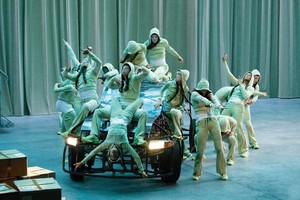
The first dancer is a machine, one whose whine has sounded a gleaming paean to industry for the past hundred-odd years. The car reeks with the gall of progress; it personifies our obsession with the creation of object-systems that exceed human possibility even as they service it. They are the prostheses to our greed, and they have become indispensable to the way our bodies live and move. This car, designed by the scenographer Julien Peissel, is a creature of structure—its exoskeleton is rendered visible in the style that is constantly à la mode until it isn’t. When a human dancer does arrive, it is not the person that moves the machine but the machine that moves the person. One dancer mounts the other’s hood, splays their arms, and stabs out their hip in a gesture spliced straight from every music video of the last twenty years. They grip the car’s metal frame and hang upside down, head bobbing where a license plate might otherwise be, legs akimbo and paddling the open air. In a minute, the person will sprawl recumbent with the car hood (still moving) as both pillow and tow bar, lounging in the style of a Renaissance painting. Each gesture is executed with a gussied-up efficiency in which choreography is a logic of bodily optimization. What is the best way to load my limbs from one place to another? How can I stream my flesh into motion with the least possible resistance? Movement-sans-friction is rare for the proscenium stage, which clings to an enduring fetish for the bumpy road of (quote unquote) authenticity. But what could be more real than faking something very, very well?
(LA)HORDE knows that performance is a business of making myths. It’s fabulation from ground zero, buoyed by the (theater) box and its attendant systems of faith—the way we gather to make belief, and have for thousands of years. In their timely interventions into our tastes and behaviors, (LA)HORDE are asking us to reconsider the assumed moral primacy of antispectacular and antientertainment theatrical tactics. Why should hard-boiled honesty hold the notion of realness in a chokehold? In 2024, the total and systematic erasure of naturalism is its own deep truth.
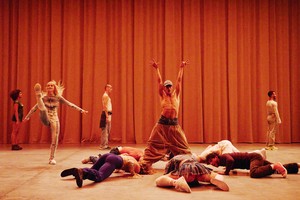
So the dancers grasp each other viciously, never quite long enough for us to believe it really hurts. They kick and struggle in a pantomime of violence that constantly vaporizes before it can cohere. Sometimes they stop to take and pose, rendering us not a crowd of a thousand people but a giant front camera. Styled and costumed by Salomé Poloudenny, they’re all wearing Juicy Couture sweat suits and queerly drawn Lycra masks stretched over their faces the way one donates a pair of tights. Running in lines, upward diagonals, and sharply spiking curves, their movements chart the geometry of progress. They etch graphs of inflation and deflation across the dance floor. Eventually they punch the air in a brash group rhythm with no discernible agenda or cause. Every finger by itself has no force.2 We’re wound taut by the pressure of one finger, one feeling, one force, into another.
The era of the poor image is over. Now, we salivate over that which is hypertouched, wealthy with the caresses of a computer mouse. In the second section, the dancers of Age of Content appear as avatars of themselves, because the twenty-first century is a role-playing game. Choice is the injunction, but the nature of the operation is blurred—pick your fighter? Your lover? The next manifestation of yourself? A lone dancer moves across the stage in a jaunt so carefully eradicated of human affect that they are a monument to blandness. They pick something up, put it in their pocket. They kneel, and their ass becomes a brief mountain, the gravitational center of our gaze. They’d be at home in Grand Theft Auto or a ChatGPT simulation, but I remind myself that this person has a liver, a bladder that fills and empties, kneecaps that creak in the morning. (LA)HORDE have pasted the choreography of virtual selves onto what the Bible would call earthly flesh, and therefore smudged their supposed separation, that fib we work so hard to maintain. The Bible was the computer of the Babylonian era—the information system through which we refracted and defined our sensation of the “natural truth.”
The dancer touches the pole like they’ve been coded to do so by a Bluetooth remote. Their chest heaves exaggeratedly to signify each taken breath; a poor image of the precondition of being alive. As the sun comes out and we exit screen, I want to sing a hymn of praise for the specific cut of the waist on the dancer’s jeans. If the butt crack is a staircase, the jeans nestle two steps below the top, riding the conflicted tightrope between perversion and liberation.
Style is a substance, as real and consequential as the sky.
After death and before birth there is the fact of fucking, and the image of it that is printed a thousandfold on every street corner since ancient Rome. The dancers bounce themselves, they bounce each other, they bounce on top, and they bounce while pressed against the floor. It’s a theme and variations of the thrust, an anthropological inquiry into the physical architecture of humping and gyrating. Pornography is a field of choreographic study, or it should be! In Age of Content, the weather is sweet and the sun is shining, as long as everyone knows to raise their ass on the downbeat. (LA)HORDE’s depiction of pieces in its complete absence of a moral flavor. The movements are studied clinically, with the detached fascination of a ballet teacher expounding on a round of leg. In the end, it’s a symphony of spinal movements that say more about our cultural moralisms than they do about sex. Every pelvis is a mecca of history, stamped with archives of repression, resistance, and straight infatuation.
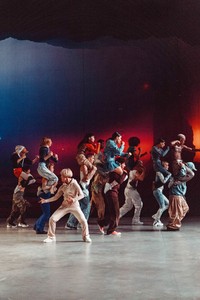
Sixty years after Warhol & Friends’ giddy rampage through the annals of high and low art, the distinctions they sought to complicate are still very much entrenched within capital-D Dance.3 (Supposedly, Philip Glass is art and twerking is a soiled handkerchief.) In the final section of Age of Content, (LA)HORDE conduct their own giddy rampage through the annals of movement, blitzing together movement quotations from a myriad of theaters, nightclubs, apps, and continents. Lucinda Childs, the glacial doyenne of East Coast postmodernism, intermingles with Jerome Robbins’s bodacious precision, and with a throng of social dances whose origins can be less confidently asserted and that circulate widely right now through TikTok. All this is tracked by a selection of Glass’s exhilarating loops of colliding rhythms (which both Childs and Robbins have worked with in masterful and iconic ways). It’s a saturnalia of movement, as irreverent as it is deeply researched. In tracing these dance quotations across distinct eras, genres, and origins, Age of Content reveals the vagabond spirit of any gesture. On the one hand, how could you even attempt to own, stamp, label, copyright, buy, sell, or distill the guttural force of any motion? On the other hand, that’s what you call a dance step, and we’ve been doing it for thousands of years.
1 This writer has received financial and professional support from Ballet National de Marseille in the past, through their activities as a national center for choreographic creation.
2 One of the earliest known instances in the United States of a protester brandishing a raised fist occurred in 1913, when “Big Bill” Haywood spoke to strikers during the Paterson silk strike in New Jersey. Haywood, a founding member of the union Industrial Workers of the World (the “wobblies”), preached working-class solidarity across all races and trades. “Every finger by itself has no force,” he said, lifting his sizable hand to the crowd. “Now look,” he said, closing his fingers into a fist. “See that, that’s the IWW.” See James Stout, “The History of the Raised Fist, a Global Symbol of Fighting Oppression,” National Geographic, July 31, 2020. Available online at https://www.nationalgeographic.com/history/article/history-of-raised-fist-global-symbol-fighting-oppression (accessed September 6, 2024).
3 Certainly they are within the theaters in which (LA)HORDE often work.
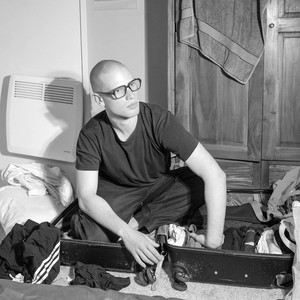
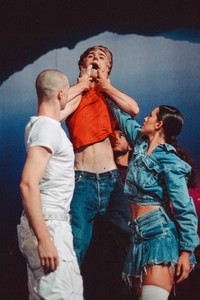
Photos: Age of Content (2023), designed and directed by (LA)HORDE—Marine Brutti, Jonathan Debrouwer, and Arthur Harel; choreographed in collaboration with the Ballet National de Marseille
Amit Noy is a choreographer, dancer, and writer who lives in Marseille, France. He makes performances (which often involve multiple generations of his own family), dances for the choreographer Michael Keegan-Dolan, and writes obsessively on dance for publications including Artforum, bomb, and the Brooklyn Rail.