Rennie McDougall is working on a book on dance in New York, to be published by Abrams Press in 2026. Here he shares an overview of one of the topics included: dance diplomacy. Drawing on past scholarship, McDougall reminds us of the fine line between cultural exchange and propaganda in government-sponsored art.
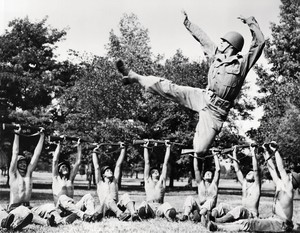
José Limón leaps high as a part of an all-soldier revue for the Third War Loan Drive, Camp Lee, Virginia, 1943. Photo: Underwood Archives/UIG/Bridgeman Images
José Limón leaps high as a part of an all-soldier revue for the Third War Loan Drive, Camp Lee, Virginia, 1943. Photo: Underwood Archives/UIG/Bridgeman Images
Rennie McDougall is a writer based in Brooklyn. His work has appeared in the Brooklyn Rail, frieze.com, Guernica, T Magazine, the Village Voice, and other publications. He received an Anthony Burgess Prize for Arts Journalism in 2018. His first book will be published by Abrams Press in 2026.
World War II ended shortly after the United States dropped atomic bombs on Hiroshima and Nagasaki, Japan, each blast killing tens of thousands of civilians in an instant and tens of thousands more in the aftermath. America had proved its brute power, showing the world that it would not hesitate to eradicate innocents in its quest to “defend democratic freedom.” Once the dust had settled and the United States had rewritten international constitutions, occupied rival territory with military bases, and imposed disarmament on other countries while strengthening its own armory, its government was determined to project an image of America as the harbinger not of mass destruction but of freedom and culture, with capitalist democracy the marker of peace.
To accomplish this, the US government developed a multifaceted plan to win the cultural war between capitalist democracy and communism through radio programs and state-sponsored artists’ tours. President Dwight D. Eisenhower established the Emergency Fund for International Affairs to present American artists abroad in what he called his “Crusade for Freedom.” Jazz musicians, modernist writers, and Abstract Expressionists traveled the globe advertising the creative freedoms afforded in America and denied to artists in communist countries. So too did dancers—via the advisory panel of the American National Theater and Academy (ANTA)—performing a freedom of expression through their bodies that challenged the old European hegemony of ballet. In all the arts, modernism was the wave of the free global future. Central to this mission’s success was convincing people—Americans and international citizens alike—that this pro-American propaganda was not propaganda at all but the free expression of individuals.
Martha Graham, one of the most prominent figures in modern dance—not only because of her studied technique, which drew from the central motor power of the body to express deep emotional states, but also because of her powers of oration—went on her first state-sponsored tour as part of Eisenhower’s “Crusade for Freedom” in 1955. Graham and her company visited the Philippines, Thailand, Malaysia, Singapore, Indonesia, Burma, Pakistan, India, and Iran—countries that Eisenhower referred to as “domino states,” vulnerable to falling into communism at the slightest bump.
Graham had become an advocate of American freedom during the war years. Her Americana works, beginning with Frontier in 1935, depicted the vast American West as a place of unbridled opportunity and the spirit of the individual over the oppression of the group. Perhaps her most overtly nationalistic work was American Document (1938), a dance accompanied by readings of the Emancipation Proclamation and the Declaration of Independence. When American Document premiered, it included text critical of American history, but as the work toured those sections were edited out in favor of a more bluntly patriotic message.1
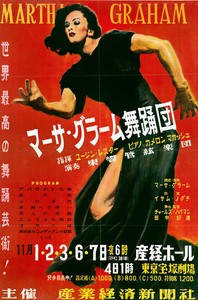
Poster for Martha Graham Dance Company’s performances in Japan, 1955, Ethel Winter and Charles Hyman Collection, Music Division, Library of Congress
Despite this, Graham insisted that her works were not political. “I am not a propagandist,” she told an audience in India. Modernism, she and others claimed, was an artistic mode free from any definitive meaning that could be wielded toward political ends. Not that Graham herself didn’t take political positions publicly: she famously rejected an invitation to perform at the Olympic Games in Berlin in 1936, stating that Jewish members of her company would be unwelcome there. “So many artists whom I respect and admire have been persecuted,” Graham stated, “that I should consider it impossible to identify myself, by accepting the invitation, with the regime that has made such things possible.”2 During the Spanish Civil War, she participated in pro-communist fundraising (which earned her an FBI file), yet she also expressed avowedly anticommunist sentiments. According to Agnes de Mille, Graham’s friend, biographer, and fellow choreographer, in the late 1920s she likened communists to demolition workers: “Just give them a building to tear down, and they’ll be quite happy to leave our government structures alone.”3
Graham’s works, she said, expressed universal truths, sometimes through ancient Grecian myths, sometimes through an American sensibility. This clever contradiction, that American ideology could become synonymous with universal truth, was central to the American propagandist project during the Cold War and made Graham a perfect ambassador for American interests overseas. The State Department tours were manifestly political in intent. A United States Information Service (USIS) memo, circulated during the planning of Graham’s domino-nations tour and unearthed by historian Victoria Phillips in her exhaustive research on the subject, read, “Entertainment which does not also carry a political message should be reduced to a minimum.” Another read, “Events should be planned and ‘planted’ to implement propaganda themes.” Graham was a vital ambassador precisely because her work could be wielded as propaganda—a word used frequently in USIS memos—but, importantly, didn’t appear to be so.
To avoid the accusation of propagandism, Graham did not perform American Document during her Asian tour. Instead, she presented Appalachian Spring (1944), her vision of the American frontier and its promise of self-made opportunity, free from the tyranny of religion or state. Every performance during the Asian tour ended with Appalachian Spring, and audiences from Japan to Iran stood in rapturous applause during the curtain call. Political leaders, who initially thought modern art inscrutable and indulgent, attended the performances and became convinced of America’s cultural supremacy in relation to the Soviet ballet. The Russian ballerina Galina Ulanova had toured the same region with a small company just before Graham’s arrival, and the comparison generated what the Japanese press called a “literal war of dance.”4 The Soviet dance was that of the old world, a product of czarist Russia, art for the elite. Graham’s modernism, conversely, was stark and new, and her diplomacy was hugely effective; her multiracial dance company, as well as her collaboration with the Japanese-American artist Isamu Noguchi, demonstrated an American ideology of inclusion and cultural exchange. In 1957, Paul Gray Hoffman—president of the Ford Foundation, delegate to the United Nations, and later the first administrator of the United Nations Development Program—called Graham “the greatest single ambassador we have ever sent to Asia.”5 In matters of culture, at least, Graham won the war over the Russians.
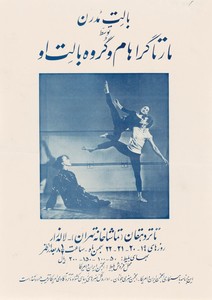
Martha Graham poster in Farsi by the US Information Agency, Tehran, 1956. Photo: Artvee
“Dance Is a Weapon” is a phrase that once appeared in materials produced by leftist dance groups in 1930s New York, such as the New Dance Group and Workers Dance League. During the ’30s, communism had serious support among Americans who’d become disillusioned with capitalism during the Great Depression. In the Communist Party USA, dance played a vital role in uniting workers and their allies. Dance was both a group activity in which everyone could participate and a form of theater that could communicate communist ideology through the dancers’ collective bodies.
Critics found the communist dancers’ use of agitprop techniques—poses and actions used to convey communist messaging in as legible a way as possible—stilted and obvious, deadening the spontaneity and sophisticated possibilities of modern dance. John Martin, the first dance critic for the New York Times, was crucial in popularizing the opinion that politics was anathema to art and that modernism was the movement of America’s future. Modernists such as Graham, whom Martin championed and who opposed the communist agitprop dances, were loath to admit that their own choreographies could be used as a tool in any large political or ideological war. Yet modern dance did become a potent weapon for America during the Cold War, capable of swaying the minds of millions. Modernists were also capable of using overt political messaging in dance, as Graham did in American Document. But when they revealed politics in their works, it was considered universal and apolitical.
Graham was not the first American choreographer supported by Eisenhower’s Emergency Fund. José Limón, a dancer and choreographer originally from Mexico who was a student of modern dancers Doris Humphrey and Charles Weidman, toured Latin America in 1954, following the CIA’s successful overthrow of democratically elected Guatemalan president Jacobo Árbenz, ending the Guatemalan Revolution. Limón’s presence in Latin America, as a Spanish-speaking Mexican immigrant to the United States, was of particular use to the US government in their fight against rising anti-American feelings in the region. Limón symbolized a solidarity between North and Latin Americas, with the goal of distracting from continued US interference in Latin American countries’ right to govern themselves.
As the cultural Cold War continued, the United States worked to further its claim of cultural supremacy by using defectors from the Soviet Union who had come to America to escape limitations placed on Russian artists. George Balanchine came to the United States after first escaping the Soviet Union in 1924 (the year Joseph Stalin assumed power), then fleeing Europe on the eve of World War II. He adopted Americana wholeheartedly, dressing in cowboy attire and idolizing Ginger Rogers and Josephine Baker. Between 1952 and 1956 he took his New York City Ballet on multiple state-sponsored tours, proudly boasting of American freedom and rejecting the limitations put on art in the USSR. Both Rudolf Nureyev and Mikhail Baryshnikov, two star ballet dancers who defected from the Soviet Union in 1961 and 1974, respectively, effectively acted as living endorsements of America’s victory in the cultural Cold War.
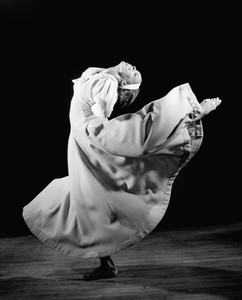
Thea Narissa Barnes in Martha Graham’s work Frontier, 1987, Martha Graham Legacy Archive, Music Division, Library of Congress. Photo: David A. Fullard, PhD
But the idealistic postwar image of America projected to the world was threatened by contradictions within. Undermining the notion of American freedom was the continued disenfranchisement of Black Americans, brought to global attention by the civil rights movement and used as evidence against America by the Soviets. US agents of the cultural war needed to rectify that image.
In 1962, Alvin Ailey, who founded his company in 1958 with a group of African-American dancers, went on a state-sponsored tour of Australia, Burma, Vietnam, Malaysia, Indonesia, Hong Kong, Formosa (Taiwan), Japan, and Korea. Ailey’s works, and specifically his piece Revelations (1960), a dance set to traditional spirituals and reflecting the African-American journey from bondage and struggle to freedom, attested to America’s uplifting of the African-American experience and expression.
Ailey, an artist whose work spoke both specifically about African-American experience and universally about the human spirit overcoming oppression, was an ideal American ambassador during the civil rights movement. Black artists whose works confronted racism more directly found less support. Katherine Dunham, a pioneer of modern dance who actively challenged segregation, believed she was ignored by ANTAafter one of her works, Southland (1951), which depicted a lynching on stage, received praise from the communist press in Paris. “The State Department has given us no recognition whatsoever,” she said in 1958, “and it is becoming increasingly difficult for me in giving interviews to canny press people to cover up for what could look like discrimination to the rest of the world.”6 Eleo Pomare, a choreographer whose works such as Blues for the Jungle (1966) also reflected the ugly truths of the Black experience in America, said in 1969, “I’m labeled undisciplined, angry, and I know the State Department has forgotten my behind—if they ever even considered sending me overseas to represent the US as an artist—because I will not do what they want from a Black dancer.”7 It was clear that state sponsorship would not come to certain artists who dared to reveal any truth about America’s contradictions when it came to freedom.
The generation of modernists supported by the Cold War campaigns are still upheld as titans of American dance nearly fifty years on. Their legacy as American diplomats and propagandists is less appreciated than their individual artistry and expression. But their legacies cannot be removed from the fact that the individualistic modernism within which they operated played a vital role in diplomatic operations and propagandistic missions in the cultural Cold War. As such, the freedom of their expression was somewhat kept on a leash.
Following the success of the state-sponsored tours, the US government began investing in dance and other arts at home. This was something new, state sponsorship of art being, after all, more of a Soviet project. In 1965, President Lyndon B. Johnson established the National Endowment for the Arts, and among the first individual recipients of its dance grants were choreographers previously supported by state-sponsored tours, including Graham, Limón, and Ailey. In the decades to follow, dance experienced a golden age of support, building audiences and appreciation for a modern dance that signaled both a unique American sensibility and a universal appeal. Importantly, support was granted by peer-review panels, ensuring some separation between the government and the arts.
Alvin Ailey American Dance Theater in Leningrad, 1970, Alvin Ailey Dance Foundation Collection, Music Division, Library of Congress
This support, vital for the ascendance of modern dance in the United States, helped to establish the contradictory sense that American art was both free from political intervention and useful as pro-American propaganda. This contradiction would become harder to reconcile in the latter half of the century, as the postwar belief in the benevolence of American diplomacy started to wane. American involvement in wars in Korea, Vietnam, Iran, Afghanistan, and Iraq (to name just a few) dispelled many Americans’ belief that their country’s diplomacy relied solely on peace and cultural exchange. Artists became less inclined to be used as propaganda and were more likely to critique American imperialist projects, both in their works and beyond. The idea that modernism had been an apolitical art movement was no longer tenable.
In 1998, the dance historian Naima Prevots, in the prologue to her book Dance for Export: Cultural Diplomacy and the Cold War, wrote that cuts to arts funding in the 1990s threatened the arts in America and that it would be instructive to look back to Eisenhower’s support of the arts “as an important aspect of American life, but also as a powerful tool in the creation of world peace.”8 But when posing the question of whether government support of dance during this period had a political agenda, Prevots answered no. “In dance,” she wrote, “the groups sent abroad were chosen by a panel of professional peers,” which “sought to insulate the selection process from overt political pressure, ensuring that merit would be the chief consideration.”9 Today, in considering the lessons of that period of governmental support, we should recognize what Prevots could not: that merit alone is an often dubious claim, and that even in the absence of overt political pressure, government support of the arts depended on their usefulness for diplomatic and ultimately propagandistic goals. During the same postwar period when state support elevated the modernists, the development of McCarthyism led to the scouring of government departments for anyone with communist sympathies. Leftists were thrown out of the very government arts departments they had helped establish during the New Deal era. By the ’90s, the National Endowment for the Arts declined funding to performance artists whose work it deemed immoral and degenerate (code for work with overtly homosexual content), ending the period of peer-reviewed arts funding free from obvious political interference. But as some artists had known from the start, the artistic freedom for which America prided itself around the world was greater for those who did not challenge America’s idealized vision of itself.
1 See Susan Manning, Modern Dance, Negro Dance: Race in Motion (Minneapolis: University of Minnesota Press, 2006), pp. 127–28.
2 Martha Graham, in Dance Observer, April 1936, p. 32.
3 Graham, quoted in Agnes de Mille, Martha: The Life and Work of Martha Graham (New York: Random House, 1991), p. 87.
4 See Victoria Phillips, Martha Graham’s Cold War: The Dance of American Democracy (Oxford: Oxford University Press, 2020), p. 4.
5 Paul Gray Hoffman, quoted in Ellen Graff, Stepping Left: Dance and Politics in New York City, 1928–1942 (Durham, NC: Duke University Press, 1997), p. 175.
6 Katherine Dunham, quoted in Naima Prevots, Dance for Export: Cultural Diplomacy and the Cold War (Middletown, CT: Wesleyan University Press, 1998), p. 104.
7 Eleo Pomare, quoted in Thomas A. Johnson, “I Must Be Black and Do Black Things,” New York Times, September 7, 1969.
Rennie McDougall is a writer based in Brooklyn. His work has appeared in the Brooklyn Rail, frieze.com, Guernica, T Magazine, the Village Voice, and other publications. He received an Anthony Burgess Prize for Arts Journalism in 2018. His first book will be published by Abrams Press in 2026.