The dance begins with an object: Loie Fuller twisting with a silk scarf; Charlie Chaplin as Hitler in The Great Dictator (1940), engaging in a pas de deux with a balloon globe; Fred Astaire twirling a hat rack in Royal Wedding (1951). They animate their inanimate partners and together they become a soliloquy of movement, dancing as though there were no audience, a world bursting with the interiority of one. Of course this is an illusion: caught on film, they dance as though they were alone, but they know that the crew and the film audience will watch their reverie. Yet their absorption seems to cancel out those watchers, creating a temporary world in which there are none.
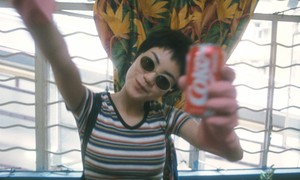
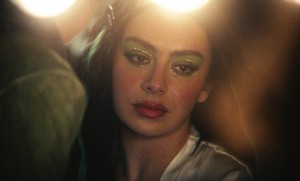
In Wong Kar-wai’s Chungking Express (1994), Faye Wong dances with kitchen prongs behind the counter of the food stand where she works, moving her hips while squeezing ketchup into a cup. Her favorite song to dance to is “California Dreamin’” by the Mamas & the Papas, and the song plays many times in the film. She is in love with a policeman who is getting over someone else, so naturally she breaks into his empty apartment, puts on her Mamas & Papas CD, and dances to it, swinging plastic bags of goldfish. She likes her music loud—“the louder the better, keeps me from thinking”—and her relationships simple; when the policeman finally asks her on a date, she moves to California. When she dances she is always alone.
It’s honest, this dancing. It looks unrehearsed, inexperienced, and loose. I would use the word amateurish if Faye cared about such distinctions, which she clearly doesn’t. Her character simply does not care if she looks good. In fact, she looks good because she doesn’t. Faye does not give a damn about who is watching her. She is almost animalistic in her movements, like a dog bobbing its head to music. She shows the revelry we allow ourselves when we are alone.
On film, there’s a clear difference between the dancing of those who seem to be dancing alone and the dancing of people dancing for someone else. The difference is a degree of affect. When we dance, being looked at transforms us. We respond with a smile, a practiced glance that we know looks good. When no one is watching we lose self-consciousness. We put on a favorite song, we crank it real loud, we start to mouth along, our bodies loose, and we let ourselves repeat a movement over and over. We bite our underlip and bob our heads, we swing our arms in windmills, our faces fall slack. We don’t necessarily smile with teeth, though sometimes we do, when the feeling takes us. We don’t have a someone to look to so our eyes scatter everywhere, the floor, the ceiling, focusing, unfocusing. The quality of this dance, then, depends on how much we can inhabit this paradox of performance—how much we can strip away the clean snap of training and technique, the acknowledgment of another.
Faye Wong’s dancing in Chungking Express makes us feel because it feels like the opposite of performativity while continuously being a performance. And her alone-dancing changes. In one shot she dances around an apartment she’s broken into, bursting with glee, pink dishwashing gloves on her arms, delighting herself with her antics. In another she bobs along to the same song again and again at her food stand. Learning that her policeman loves someone else, she dances with a small, desperate smile on her face, snapping her hips, squeezing ketchup into a jar. It is a kind of dancing that does not care for control, training, or timing, and is fundamentally at odds with what a dance is usually for: an audience. As an audience we feel like an unwelcome witness—feel that if the character knew someone was watching, she would cease to dance.
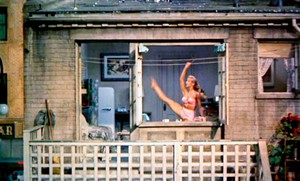
But let us tread carefully. Consider James Stewart staring at a blonde girl dancing alone in her pink underwear in the opening scene of Alfred Hitchcock’s Rear Window (1954). Is the thrill of watching someone dance alone the indulgence of a voyeur? To put it crudely, what distinguishes viewing someone dancing alone from watching someone through a peephole? In Hitchcock’s hands, the dance alone is a reminder that cinema turns everyday banalities into entertainment—and that everyday banalities and entertainments are double-edged, both ordinary and strange. Film offers the private affair—a dancer gnawing on chicken while she practices alone, waiting for a man—as an easy visual thrill for someone else, and we indulge our curiosity while knowing we would be offended by such breaches in our own lives.
In Douglas Sirk’s melodrama Written on the Wind (1956), Dorothy Malone’s Marylee takes off her dress, smoking, throws on a sheer pink nightgown, and dances in her bra with a portrait of Rock Hudson, her unrequited love. After a few seconds, while she clutches Hudson’s portrait to her chest, it’s clear that she’s not dancing with him, or with any idea of him. If the girl dancing in Rear Window is above all a portrait of American domesticity—one that can be leered at from the safety of another window—then Marylee is its underside, American derangement, rolling her eyes and snapping her hips, teetering drunk and out of control. Marylee is constantly too messy to make us feel as though we were getting a peek at her hidden everyday. Instead, she dances as though she wanted to rip the world apart along with herself. She can’t get what she wants, even when, or perhaps because, she has more than anyone can desire. Therefore she will dance. As she hits the climax of the song, her father, an oil tycoon, falls down a grand staircase to his death. Glorying in the excesses of her world—she is arrayed in the spoils, the silk, the jewels—she is also the spark that will make it implode.
Over time, Marylee’s mess gets harder to watch. When I was a teenager I loved her rollicking, how she seemed to leave splinters everywhere for other people to step on, how campy it is that she seems to accidentally kick her father into oblivion. Now I feel for her, thrashing around in her prolonged adolescence, all to send her family a message—I don’t care what you think—when in fact that’s all she cares about. And I see the weariness of her father, the fragility of his gray hand on the banister. How he had heard the loud music she’d put on and still decided to try and speak with her, a woman trying to drown the world out. Perhaps the dance alone is the expression of a flawed teenage logic: the idea that self-consciousness should be escaped in solitude (instead of, say, out in the world, in a club), that it is only behind closed doors that we can access the promise of some authentic self. That if the world will not embrace that self, it must all burn down. Turn down the music, I want to tell her—and get out of that house.
And yet there is something that rings true in Marylee’s gesticulations, in how she confronts and simmers and gives shape to her unhappiness, that I do not want to dismiss as part of some adolescent phase, or as something that will be solved by a mere change of location. It is silly to box dissatisfaction, yearning, and revelry into adolescence, as though the expression of asynchronicity were merely a matter of youthful energy. The dance alone is tinged with the force of restlessness; it is an effort to make something of envy and regret.
The dance alone holds twin tantalizing but opposing promises: of being our strongest expression of interiority (when we are not moving for someone else, we are moving for ourselves), but also of giving us a way to become someone radically different, or even to cease to be a person at all, through movement. If you look at Bulle Ogier’s character, an assembly-line worker, dancing and shaking in Alain Tanner’s The Salamander (1971), we might be tempted to argue that her dance alone is proof of a social fabric breaking apart, her movements simply reverberations of the atomizing shocks of modernity, the vibrations of machines. The dance alone, in that argument, is no escape: it is simply proof that we are solitary toys tottering forth after being wound up too much by the forces of capitalism.
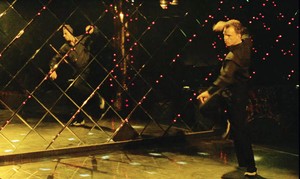
What the lone dancer brings forth is not personality and individuality or the lack of it, but courting the space between our various possible selves, including between life and death. At the end of Claire Denis’s Beau Travail (1999), after being ejected from the French Foreign Legion after a lifetime of service, Denis Lavant’s character Galoup decides to kill himself. He makes his bed and lies down on it, clutching his gun with his left hand. A vein on his arm pulses, and the unmistakable echoes of Corona’s “Rhythm of the Night” (1993) start to pulse along with it. The next shot: Galoup leans against the mirrored wall of a dark, empty club, watching himself smoke in an unseen mirror to the left of the camera. The viewer doesn’t know when or where he is in time, just that he is alone. His eyes track the sensual arc of his arm swinging down as he walks slowly, still smoking, to the center of the room. With one hand he traces tiny movements in the air to the music, then rejects them. He starts the process of forgetting himself. He raises his cigarette to his lips, then spins in a tight circle, smoke wrapping around his figure like a cape. Denis has said that in an earlier version of the screenplay, the dance fell before the scene where he takes the revolver, but when she was editing, she decided to put the dance at the end. She wanted to “give the sense that Galoup could escape himself.”
To escape ourselves—to reach our heights by retracing the figures of what you were. By saying goodbye to them, no matter how cherished. What Lavant shows us is that in fact, the dance alone is both the imagination of sheer potential and the resolution it takes to face the end of things. His performance tells us that you cannot actually have the former without the latter. And in this steadfastness before oblivion, he marks what has been lost, and what is still to come.