
Now available
Gagosian Quarterly Summer 2026
The Summer 2026 issue of Gagosian Quarterly is now available, featuring Ellen Gallagher’s Fast-Fish and Loose-Fish (2026) on the cover.
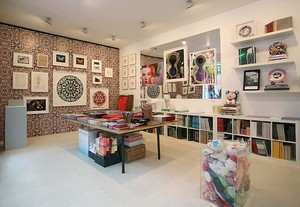
Installation view
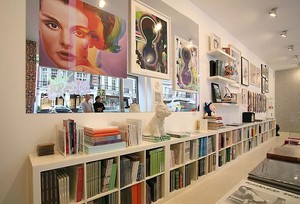
Installation view
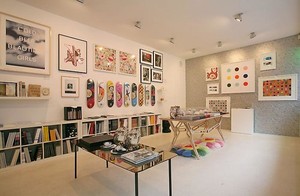
Installation view
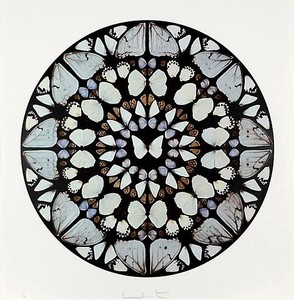
Damien Hirst
Psalm Print: Benedictus Dominis, 2009
Silkscreen print with glaze, 43 × 42 ⅜ inches (109 × 107.5 cm), edition of 50
© Damien Hirst and Hirst Holdings Ltd. All rights reserved, DACS 2010
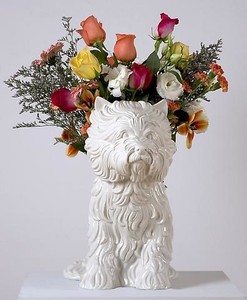
Jeff Koons
Puppy, 1998
White glazed porcelain vase, 17 ½ × 17 ½ × 10 ½ inches (44.4 × 44.4 × 26.7 cm), edition of 3,000
© Jeff Koons

Takashi Murakami, Mr. DOB large stuffed toy
© Takashi Murakami/Kaikai Kiki Co., Ltd. All rights reserved
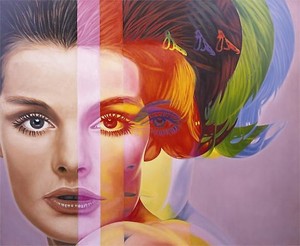
Richard Phillips
Spectrum, 2009
Printed canvas, 30 × 36 ½ inches (76.2 × 92.7 cm)
Produced by Art Production Fund
© Richard Phillips
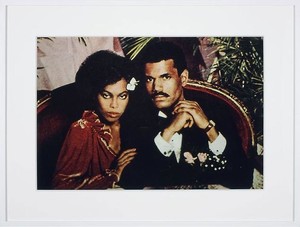
Richard Prince, Untitled (Couple), 1978, printed 2006
Ektacolor print, 20 × 27 ½ inches (50.8 × 70 cm), edition of 26
© Richard Prince
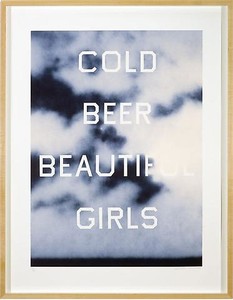
Ed Ruscha
Cold Beer Beautiful Girls, 2009
3-color lithograph, 30 ¾ × 30 ⅞ inches (78.1 × 78.4 cm), edition of 60
© Ed Ruscha
To bring on the festive season, Gagosian will present a pop-up exhibition of catalogues, posters, prints, and limited editions by gallery artists including John Currin, Ellen Gallagher, Douglas Gordon, Damien Hirst, Jeff Koons, Yayoi Kusama, Roy Lichtenstein, Takashi Murakami, Richard Prince, Anselm Reyle, Ed Ruscha, Andy Warhol, and Franz West. This exhibition presents a selection of the works available for sale at the permanent Gagosian Shop in New York, which opened in 2009.
In addition to the scholarly monographs, innovative catalogues, and limited editions of Gagosian’s unparalleled publishing program, Gagosian Pop-Up! will feature exclusive limited-edition furniture and design objects—from Jeff Koons’s Puppy vase and Franz West’s Uncle Chairs to striking posters from gallery exhibitions including Crash and Pop Art Is… Limited-edition artist’s books include Ed Ruscha’s illustrated version of Jack Kerouac’s historic novel On the Road, a special edition of Gregory Crewdson’s most recent photographic reverie Sanctuary, and Richard Prince’s Bettie Kline, a surprising visual dialogue between the model Bettie Page and the painter Franz Kline. In addition, etchings and lithographs by John Currin, Dexter Dalwood, Jenny Saville, and others will be available.
A special feature of Gagosian Pop-Up! in London will be the presence of Other Criteria—the London-based publisher of artist editions, books, multiples, and artist-designed merchandise, launched in 2005 by Damien Hirst, Hugh Allan, and Frank Dunphy. Available works by Hirst include editioned prints of the Spot, Pill, and Butterfly paintings, and a series of deck chairs designed by Hirst in an assortment of punchy colors featuring the “stained-glass” butterfly motif from the Superstition series.
On Saturday, December 11, 2010, from 2 to 4pm, Turner Prize nominee Dexter Dalwood will be signing copies of his new monograph published by JRP Ringier.
The Summer 2026 issue of Gagosian Quarterly is now available, featuring Ellen Gallagher’s Fast-Fish and Loose-Fish (2026) on the cover.

In this video, Jenny Saville sits down inside her first major exhibition in Venice to discuss how the great Venetian artists of the past and the city’s heritage influence her work. The show brings together more than thirty canvases and works on paper from the 1990s to the present, tracing the development of her practice, which is deeply rooted in the history of painting.

On March 28, a major exhibition of Jenny Saville’s work opened at Ca’ Pesaro–Galleria Internazionale d’Arte Moderna in Venice, bringing together nearly thirty paintings from the 1990s to the present. The exhibition is curated by Elisabetta Barisoni, head of the museums division at Venice’s Ca’ Pesaro, Museo Fortuny, and head of MUVE in Mestre. Saville’s monumental canvases are set in dialogue with the great Venetian artists of the past, creating a unique encounter between contemporary painting and the city’s artistic heritage. Here, the artist speaks with Stefania Ventra, professor with Ca’ Foscari University of Venice, about her early trips to Venice, the radicality of Titian’s painting, and depicting emotional truth.
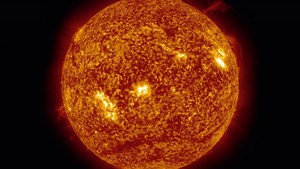
Helter Skelter—an exhibition at Fondazione Prada’s Venetian venue, Ca’ Corner della Regina—marks the first creative dialogue between two visionaries of American art, Arthur Jafa and Richard Prince. The show explores the grit, grift, violence, and ingenuity of American culture through more than fifty works, including photography, video, and large-scale installations that interrogate themes of race, gender, media, and politics. In the interview below, Nancy Spector, the exhibition’s curator, speaks about the shared motifs—from apocalyptic sunsets to a fascination with “monstrosity”—that led her to pair these artists for the first time.
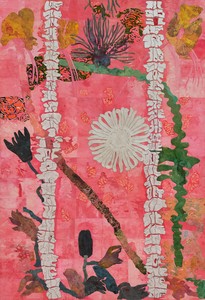
Sharad Chari reflects on a recent visit to Ellen Gallagher’s studio in Rotterdam, Netherlands, thinking through the artist’s intertextual interrogation of the oceanic and the ways in which her practice is informed by a wider Black intellectual and artistic world, an abiding interest in Herman Melville’s Moby-Dick, and the imperatives that surround this studio by the Port of Rotterdam.
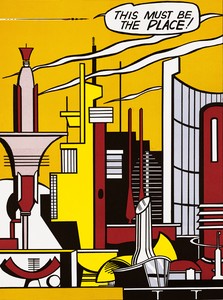
Avis Berman’s biography of Roy Lichtenstein, Becoming Roy Lichtenstein: The Path to Pop, will be published this fall by Abbeville Press, aligning with a major retrospective at the Whitney Museum of American Art, New York, in October. For the Quarterly she has adapted part of her text to focus on the artist’s formative experiences in New York in the 1920s and ’30s.

Stella McCartney’s new limited-edition capsule collection made in collaboration with Jeff Koons launched in January 2026. Blending the two creators’ singular visions, the collection, which was first seen in McCartney’s Winter 2025 runway show, features a wide array of garments and accessories printed with artworks by Koons and slogans by McCartney. The collaboration continues the pair’s long-standing creative partnership, which has previously included jewelry, prints, and charitable initiatives. At the unveiling in New York, Koons met with Derek C. Blasberg to reflect on the collaboration, the importance of caring and community, and meeting Salvador Dalí when he was nineteen years old.

The Winter 2025 issue of Gagosian Quarterly is now available, featuring Jeff Koons’s Kissing Lovers (2016–25) on the cover.

With an exhibition of all-new work at Gagosian, New York, in November, Jeff Koons met with Alison McDonald at his New York studio to discuss the processes, inspirations, and metaphysical underpinnings of his latest sculptures and paintings.

The Fall 2025 issue of Gagosian Quarterly is now available, featuring Andy Warhol’s Blue Liz as Cleopatra (1962) on the cover.

Ahead of her exhibition over the summer at the National Portrait Gallery, London, Jenny Saville met with the novelist Douglas Stuart to discuss Glasgow, the beauty and blemishes of bodies, and their respective creative processes.

Carlos Valladares tracks the artist’s engagements with Hollywood glamour, thinking through the ways in which the star system and its marketing engine informed his work.

Sydney Stutterheim traces the linkages and affinities between the work of Richard Prince and that of Bob Dylan. Using Prince’s Untitled (Dylan) as a starting point, she considers the artist’s enduring interest in questions of originality and authorship, as well as his sustained relationship with the worlds of American music and counterculture.

Jenny Saville reflects on Cy Twombly’s poetic engagement with the world, with time and tension, and with growth in this excerpt from her Marion Barthelme Lecture, presented at the Menil Collection, Houston, in 2024.

In conjunction with the exhibition Japanese Art History à la Takashi Murakami at Gagosian, London, Takashi Murakami and Hans Ulrich Obrist, curator and artistic director of Serpentine, London, sit down to discuss the artist’s exploration and contemporizing of ancient Japanese artworks and movements. The two delve into Murakami’s investigation of Iwasa Matabei’s seventeenth-century masterwork Rakuchū-Rakugai-zu (Scenes in and around Kyoto) and the Kyoto-based style of Rinpa painting, among other examples.

Ed Schad, curator and publications manager at the Broad, Los Angeles, examines Takashi Murakami’s prolonged engagement with the practice and concept of the copy. An exhibition of new paintings by the artist, Japanese Art History à la Takashi Murakami, opened at Gagosian, London, on December 10, 2024; Schad reflects on Murakami’s recent works in the wake of his visit to the artist’s 2024 exhibition at Kyoto City Kyocera Museum of Art.
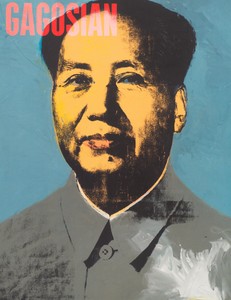
The Fall 2024 issue of Gagosian Quarterly is now available, featuring Andy Warhol’s Mao (1972) on the cover.

Jessica Beck examines Andy Warhol’s return to painting in the 1970s, focusing on the artist’s Mao series.
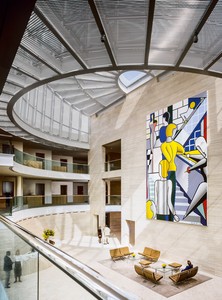
Michael Ovitz, cofounder of Creative Artists Agency (CAA), looks back to 1989, the year he and the architect I. M. Pei commissioned Roy Lichtenstein to create the Bauhaus Stairway Mural for the then new CAA Building in Los Angeles. Through the experience of working with Lichtenstein, Ovitz formed a meaningful friendship with the artist.
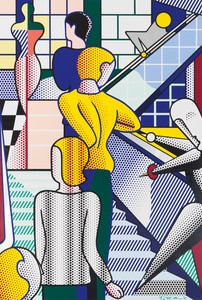
Alice Godwin and Alison McDonald explore the history of Roy Lichtenstein’s mural of 1989, contextualizing the work among the artist’s other mural projects and reaching back to its inspiration: the Bauhaus Stairway painting of 1932 by the German artist Oskar Schlemmer.
