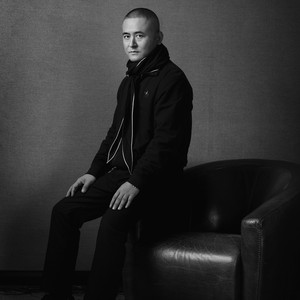
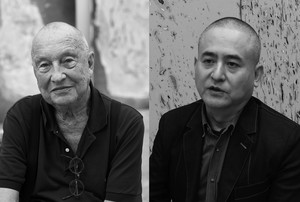
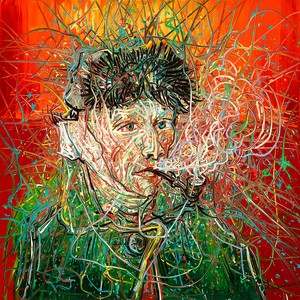
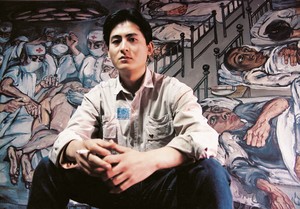
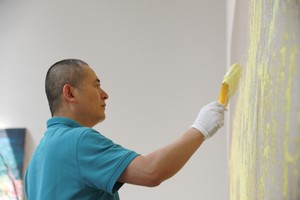
Zeng Fanzhi speaks about curating the exhibition Cézanne, Morandi, and Sanyu at Gagosian, Hong Kong, and the connections between the three artists’ works. Interview by Jin Jing.
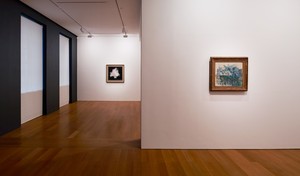
Installation view, Cézanne, Morandi, and Sanyu, Gagosian, Hong Kong, March 26–May 11, 2019
Installation view, Cézanne, Morandi, and Sanyu, Gagosian, Hong Kong, March 26–May 11, 2019
Jin Jing Have you ever thought about becoming a curator?
Zeng Fanzhi This is just a temporary title for me—I am in no way looking to make a career change! Curating is, for me, a one-off project that happens to match my current interests.I have neither the drive nor the attributes for this role. In fact, I haven’t used standard curatorial methods in organizing this exhibition; my narrative is not developed from art history and the works aren’t organized according to date or genre, as they might be in a more academic show organized by formally trained curators and specialists. As an artist, I also have little interest in relying on language to explain the history and ideologies behind these works.
With this exhibition, I sought to trace the visual logic within Cézanne’s, Morandi’s, and Sanyu’s works by observing and grouping them from an artist’s perspective. One could say it’s a practitioner’s view on practice rather than a theorist’s view on theory. I have employed the format of an exhibition as an artistic medium, using these classic works to present my subjective interpretation. While there is no way of knowing whether the viewer will agree with my point of view, I hope that the exhibition will shed light on some of the observations that I have made.
JJ It seems that this approach has a direct connection to your usual work. In your three-location exhibition last year—simultaneously held in Zurich, London, and Hong Kong—you utilized your method of “displaying research” for the Hong Kong segment, using your own artworks to demonstrate the relationship between the works of Cézanne, Morandi, and the tenth-century Chinese artist Zhao Gan.
ZF That’s correct—although I did not immediately form a connection between the two shows when I took on this current project. It was only later that I realized that this new exhibition is a sort of extension of that method of “displaying research” that I had employed previously. I tend to focus on a specific target or theme for a certain period of time.
I have employed the format of an exhibition as an artistic medium, using these classic works to present my subjective interpretation.
Zeng Fanzhi
JJ Could you talk a little about how you observe these artists’ works?
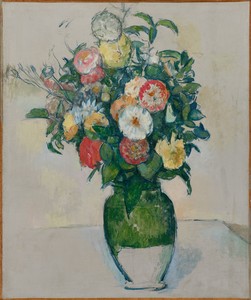
ZF When I observe Cézanne’s work I like to blur my vision, usually by squinting, so that I can see the compositions as almost monochromatic. This allows me to see how Cézanne uses light and dark to construct form. In his work, I think that color is primarily revealed through contrast, while form is revealed through color. I imagine that every stroke was painted painstakingly slowly, requiring complete consideration of the transitional relationship between the stroke and the canvas. Every single detail is considered and backed up by a precise and logical thought process. In my opinion, the subject of Cézanne’s painting is unimportant, because no matter what he happens to be depicting, his process bestows a unique beauty on its subject. I think that Cézanne’s process is painting in its purest form.
Paul Cézanne, Fleurs dans un pot d’olives, 1880–82, oil on canvas, 26 ¾ × 22 ½ inches (68 × 57 cm)
Following this, if you look at Morandi’s and Cézanne’s still-life works side-by-side, you can discover a certain connection between them. I believe that to some extent Morandi’s work is a continuation of Cézanne’s observational style, yet with the notable addition of Morandi’s own logic. When I view Morandi’s work, the first thing that catches my eye is the extremely purposeful horizon line, which alters the relationship between the still-life objects and the background, softening the image’s perspective. In addition, Morandi carefully introduces gray tones, reducing the purity of his colors. The relationship between these pale colors has the effect of further flattening his three-dimensional subjects. Sometimes you can clearly see that the subject of his paintings is a bottle, a jar, or something similar, while at other times you see only a vague square that feels as if it was added only for the sake of the composition. Because of these three aspects of his work, I feel that Morandi successfully painted a figurative reality with an abstract approach.
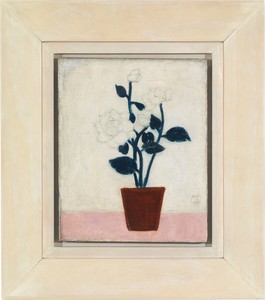
Both Sanyu’s perspective and his expressive technique have many similarities to those of Cézanne and Morandi, in that they all flatten the subject. However, I feel that Sanyu’s approach is inherently Eastern, akin to that of an observer. At the time he was working, many Western artists went to study Eastern woodcuts, but Sanyu didn’t need to do so as everything he painted naturally incorporated a sense of Easternness, as if he were using oils to paint inks. His works contain a large amount of black and white, and the colors he uses are very pure, possessing a sort of Eastern charm.
The focal points in these artists’ works are also of interest. For example, when Cézanne painted a bottle he did not do so with just one focal point, observing the object as if through a camera lens, but instead he observed objects from many angles, incorporating multiple perspectives within one image. In Morandi’s and Sanyu’s work, a similar effect can be observed; however, I believe that in Sanyu’s case, this was due to the fact that he had been influenced by the multi-point perspective used in traditional Chinese painting—an extremely fortunate coincidence.
Sanyu, White Roses, c. 1930, oil on canvas, 16 ⅛ × 13 inches (41 × 33 cm). Courtesy The Li Ching Cultural and Educational Foundation
JJ Have you discovered anything new through your meticulous observation?
ZF When I discovered the visual logic in these works, I was able to incorporate additional elements and even think of other artists who could be included. Euan Uglow was one such example. His still-life works—such as those depicting a loaf of bread, a pair of peaches, and a vase—would have been an extremely good fit in this exhibition.
Aside from this, the way in which these three artists were able to extract a sense of purity and abstraction from narrative themes has been very inspiring. When these paintings were created and displayed for the first time, audiences were accustomed to viewing classical paintings, but seeing these works caused them to approach art from a new perspective. It is quite possible that these same viewers later became some of the first people to appreciate abstract painting. As this process developed, stage by stage, the history of painting developed too. While today’s abstract artists may no longer need to paint any figurative works in order to be accepted as legitimate artists, their observation must still go through a similar process of moving from observation to realism to abstraction. Abstraction both requires a basis and follows its own logic.
Video created to accompany the exhibition Cézanne, Morandi, and Sanyu
JJ How do you think this change in the public’s viewing habits influenced artists?
ZF Subsequent artists became more confident and were able to push further ahead, in turn stimulating new audiences. I think that this is the way that art develops. Only if pioneers lead the charge will those behind them be brave enough to push the boundaries further.
JJ Did you organize the exhibition in order to elicit a certain response from the audience?
ZF I organized the show according to the exhibition space itself, as well as the color in the paintings. I also considered the horizon lines that, whether set high or low within the composition, tie the works together. Following these visual prompts, the viewer is reminded that the works are two-dimensional—a fact that is emphasized by the almost complete lack of shading and chiaroscuro. As for the color, I decided to use both black walls and white walls in the exhibition space. Black walls are better for displaying Sanyu’s works. Another factor I considered is the construction of the space. I wanted the space not only to allow viewers to appreciate the paintings individually, but also to encourage them to draw comparisons between the works. I didn’t want to overload the viewer with information, so I left some blank space—some room for reflection. I also spent a significant amount of time comparing and laying out the artworks. As with all creative processes, this was a test of my imagination in the real world. I had to find a way to express the countless relationships between the works within the limitations of the space.
I also made a video as an extension of the exhibition space, utilizing the camera’s lens as a way to narrow in on the details that I had observed. The video was posted on Gagosian’s Instagram, offering access to viewers around the world. I hoped that I might provide some clues, like parts of a jigsaw puzzle, so that the audience could then piece together the rest, using their own observations.
Cézanne, Morandi, and Sanyu, curated by Zeng Fanzhi, Gagosian, Hong Kong, March 26–May 11, 2019; interview published in full in Cézanne, Morandi, and Sanyu, exh. cat. (Hong Kong: Gagosian, forthcoming 2019)