Georg Baselitz and the Possibilities of Print
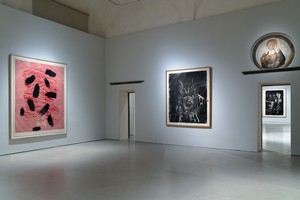
On the occasion of Baselitz: AVANTI! at the Museo Novecento in Florence, Italy, Holly EJ Black considers the roots and reverberations of Georg Baselitz’s printmaking.
Art Fair
March 29–31, 2019, booth 1C18
Hong Kong Convention and Exhibition Centre
www.artbasel.com
Gagosian is pleased to participate in Art Basel Hong Kong 2019, with works by Georg Baselitz, Edmund de Waal, Urs Fischer, Katharina Grosse, Andreas Gursky, Duane Hanson, Damien Hirst, Thomas Houseago, Yayoi Kusama, René Magritte, Giorgio Morandi, Takashi Murakami, Albert Oehlen, Nam June Paik, Richard Prince, Ed Ruscha, Richard Serra, Andy Warhol, Tom Wesselmann, Rachel Whiteread, Jonas Wood, Christopher Wool, Zao Wou-Ki, Zeng Fanzhi, and others.
To receive a PDF with detailed information on the works, please contact the gallery at inquire@gagosian.com. To attend the fair, purchase tickets at artbasel.com.
Download the full press release in English (PDF), Simplified Chinese (PDF), or Traditional Chinese (PDF)
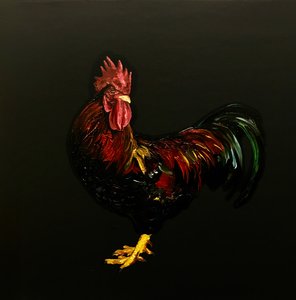
Zeng Fanzhi, Rooster, 2019 © 2019 Zeng Fanzhi
On the occasion of Baselitz: AVANTI! at the Museo Novecento in Florence, Italy, Holly EJ Black considers the roots and reverberations of Georg Baselitz’s printmaking.
Ed Ruscha sits down with the author and explorer Erling Kagge to discuss existence.

Helter Skelter—an exhibition at Fondazione Prada’s Venetian venue, Ca’ Corner della Regina—marks the first creative dialogue between two visionaries of American art, Arthur Jafa and Richard Prince. The show explores the grit, grift, violence, and ingenuity of American culture through more than fifty works, including photography, video, and large-scale installations that interrogate themes of race, gender, media, and politics. In the interview below, Nancy Spector, the exhibition’s curator, speaks about the shared motifs—from apocalyptic sunsets to a fascination with “monstrosity”—that led her to pair these artists for the first time.

Following a recent visit to Jonas Wood’s Los Angeles studio, Justin Beal thinks through the artist’s paintings of tennis courts—the subject of an exhibition at Gagosian, Beverly Hills—examining their relation to the game, color theory, and the rewards of practice.

In this video, musical ensemble Sō Percussion performs Steve Reich’s “Music for Pieces of Wood” inside the exhibition Richard Serra: Running Arcs (For John Cage), 1992, at Gagosian, New York.
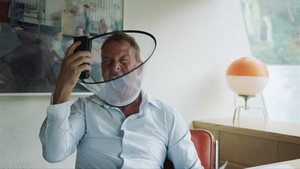
Albert Oehlen in conversation with Max Dax.

Jonathan Griffin traveled to Marfa to see the second iteration of Christopher Wool’s See Stop Run exhibition and to talk with the artist about his latest work, and about the photography series and sculptures that grew from his time in the Texas town.

The Fall 2025 issue of Gagosian Quarterly is now available, featuring Andy Warhol’s Blue Liz as Cleopatra (1962) on the cover.

Carlos Valladares tracks the artist’s engagements with Hollywood glamour, thinking through the ways in which the star system and its marketing engine informed his work.

For Art Basel 2025, the fair has commissioned Katharina Grosse to create CHOIR, a large-scale, site-responsive painting for the Messeplatz Project. The curator for the project, Natalia Grabowska, met with Grosse in her studio in Berlin ahead of the work’s creation to talk through the process; Grosse’s approach to the specifics of the Messeplatz’s architecture; and the importance of unscripted encounters.

At the center of Andreas Gursky’s new exhibition in Paris at Gagosian’s rue de Castiglione gallery is Paris, Montparnasse II (2025), a reengagement with his celebrated photograph from 1993 of the architect Jean Dubuisson’s iconic building in the capital city. In the new work, Gursky reexamines the subject, tracing the changes time has inscribed on the architecture and its occupants. Here, in conversation with the Quarterly’s Wyatt Allgeier and shown alongside behind-the-scenes images from the artwork’s making, the artist addresses his motivations and interests in this long-term project.

Sydney Stutterheim traces the linkages and affinities between the work of Richard Prince and that of Bob Dylan. Using Prince’s Untitled (Dylan) as a starting point, she considers the artist’s enduring interest in questions of originality and authorship, as well as his sustained relationship with the worlds of American music and counterculture.